
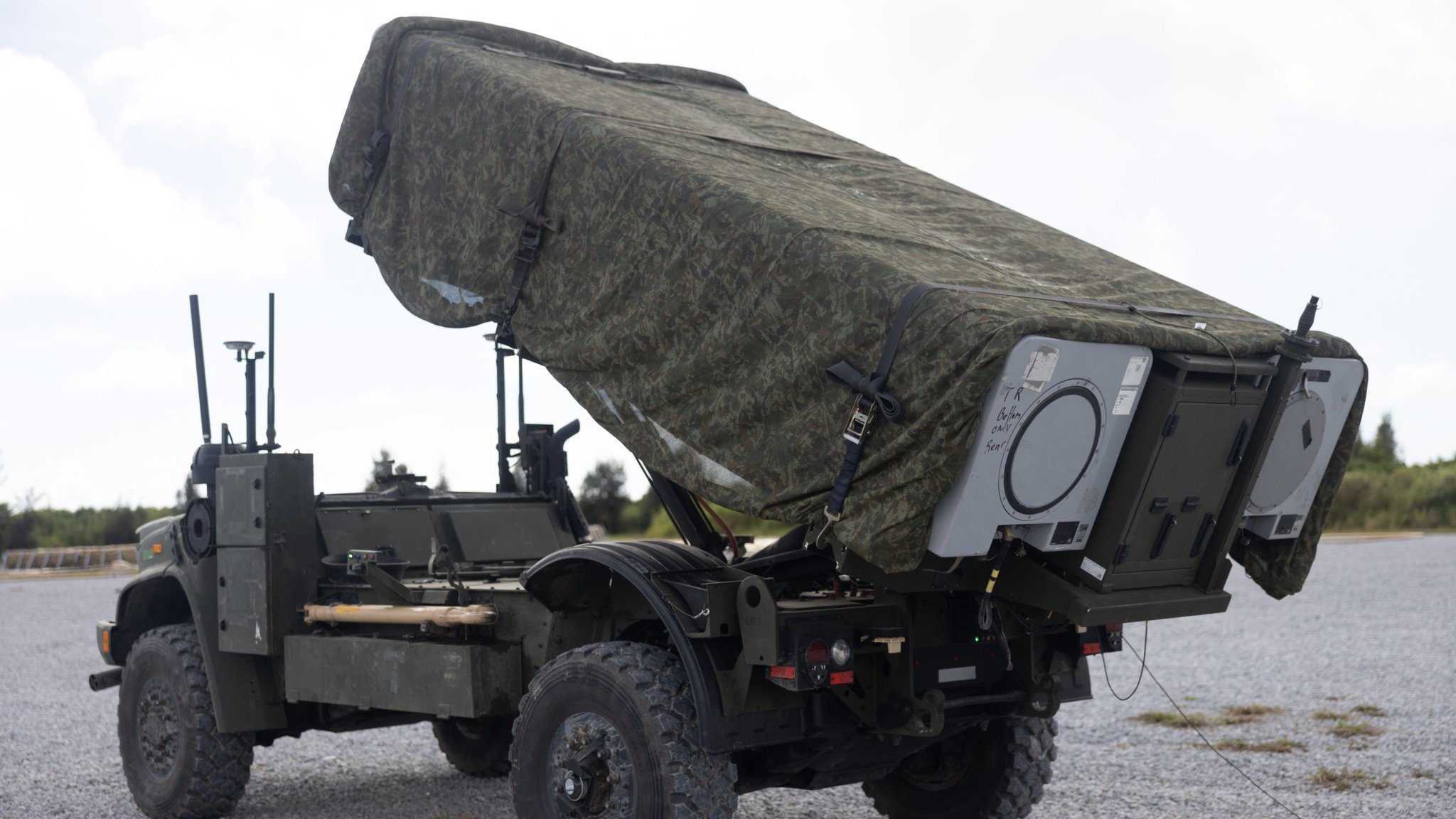
This month, Marines on Okinawa got some additional firepower designed to take out enemy warships. Late on Sunday, the 3rd Marine Division announced that the 12th Marine Littoral Regiment took custody of two of the Marine Corps’ newest weapons: the Navy-Marine Expeditionary Ship Interdiction Systems, or NMESIS, and Marine Air Defense Integrated Systems, or MADIS.
The arrival of the two weapons platforms comes as the military reorganizes its Pacific forces to deter or outright fight China. The NMESIS is a remotely operated platform, mounted on a Joint Light Tactical Vehicle, that fires Naval Strike Missiles. They can hit targets as far out as 115 miles, making them effective as a coastal anti-ship capability. Their deployment to Japan has long been a part of the Marine Corps’ Force Design Initiative, which puts greater emphasis on conflicts between nations, specifically around large-scale island hopping campaigns.
The deployment deeply strengthens the 12th Marine Littoral Regiment’s capabilities, according to Mark Cancian, a senior advisor with CSIS and a retired Marine colonel. The Marine Littoral Regiments are a newer formation, set up to fight in “a contested littoral environment,” which is another way of saying on an island, with an enemy force close by.
Top Stories This Week
In practice, they’re meant to be a forward-deployed force for island-hopping campaigns, conducting counter-reconnaissance and armed with enough firepower to take out enemy warships trying to navigate to or past those islands. Roughly 2,000 Marines are part of the 12th Marine Littoral Regiment.
“Getting NMESIS out there is critical as that’s the backbone of the [Marine Littoral Regiment],” Cancian told Task & Purpose. “The two key pieces are the anti-ship missiles, which are the most important, and also the air defense piece.”
The United States has strengthened its forces around East Asia, including sending newer fighter jets to Japan, bolstering air squadrons in South Korea and conducting several large-scale drills with partners around the South China Sea. Cancian said that the deployment of NMESIS and its ground-based anti-ship missiles offers a specific tool to U.S. forces: the platform’s mobility and ability to hide. Surface ships, Cancian argued, are very vulnerable, whereas NMESIS and MADIS are able to be quickly and relatively easily relocated in case of threats.
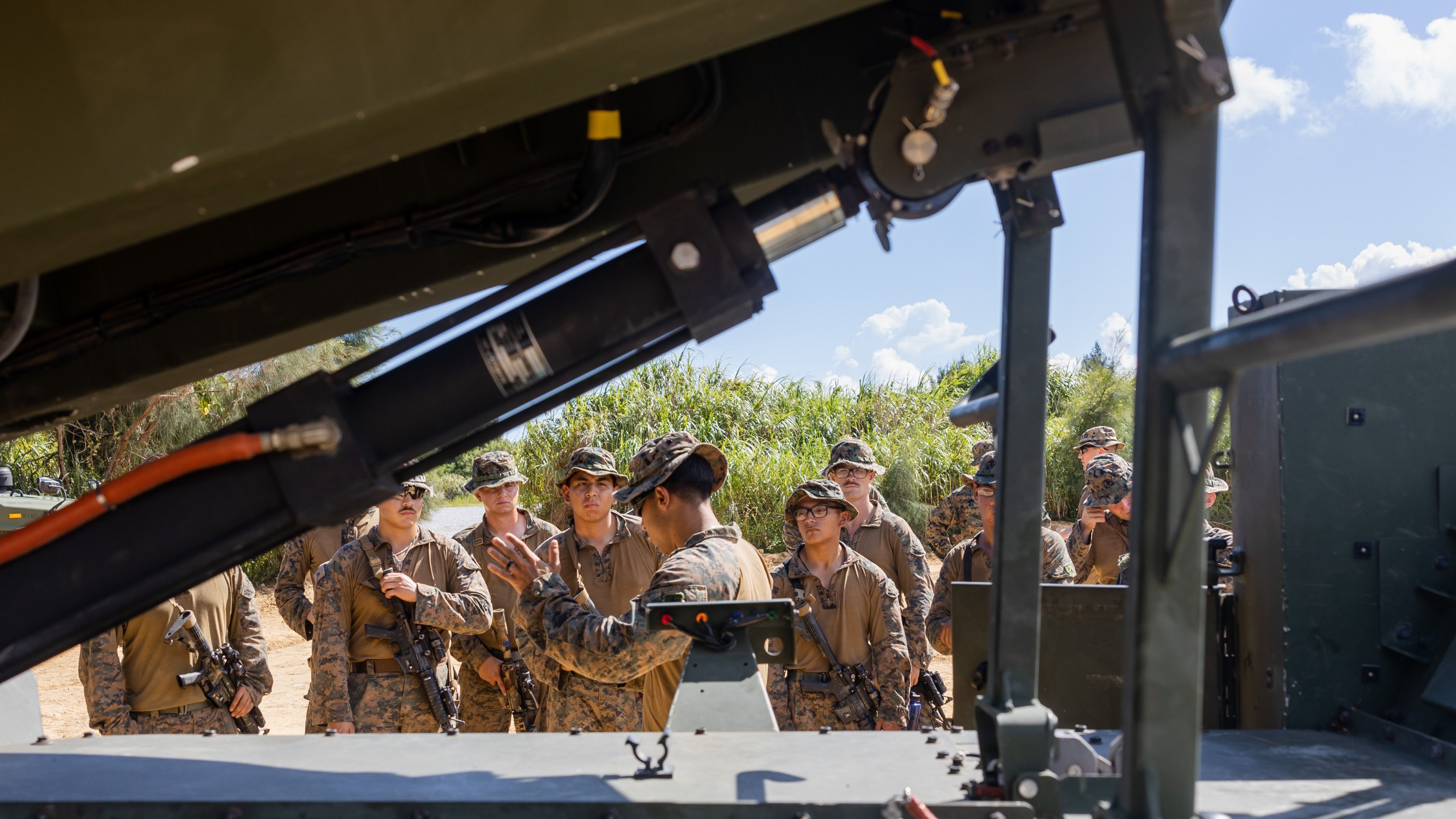
For its part, the MADIS is intended as a complementary defensive measure. The surface-to-air weapons system is meant to take out low-altitude aircraft.”
The critical issue, Cancian said, is being able to move the anti-ship weapons closer to Taiwan or the Philippines in the event of a conflict with China. Okinawa, he said, has some strategic value, but the weapons would need to be quickly relocated to help in a peer-on-peer fight around contested areas.
Marines with the 3rd Marine Littoral Regiment in Hawaii first received both weapons systems in late 2024, and have briefly brought them to Japan for exercises, including last fall’s Resolute Dragon. A large part of the drill involved rapidly deploying the systems to island locations for coastal defense. That mirrored other training that U.S. forces have done in recent months, where units work to quickly load, transport, and field artillery and missile defense systems.
Most recently, the 3rd Marine Littoral Regiment brought both MADIS and NMESIS to the Philippines for the Balikatan 2026 exercise this spring. Marines worked with Army and Air Force personnel to quickly load NMESIS systems onto transport ships and cargo planes to practice redeploying the systems by air and sea.
Loading comments…
Comments couldn’t be loaded. Please refresh the page.