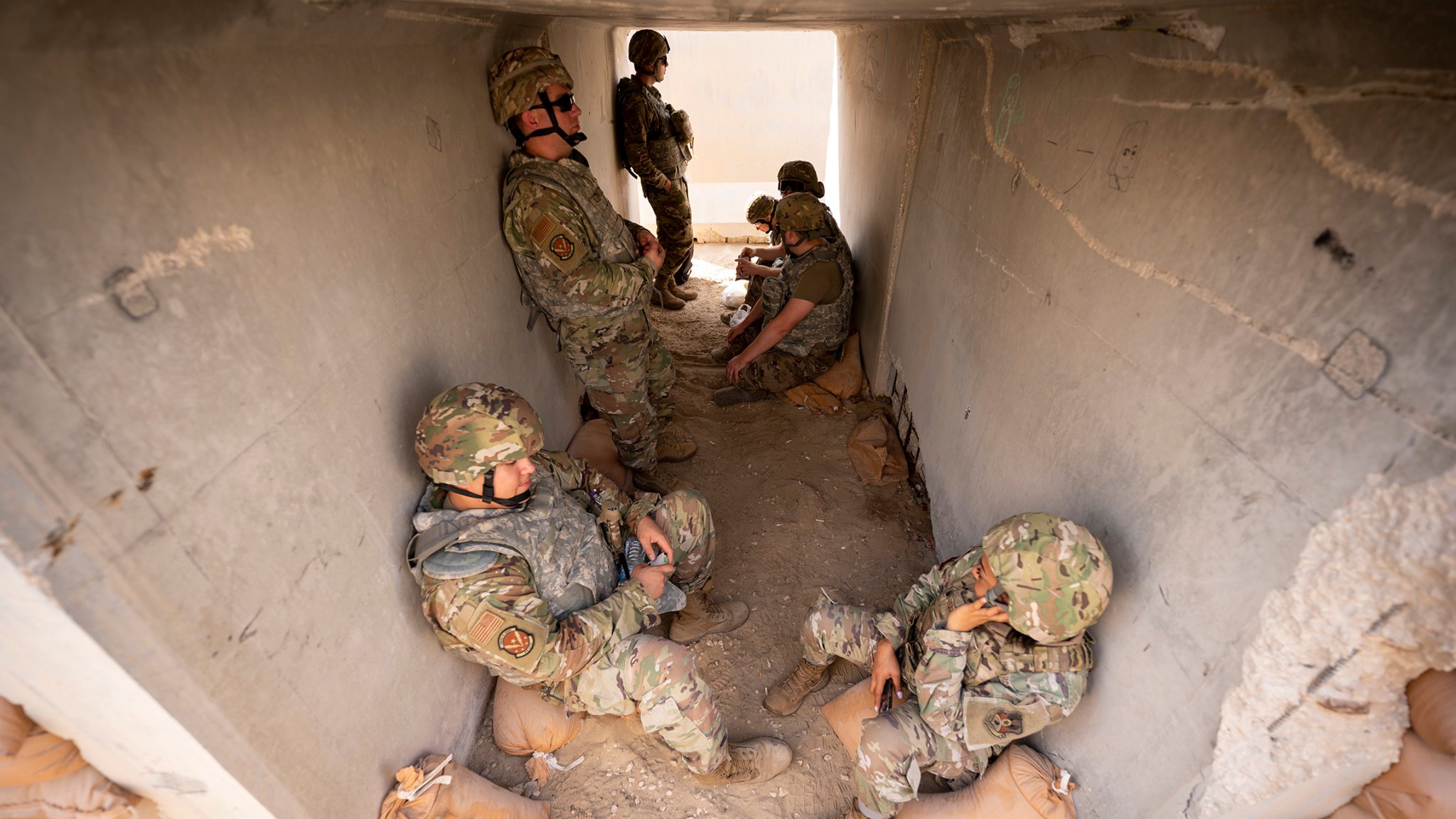
The Defense Department is trying to quickly find vendors who are able to ship pre-made shelters to protect troops in the Middle East as the United States’ war with Iran continues.
The department is looking for information from private contractors who can provide “prefabricated, transportable, hardened shelter systems designed to protect personnel from blast and fragmentation threats,” according to a new federal contract notice posted Monday.
The March 23 notice has a deadline of Friday and asks for companies to submit possible delivery timelines for 3 days, 15 days, and 30 days and include information about the “highest threat level” that the bunkers could withstand, like blast force, fragmentation, or ballistic impact. The bunkers will be sent to the Aqaba Air Cargo Terminal at King Hussein International Airport in Aqaba, Jordan, according to the posting.
U.S. Central Command officials declined to comment on the solicitation.
The notice is for “sources sought,” which the government uses to plan and gather vendor options before issuing a contract with funding behind it — which the National Guard did to see who could feed troops in Washington D.C. through January 2026, before their deployment was extended.
Chelsea Roberts, CEO of Collaborative Compositions LLC, a federal contractor consulting firm, told Task & Purpose that the notice indicates that the Defense Department is looking for vendors who can deliver shelters soon. She also said that the notice “seems to align” with recent Pentagon moves and comments from service officials about increasing the speed of procurement.
“It does seem like they’re interested in the rapid deployment of these shelters,” Roberts said. “It does not bind the government to procure any of the solutions submitted, but it does give them the sense of what the capacity in industry is to respond to and produce those types of supplies rapidly.”
Top Stories This Week
The search for new shelters comes one month after the start of Operation Epic Fury on Feb. 28, and the U.S. plans to deploy more troops — at least 1,000 82nd Airborne Division soldiers — to the Middle East in the coming weeks. Central Command officials said Monday that the U.S. military had hit more than 9,000 Iranian targets and damaged over 140 Iranian vessels.
Since the war began, 13 U.S. service members have been killed — six died in a KC-135 aerial tanker crash in Iraq, one soldier died after being wounded in an attack on the Prince Sultan airbase in Saudi Arabia and six soldiers died in a March 1 Iranian drone attack on a port in Kuwait. More than 200 service members have also been wounded.
Retired Col. Joe Buccino, former head of communications for Central Command from April 2020 to August 2023, said that a lot of the bunkers and shelters at Middle East bases are “fairly unimpressive,” and are made up of concrete T-walls that were put up after the invasion of Iraq. The majority of shelters, he said, have “never been terribly fortified,” but some bunker complexes do exist.
“A lot of the hardened shelters really are outdated and could be defeated if enough missiles get through the defense system, so I think this is a good move,” he said.
Following the Kuwait attack, Defense Secretary Pete Hegseth said that the deadly strike had hit a “tactical operation center that was fortified,” but “one” projectile made it through nearby air defenses.
In the wake of the attack, news outlets reported that Iran had struck a makeshift operations center. Defense officials pushed back on the description of the structure and argued that the U.S. military has taken “every possible measure” to protect troops in the Middle East.
On Wednesday, the New York Times reported that many of the 13 regional bases used by American troops have become “all but uninhabitable.”
An active duty field grade officer who deployed to the Middle East over 10 times told Task & Purpose that previous attacks over the years, with new threats like drones and ballistic missiles, have often led to reviews and force protection improvements, but there’s always more to be done. At the same time, he said it was an “encouraging sign” that the military is looking for quick and available shelter options.
“How many billions of dollars did we spend on each Patriot? So it’s not like they’re not doing anything. It’s not all bad,” he said. “I guess it’s hard to be very black and white on ‘should they do more’, ‘should they not?’”
When Al-Asad Air Base in Iraq was struck by Iranian ballistic missiles in 2020, retired Lt. Col. Alan Johnson sought refuge in an indirect fire shelter. The shelter was an above-ground structure surrounded by sandbags that were tightly stacked on top of each other, according to a photo he shared with Task & Purpose for a previous story. Johnson noted in his March testimony to Congress that the shelter lacked a protective door and “offered limited protection from nearby blast impacts.”
Johnson said the shelter was designed to protect troops against rockets, small arms, grenades, or mortar fire, but “not the ballistic missiles that [rained] down on us.” He and dozens of others suffered TBIs from the attack.
Then in 2023, troops based in Iraq and Syria came under more than 100 rocket, drone and missile attacks from Iranian militia groups. 10th Mountain Division, 2nd Brigade Combat Team leaders deployed at the time previously told Task & Purpose that a great deal of time was spent on hardening structures, and learning the science behind design changes to mitigate the impact of blast overpressure waves.
However, as American troops have withdrawn from Iraq and Syria, many of those bases are no longer in use by the U.S. As of January, the Iraqi government announced that it officially took over Al Assad, one of the largest U.S. bases in the region.
“It sounds to me that they just said, ‘Hey, what’s everybody got? What’s the best we can get out there?’ Ballistic missiles are getting shot every day,” the officer said of the contract notice. “The amount of time it would take to build everything for a ballistic missile, at some point, it could take years right? You got to assume this is going to be over.”