When people talk about Iran’s “axis of resistance,” they usually mean places like Lebanon, Syria, Iraq, or Yemen. But Tehran has another partner thousands of miles away, sitting on the edge of the Caribbean and just a few hundred miles from the United States: Venezuela.
The relationship between Iran and Venezuela isn’t new. Their formal ties predate the Iranian Revolution of the late 1970s, but they got much deeper under Hugo Chávez in the early 2000s and under Nicolás Maduro since 2013. In the past two decades, the two oil-dependent countries have deepened their ties with increasing industrial, economic, and military cooperation that includes fast-attack boats, anti-ship missiles, drones, and even a Hezbollah presence.
How Iran and Venezuela got this close
Under Chávez and then Máduro, Caracas leaned hard into relationships with any country willing to help it dodge U.S. sanctions and provide political cover. These efforts brought the government closer to Russia, China, Cuba, and Iran. In June 2022, Venezuela and Iran nations signed a 20-year cooperation agreement that covered oil, industrial projects, and defense.
The basic deal is straightforward. Iran gets:
- A logistics hub in the Western Hemisphere to dodge U.S. sanctions.
- New markets for its oil and arms industry.
- A friendly government willing to host Iranian ships, aircraft, and advisers.
Venezuela gets:
- Fuel and refinery expertise to keep its battered energy sector running.
- Industrial help for everything from automobile factories to drone workshops.
- Access to new Iranian military technology at a time when its Russian-supplied gear is aging and the economy is in freefall.
A lot of these goods were moved under “dual use” cover. Cargo flights and ships would come in carrying auto parts or industrial machinery that also happened to be useful in building missile components, drones, and other military hardware.
By 2023, the cooperation wasn’t just a matter of ship manifests and tail numbers. Iranian influence was visible in military parades and in satellite imagery of ports. Iranian-made fast-attack boats were delivered, complete with anti-ship missiles. Around the same time, Venezuelan officials began talking more openly about “strategic cooperation” with Iran and showing off locally produced drones that strongly resembled Iranian designs.
Fast-attack boats and CM-90 anti-ship missiles
The most visible aspect of Venezuela’s military cooperation with Iran is the Peykaap III fast attack boat. Sometimes referred to as “Zolfaghar” boats, these are just under 57 feet long, can reach speeds of up to 52 knots, and carry two anti-ship missiles and two torpedoes. In the Persian Gulf, the Islamic Revolutionary Guard Corps (IRGC) Navy uses them as part of a swarm tactic in which they rush larger vessels from multiple angles while firing missiles, rockets, and machine guns. In Venezuelan service, the concept is similar.
What makes the boats particularly dangerous are their CM-90 anti-ship missiles, which are the export version of Iran’s Nasr. They have a range of 55 miles and travel at 760 miles per hour using active radar guidance.
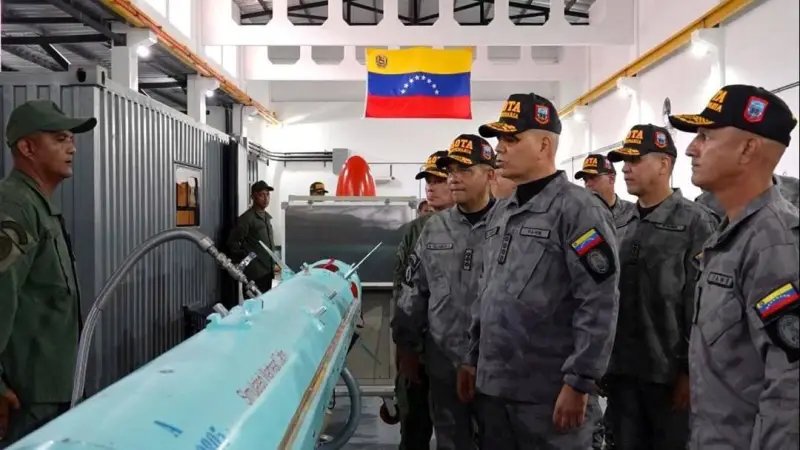
That range is not a game-changer by itself, but an accurate, sea-skimming missile still creates an effective anti-ship bubble around Venezuela’s coastline, especially near naval bases like Puerto Cabello. Mounted on fast-attack craft, that bubble becomes mobile.
Venezuela’s Iranian-derived Drones
The other major piece of Iranian kit in Venezuela is in the air.
Iran has spent the last decade aggressively exporting drones and loitering munitions. Mohajer reconnaissance/strike drones and Shahed one-way attack drones have turned up in Iraq, Syria, Israel, Yemen, and Ukraine. It was only a matter of time before they showed up in Latin America.
Venezuela’s drone fleet is a mix of legacy Iranian designs, local derivatives, and newer imports.
Back in 2013, Venezuela put a domestically produced Arpía drone into service. This is basically a licensed or cloned version of the Iranian Mohajer-2 drone. By modern standards, the Arpía is limited with just three hours of loiter time and relatively simple sensors, but it has been adapted to carry small munitions. In 2022, Venezuela unveiled an updated version called the Antonio José de Sucre, or ANSU-100, which officials say is produced domestically thanks to a technology transfer from Iran.
Iran has also supplied Venezuela with more modern Mohajer-6 drones. These are medium-sized multirole UAVs roughly comparable to a smaller Bayraktar TB2. Open-source specs say the Mohajer-6 can stay airborne for around 12 hours, cruise at about 125 miles per hour, and operate out to several hundred kilometers from its ground control station. It can carry up to four small precision-guided munitions, usually the Qaem series of glide bombs.
On the loitering munition side, Venezuela has introduced a Shahed-style one-way attack drone called the Zamora V-1. An infographic shown alongside the drone in 2024 listed a range of about 18 miles, a ceiling of 6,500 feet, a top speed of roughly 93 miles per hour, and an RPG-7 warhead for the payload. It’s a much shorter-range system than the Shahed-136s Russia has used against Ukrainian cities, but the design language is unmistakable.
Venezuela has also displayed a flying-wing drone called the ANSU-200 that appears to be modeled on the Iranian Shahed-171, which itself was based on an American RQ-170 Sentinel that crash-landed in Iran in 2011. The ANSU-200 was rolled out during a 2022 parade, but both Iran and Venezuela have been tight-lipped about its actual capabilities. It’s not clear whether it’s armed, how many exist, or whether it’s anything more than a prototype.

Taken together, these systems tell a clear story. Iran has provided at least some Mohajer-series drones directly. There has been enough technology transfer to let Venezuela assemble or modify UAVs locally. And Caracas is trying to copy the Shahed-style one-way attack drone concept that Iran’s other partners have used to hit ships and infrastructure.
The Hezbollah Connection
Hardware is only part of Iran’s export package. The other part is people, money, and the proxy networks that go with it.
The U.S. government has been worried about terror groups operating in Latin America for decades, but Iran’s role started getting extra attention after Mahmoud Ahmadinejad became president in 2005 and began publicly cozying up to Chávez. A 2006 hearing of the House Subcommittee on International Terrorism and Nonproliferation, titled “Venezuela: Terrorism Hub of South America?”, mentioned Iran dozens of times.
The concern wasn’t limited to Colombian groups like the FARC and ELN. Members of Congress and analysts also flagged Hezbollah, Hamas, and al-Qaeda, with Hezbollah getting the most attention. Despite being rooted in Lebanon, Hezbollah has long operated global fundraising and logistics networks. Intelligence and academic reports describe Hezbollah-linked facilitators and businesses in the so-called Tri-Border region of Argentina, Brazil, and Paraguay, and in Venezuela itself, particularly around the free-trade resort zone of Margarita Island.
The fear in Washington is that these fundraising and smuggling networks give Iran a sticky, long-term presence in the region. Even if the Maduro regime fell tomorrow, the argument goes, Hezbollah and other Iranian-backed networks would likely continue operating in the shadows, giving Tehran eyes, ears, and influence in the Western Hemisphere that can’t be wiped out with a couple of airstrikes.
Why This Matters
Big picture, none of this turns Venezuela into a peer adversary for the United States. The CM-90s, Peykaap boats, Mohajer drones, and Hezbollah-linked networks don’t add up to a second Cuban Missile Crisis. What they do create is a localized anti-ship and intelligence, surveillance, and reconnaissance (ISR) bubble in the Caribbean, tied to a fragile regime that has a history of using the military as a political prop. That’s the sort of mix where miscalculations, accidents, or a single bad decision can get very dangerous, very fast.
Iran hasn’t invented a new playbook here; it’s exporting the same mix of cheap drones, missiles, and proxy networks it uses everywhere else. The difference is that this time it’s a few hundred miles from U.S. shores.
For a deeper dive into the hardware, the swarm tactics, and what all of this means for U.S. ships and commercial traffic, check out our full breakdown on the Task & Purpose YouTube channel here.