
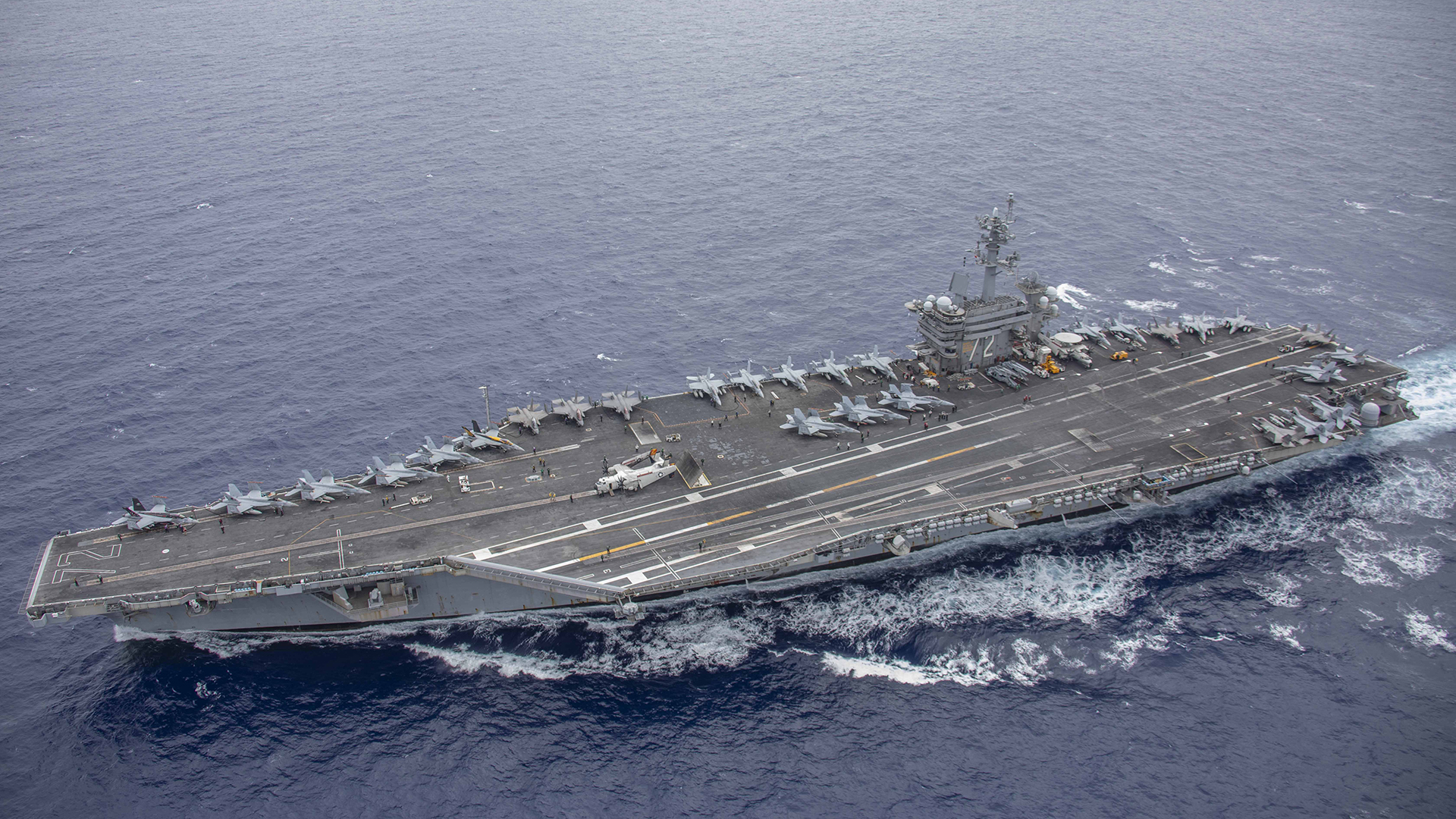
The aircraft carrier USS Abraham Lincoln and its strike group have steamed into the Middle East, U.S. officials confirmed on Monday. The news of the ships’ arrival in the region overseen by U.S. Central Command comes a few days after President Donald Trump said that a U.S. Navy “armada” was approaching Iran.
The ships are currently in the Indian Ocean, a Navy official told Task & Purpose on Monday. Fox News Chief National Security Correspondent Jennifer Griffin posted on X on Monday that the Lincoln strike group is not yet in position to launch any possible strikes against Iran. A U.S. official confirmed to Task & Purpose that military assets are moving to the Middle East.
President Trump is reportedly considering whether to order military action against Iran, which has been convulsed by nationwide chaos and uncertainty. Iran has been engulfed in massive street protests over the last month, to which the regime has reportedly reacted with unprecedented violence. The nation has dropped almost entirely off the internet in recent weeks, but some reports indicate that Iranian security forces may have killed more than 5,000 protesters.
Top Stories This Week
While Trump has said that June’s Midnight Hammer strikes were aimed at derailing Iran’s nuclear program, he has painted the current build-up as direct support to the anti-government protests.
“Iranian Patriots, KEEP PROTESTING — TAKE OVER YOUR INSTITUTIONS!!!” Trump wrote in a Jan. 13 social media post. “Save the names of the killers and abusers. They will pay a big price. I have cancelled all meetings with Iranian Officials untilUntil the senseless killing of protesters STOPS. HELP IS ON ITS WAY.”
Still, he has not committed to the use of force.
“We have a big flotilla going in that direction, and we’ll see what happens,” Trump told reporters on Thursday. “We have a big force going toward Iran. I’d rather not see anything happen, but we’re watching them very closely.”
Trump warned Iran’s leaders on Thursday that if they went through with the executions of more than 800 prisoners, “You’re going to be hit harder than you’ve ever been hit.”
When asked about the ships headed to the region, the Pentagon referred questions to President Trump’s remarks.
On Jan. 18, F-15s from the 494th Expeditionary Fighter Squadron arrived in the Middle East. The squadron played a major role in shooting down Iranian drones launched against Israel in April 2024. Two of the squadron’s officers were later awarded the Distinguished Flying Cross.
Iran’s parliament speaker has warned that Iran would retaliate against any U.S. strikes by attacking American military bases and ships in the Middle East. The U.S. military is expected to move air defenses, including Patriot Missile batteries and Terminal High Altitude Aerial Defense systems, into the region, according to the Wall Street Journal.
A long war
For more than 40 years, the United States and Iran have been locked in a cold war that has turned hot several times. The two countries came close to open warfare in January 2020, when a Trump-ordered U.S. airstrike killed Iranian Maj. Gen. Qasem Soleimani, head of the Islamic Revolutionary Guard Corps Quds Force. Iran retaliated by launching ballistic missiles at U.S. troops deployed to Al-Asad Air Base, Iraq. That strike left dozens of U.S. troops injured with traumatic brain injuries, a toll the Pentagon was slow to acknowledge.
The conflict turned active again this past June when the U.S. military launched air and missile strikes against three Iranian nuclear facilities. Operation Midnight Hammer marked the first operational use of the 30,000-pound GBU-57 Massive Ordnance Penetrators, the largest B-2 bomber strike in history, and the second-longest B-2 mission ever flown.
Iran responded by firing ballistic missiles at Al Udeid Air Base in Qatar. The attack damaged the installation but caused no injuries. Many of the Iranian missiles were destroyed by U.S. and Qatari air defenses.
Iran not only has missiles that can reach U.S. military bases, it has also developed an empire of proxy forces in Iraq, Yemen, and elsewhere that it has often used to attack the United States and other adversaries.
In the aftermath of Hamas’ Oct. 7, 2023, terror attack on Israel, U.S. troops in Syria and Iraq were frequently attacked by Iranian-backed militants. Separately, the U.S. military also battled Iranian-backed Houthi rebels in Yemen, both under former President Joe Biden and again after President Trump returned to office for his second term.
Loading comments…
Comments couldn’t be loaded. Please refresh the page.