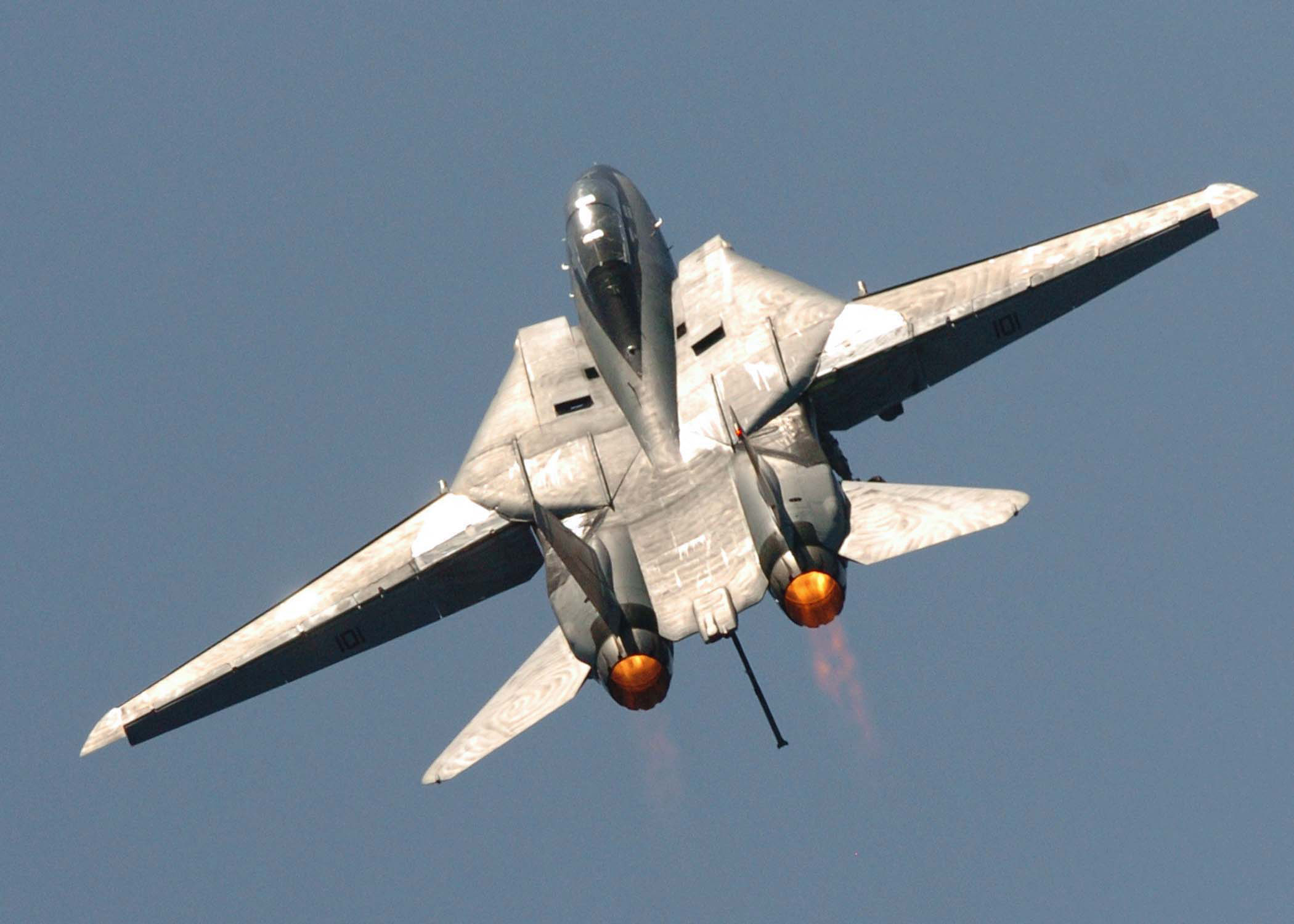
It appears that the F-14 Tomcat, retired from the U.S. Navy in 2006 but still in service with the Islamic Republic of Iran Air Force, has finally come to the end of the runway.
When the war with Iran began on Feb. 28, one of the early goals was to hamstring the Iranian air force, which boasted a smattering of aircraft. This included French Mirage F1s, Soviet MiG-29s, and American F-4 Phantoms, F-5 Tiger IIs, and the beloved F-14 Tomcats. In satellite imagery and released footage, we can see the effectiveness of that campaign, with Tomcats smoldering on tarmacs.
If you’re wondering how a U.S. Navy icon ended up spending its final years on Iranian ramps, you’re not alone. To answer that, we have to go back to the 1970s, when Iran was buying top-shelf American fighters, and the Tomcat was the newest, meanest thing the Navy had.
Why the F-14 exists
In the 1960s, the U.S. Navy was searching for a new air superiority fighter for its Fleet Air Defense mission to protect from long-range Soviet bombers and fighter aircraft. The service tried out the F-111B, a carrier version of the F-111 Aardvark, which was the first swing-wing, or variable-sweep wing aircraft put into production. Despite being fast and extremely capable, the F-111B wasn’t a great carrier-based fighter. In 1968, a contracting request was put out seeking aircraft for the Naval Fighter Experimental, or VFX, program.
The submissions had to have a crew of two who would sit under a bubble canopy, a top speed of at least Mach 2.2, and lots of room for missiles and a gun — for when the plane was too close for missiles because it had entered “The Danger Zone.”
McDonnell Douglas, General Dynamics, Grumman, North American Rockwell, and Ling Temco Vought submitted designs, but ultimately it was Grumman’s 303E that got the nod.
It was dubbed the F-14 Tomcat to pay homage to previous Grumman aircraft like the F4F Wildcat, F6F Hellcat, and also Vice Adm. Thomas Connolly, a test pilot who flew the F-111B, and whose testimony was a major reason it never entered production.
The Tomcat first flew in 1970 and entered service with the U.S. Navy in 1974, giving the fleet the interceptor it desired — one that was capable of seeing far out with its AWG-9 Radar and hitting aircraft at over 100 miles away.
How Iran got the Tomcat
The United States wasn’t the only country looking to intercept Soviet aircraft. Iran was also on the hunt.
In 1974, as the Cold War raged, Iran was a very different country than it is today. In power as a result of a CIA-backed coup in 1953, Shah Mohammad Reza Pahlavi, an authoritarian strongman, offered the West an ally in the Middle East as Soviet influence spread through the oil-rich region.
With a communist regime coming to power in Yemen in 1967 and similar rumblings in Egypt and Syria, the Soviet Union began to pressure other countries in the region, like Iran, and began overflights with MiG-25 surveillance aircraft in the early 1970s, just as the Tomcat was entering service.
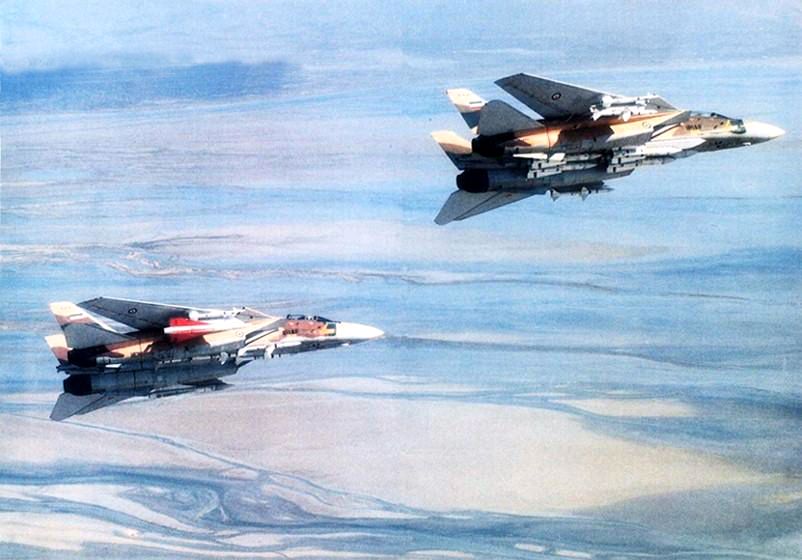
The Shah wanted to stop those incursions and negotiated to buy 80 F-14A Tomcats and 633 AIM-54 Phoenix air-to-air missiles from the United States for roughly $2 billion in 1974. The latest and greatest fighter would join the F-4 Phantom and the F-5 Tiger II, which were also sold to the Shah by the U.S.
Top Stories This Week
To give the Tomcat a suitable home, they built Khatami Air Base in the central desert as the main hub for F-14 operations. They trained pilots, radar intercept officers, and maintainers in the U.S. and in Iran.
And then, five years later, after 79 of the 80 jets were exported to Iran, the entire relationship imploded with the 1979 Iranian Revolution that overthrew the Shah and installed the Islamic Republic of Iran.
Overnight, one of the most complex aircraft in the world lost access to parts and manufacturer support, but that didn’t stop the jet from becoming a major asset in the new regime’s air force.
How Iran kept them flying
Even with the full weight of the U.S. Navy and military industrial complex behind it, the F-14 was never an easy aircraft to maintain.
Despite a near-total cutoff from U.S. support after 1979, Iranian Tomcats proved remarkably resilient. They played a significant combat role during the Iran-Iraq War, using their long-range radar and Phoenix missile capability to challenge Iraqi air operations, allegedly shooting down over 100 aircraft.
Over the decades, Iran kept fleets flying through cannibalization, improvised local manufacturing, black‑market parts, and creative engineering in a testament to resourcefulness as much as to the airframe’s original robustness.
Still, time and sanctions took their toll. Aging airframes, scarce avionics and engine spares, diminishing Phoenix missile stocks, and the increasing complexity of modern air warfare gradually eroded the F‑14’s operational viability. By the 2010s and into the next decade, the fleet increasingly shifted from front‑line interceptor to limited-service, training, and static roles, with many grounded, cannibalized, or set aside for museum display.
We discuss the F-14 in much more detail and maybe get a little emotional about it in our YouTube video, which you can watch here.