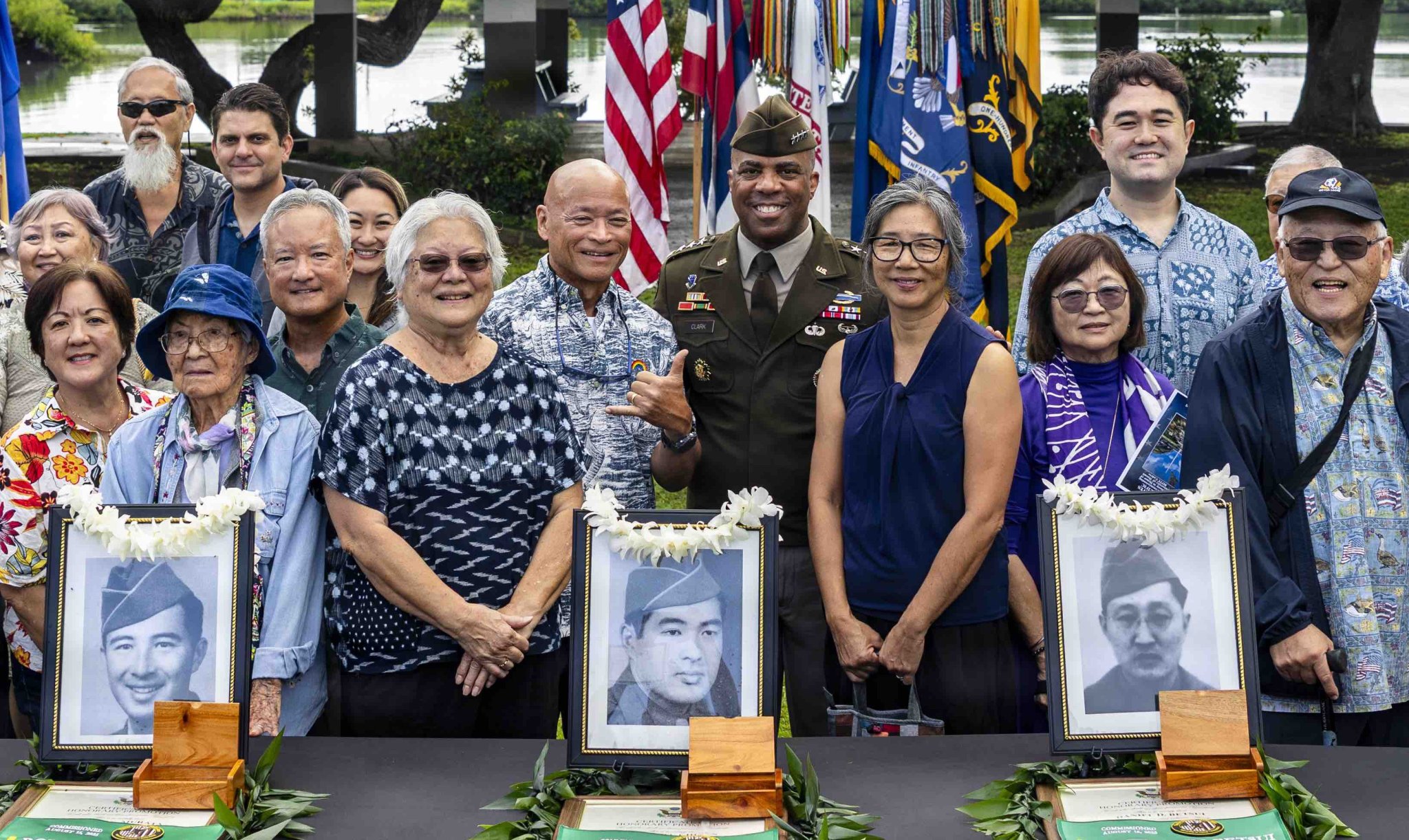
Seven Japanese-American soldiers who were once deemed “enemy aliens” but fought for the Army during World War II were posthumously commissioned as Army officers.
Prior to the war, all seven had been on track to be commissioned as Army officers at the University of Hawaii, but were expelled from the program as the war began. All seven — Daniel Betsui, Jenhatsu Chinen, Robert Murata, Grover Nagaji, Akio Nishikawa, Hiroichi Tomita, and Howard Urabe — died in combat in 1944 and 1945 while fighting as enlisted soldiers in Europe.
More than 80 years after their deaths, the seven soldiers were recognized for their service with long-delayed posthumous commissions. After “much lobbying” by several groups, Army Secretary Dan Driscoll approved their upgrades, posthumously promoting all seven to the rank of 2nd lieutenant — the appointment they all would have received if they had been able to graduate the university’s Reserve Officer Training Corps, or ROTC, program, according to Army officials.
“It has been over 80 years since the end of WWII, the sacrifices made by the greatest generation, remind us of the enduring cost of freedom, and the courage required to defend it,” Gen. Ronald Clark, commanding general of Army Pacific Command said at the Monday ceremony at Ke’ehi Lagoon Memorial State Park in Honolulu, Hawaii, according to an Army release.
The men were all born in Hawaii in the 1920s before it became an official U.S. state. They were all ROTC cadets at the University of Hawaii and were on track to become Army officers until a major policy shift in January 1942 interrupted their military careers. Weeks after the Japanese Navy bombed Pearl Harbor on Dec. 7, 1941, the Army discharged all Japanese-American students in ROTC programs and changed their draft status to 4C, branding them each as an “enemy alien,” making them ineligible for military service. Several days later, Japanese-Americans already in the Army were segregated from their units.
The seven cadets initially served in the Hawaii Territorial Guard — the state’s defense force during WWII, as the local National Guard was deployed overseas. According to Army officials, the seven men volunteered in 1942 to join the Varsity Victory Volunteers, which was made up of about 150 university students who became a volunteer labor battalion attached to the U.S. Army Corps of Engineers at Schofield Barracks, Hawaii.
In 1943, the War Department removed the “enemy alien” label from their draft records and the seven men enlisted, landing in the 100th Infantry Battalion and the 442nd Regimental Combat Team, according to Army officials.
The 442nd Infantry Regimental Combat Team was made up of “Nisei” soldiers — second-generation Japanese children born in the U.S. — with about two-thirds hailing from Hawaii and the rest from the mainland U.S. In April 1943, the men arrived at Camp Shelby, Mississippi for training. Afterwards, they shipped off to various parts of Europe.

The 442nd became one of the most decorated units in U.S. military history, according to Army history. Members of the unit received 21 Medals of Honor, 29 Distinguished Service Crosses, 560 Silver Stars, 4,000 Bronze Stars, 22 Legion of Merit Medals, 15 Soldier’s Medals, and over 4,000 Purple Hearts. As a unit, the 442nd was decorated with seven Presidential Unit Citations. Soldiers of the unit and their descendants were honored with the Congressional Gold Medal in 2010.
Seven soldiers and ‘untiring work’
Betsui was born in Hanapēpē on Kaua‘i, in the Territory of Hawaii in 1922. He was inducted into the 2nd Combat Engineer Company of the 442nd in March 1943. He died on Aug. 2, 1944, near Livorno, Italy, during the Rome-Arno campaign when a crate of explosives detonated, killing 11 soldiers.
Betsui, who was posthumously awarded a Purple Heart, wrote one final letter to his parents in July 1944 before he was killed in an explosion in Italy, according to a website honoring the memory of the 442nd Regimental Combat Team.
“I pray fate will be kind to me and spare me to harvest the fruit of this trying and inhuman period,” Betsui wrote. “I have found a remedy, and it is work. Untiring work is a good solid answer, as well as [being] a leader of 12 men whose lives I am entrusted with. I am exerting all my efforts to keep me busy. Looking for work and doing a good job of it helps keep my mind off the unpleasantness. The understanding of the Allied cause and solid conviction in its belief give me my internal push.”
Chinen was born on Oahu in 1922. He was inducted into E Company, 2nd Battalion of the 442nd in March 1943. He died July 5, 1944, during the fight for Hill 140 near Livorno, Italy in the Rome-Arno Campaign as the battalion “with little to no cover and concealment, stormed and seized a portion of the hill,” according to Army officials.
Murata was born in Honolulu in 1922. He was assigned to the 3rd Battalion of the 442nd in March 1943. He died on Oct. 9, 1944, from artillery shell wounds in the Vosges Mountains in France during the Rhineland-Vosges Campaign.
Nagaji was born in Honolulu in 1920. He was assigned to the 100th Battalion of the 442nd in March 1943. He was killed during the Battle of Belvedere in Italy on June 26, 1944.
Nishikawa was born on Maui in 1922. He was inducted into a medical detachment of the 442nd in March 1943. He was killed in action on July 11, 1944, near Casale, Italy, during the Rome-Arno Campaign.
Tomita was born on Maui in 1923. He joined the 2nd Battalion of the 442nd in March 1943 and was killed in action on July 12, 1944, during the Rome-Arno Campaign.
Urabe was born on Kauai in 1923. He was assigned to the 442nd’s 2nd Battalion in March 1943. He was killed by artillery shell fragments on July 4, 1944, near Port Piombino, Italy, during the Rome-Arno Campaign.