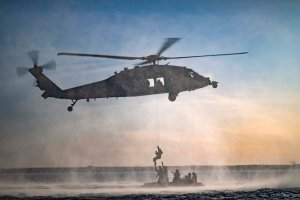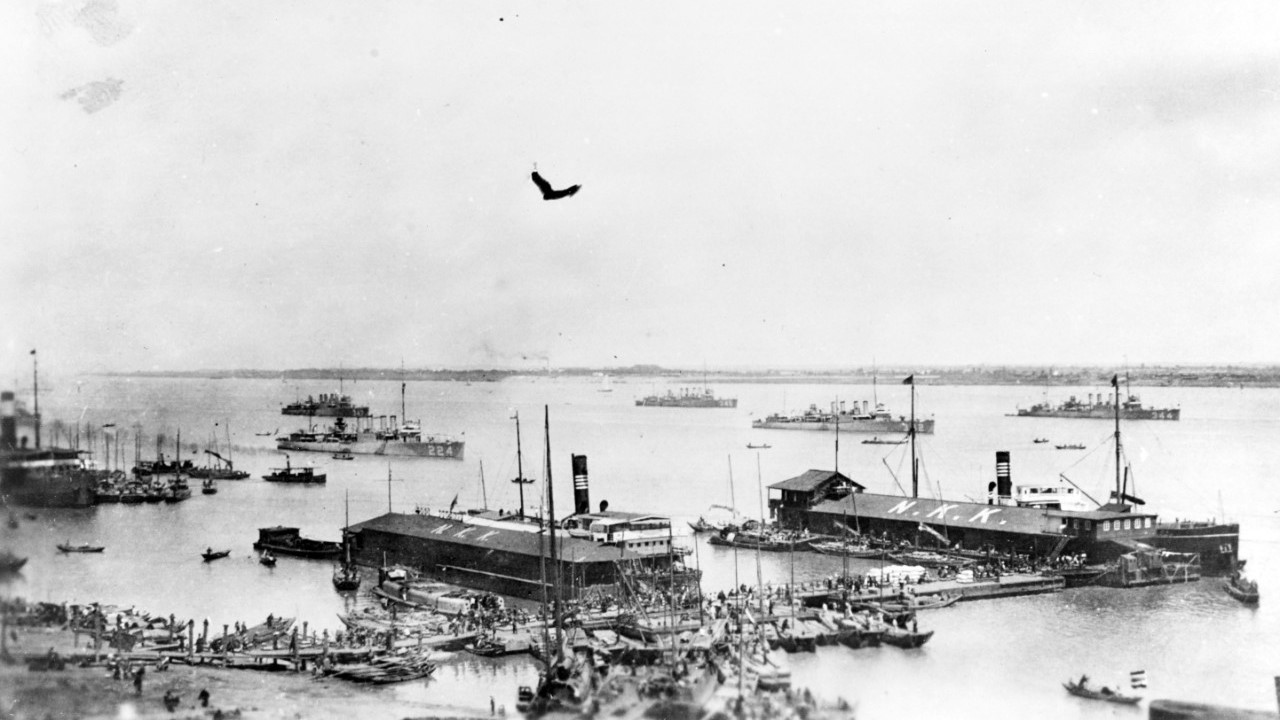
The U.S. military is currently underway with a massive strategic shift in the Pacific. The armed forces are rebuilding island bases from World War II, reviving old units in allied countries, and fortifying important bases. It’s preparation for a potential peer-on-peer war in the Pacific, where large naval fleets and island-hopping troops will — according to strategists — fight it out for important waterways and terrain.
This isn’t the first time the U.S. military has had its eye on the Pacific as a theater of war. And no, not that time. Years before the attack on Pearl Harbor, the United States was drawing up plans for a vast war in the Pacific. That strategy was dubbed “War Plan Orange.”
In the aftermath of World War I, Japan had emerged as the dominant power in East Asia. It had defeated the Russians easily in the Russo-Japanese War and taken territory during the Great War. As such, the Joint Planning Committee of the Joint Army and Navy Board — an early 20th-century precursor to the Joint Chiefs of Staff — developed War Plan Orange. It was one of several color-coded military strategies mapping out how a war with a regional peer could play out, and how to win. With Europe largely at peace in the early 1920s, American attention was aimed west, with War Plan Orange imagining a great conflict with Japan.
Top Stories This Week
Notably, the strategy evolved during the interwar period, being revised multiple times between 1919 and 1938. Earl Hancock “Pete” Ellis, a veteran organizer in the Marine Corps, had written the 1920 paper “Operation Plan 712 – Advanced Base Operations in Micronesia,” which outlined the importance of island bases for logistics and staging in the event of a Pacific War. His writings in part revolutionized the idea of what the Marine Corps would do — island hopping — and proved prescient for the Second World War. That’s why, infamously, Marine Corps Commandant John Lejeune dispatched Ellis to the Pacific in 1922 on an espionage mission. Ellis, a noted alcoholic, spent much of his time being hospitalized, but also managed to conduct a tour of the region and send back detailed maps and plans, which in turn helped update American strategy.
The first full formal plan was presented in 1924. It imagined a great naval blockade of the Philippines, with the United States having to marshal its naval forces to travel west to protect its colonial holdings. It was in many ways prescient, with plans for large-scale mobilization, naval-driven campaigns to liberate islands along the way to Japan and a realization of just how costly the fight for the Philippines would be. However, it always ended with a plan for a large, decisive fight against the enemy. As World War II eventually played out, the Pacific campaign was much more of a grinding war of attrition.
Still, the evolving strategy predicted many elements that would come to pass in World War II. The United States military already understood the importance of air power in the early 1920s, and how aircraft carriers could prove decisive in an open war. However, large naval ships were costly, and the Navy tried several alternatives. One plan included using dirigibles or rigid airships both for reconnaissance and — and this is true — flying aircraft carriers. The Navy even got four rigid airships to test this out, with crews flying them and pilots even being able to take off from them midair. They were, however, disasters, with several crashes and high casualties during their testing period. The Navy then decided that aircraft carriers in the water were the better choice.
War Plan Orange wasn’t the only military strategy the U.S. cooked up during the interwar period. Several color-coded ones were devised, including War Plan Red, a scheme on how to fight a war against the British Empire, including at sea and on land, along the northern border. Notably, military planners even created a hybrid hypothetical — War Plan Red-Orange — imagining how a two-front war against two powerful enemies could play out for the United States.
Ultimately, the years of planning ended up somewhat pointless. A 1980 article in the Naval War College Review by Michael K. Doyle noted that War Plan Orange was built around the post-World War I conceit of a defeated Germany. For the U.S. to fight the war it had prepared for, it needed peace in Europe and the Atlantic. Even before the attack on Pearl Harbor, the risks of danger on the East Coast had thrown a wrench in War Plan Orange.