Roses are red, you’re a nice guy. That baddie who likes you, is probably a spy.
At least, that’s what the Army is saying this Valentine’s Day. The Army wants soldiers not to fall for anyone who starts flirting with them.
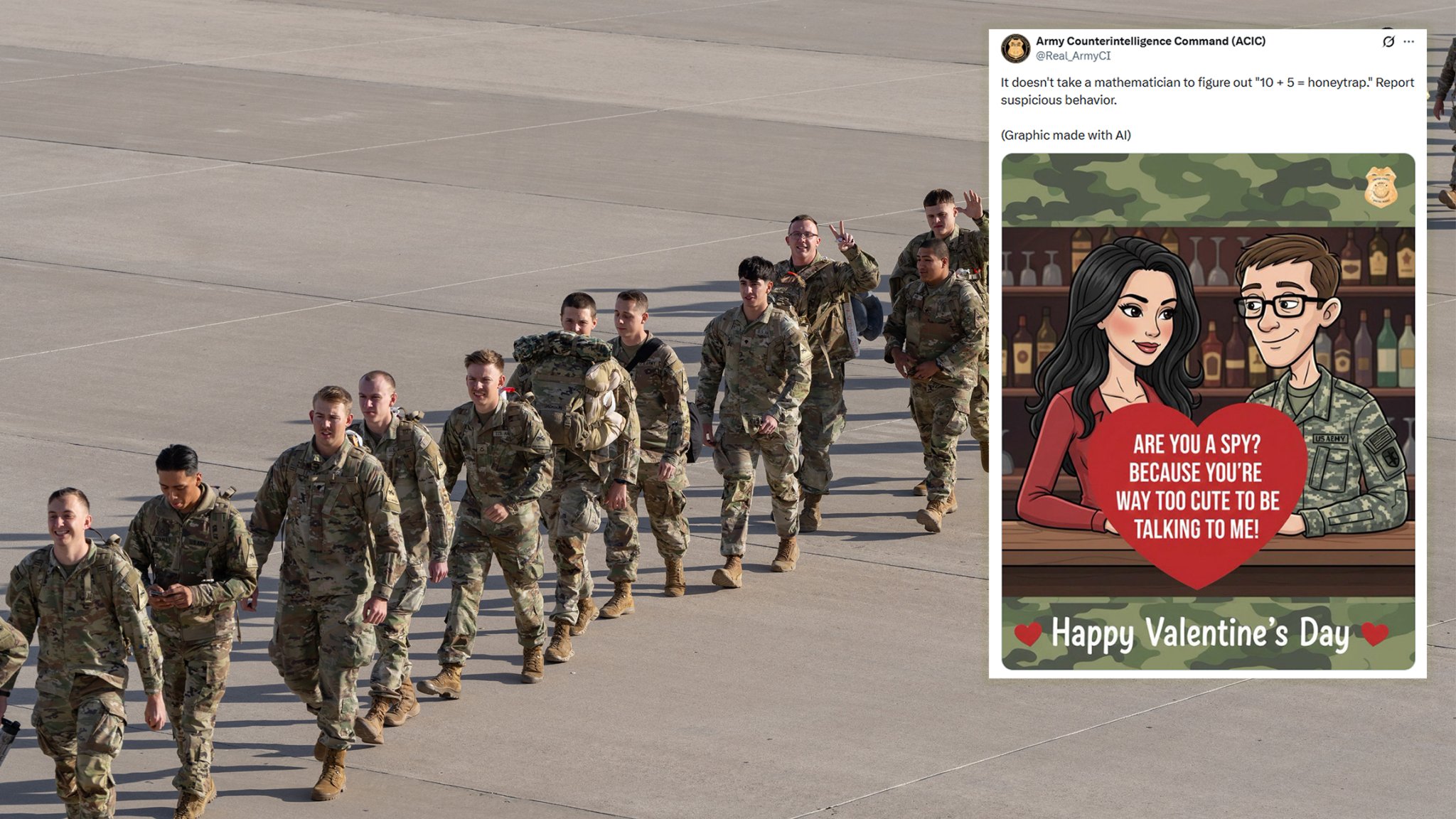
The U.S. Army Counterintelligence Command is warning soldiers to be wary of potential “honeypots.” In a post shared to its social media accounts, the Fort Meade-based center is asking soldiers to be on the lookout if anyone seemingly out of their league starts talking to them. That’s how the Army is putting it.
The post, made using artificial intelligence image generation (which gets uniform details wrong such as putting the American flag on the wrong arm), has a soldier in glasses sitting next to a blushing woman at a bar. The image, wishing troops a happy Valentine’s Day, has a simple message encased in a heart: “Are you a spy? Because you’re way too cute to be talking to me!” The Army Counterintelligence Command shared that with an additional message.
“It doesn’t take a mathematician to figure out ‘10 + 5 = honeytrap,’” the Army’s caption to the post says. “Report suspicious behavior.”
Simply put: The Army says she’s just not that into you.
The holiday theme aside, honeytraps are actually a major concern for the Army and the U.S. military as a whole. The military deals with constant threats from foreign intelligence and espionage in a variety of ways, from surveillance to misinformation. It set up new units to try and deal with those, and worked on security at bases. But honeytraps and related romantically themed schemes with active-duty service members remain a consistent tool used by adversaries.
Honey traps have also targeted veterans and military contractors. Last year a retired army lieutenant colonel who was working as a contractor for U.S. Strategic Command pleaded guilty to conspiring to transmit classified information to a “woman” he had met on a dating site. The supposed paramour asked “Beloved Dave” for information about U.S. intelligence on the Ukraine-Russia war.
Top Stories This Week
This past week, the Department of Justice unsealed indictments of 11 people involved in a plot to commit marriage fraud. According to the indictments, the people planned sham marriages with U.S. service members to get green cards and then military identification cards to gain access to bases. Plans also called for bribing service members for their role. Four former Navy sailors pleaded guilty on charges stemming from the scheme. They are waiting to be sentenced, the Department of Justice said.
So this Valentine’s Day, don’t become someone that Army Counterintelligence Command can point to and say “don’t do this.”