Four astronauts returned to Earth Friday after traveling to the Moon, splashing down off the coast of Southern California. As the spaceship bobbed in the water, a specialized team of Navy divers were there to greet them.
The Artemis II mission wrapped on its tenth day, after taking humans into lunar orbit for the first time in five decades. The Orion space capsule carrying NASA astronauts Reid Wiseman, Victor Glover, and Christina Koch, and Canadian Space Agency astronaut Jeremy Hansen, landed in the Pacific Ocean roughly 60 miles offshore of San Diego at 8:07 p.m. Eastern Time.
The landing was a “perfect bullseye splashdown,” according to NASA during its live broadcast of the return flight.
The return flight was an odyssey of its own. As expected, NASA lost contact with the ship for several minutes as the Orion spacecraft began reentry. Once in the atmosphere over Hawaii, the Artemis II crew sped across the Pacific, flying east towards California in a little over 12 minutes. The astronauts experienced nearly 4 Gs of force as the spaceship, nicknamed “Integrity,” rapidly descended. In the final minutes, its parachutes deployed, slowing it down and sending prepositioned Navy’s teams into action.
Top Stories This Week
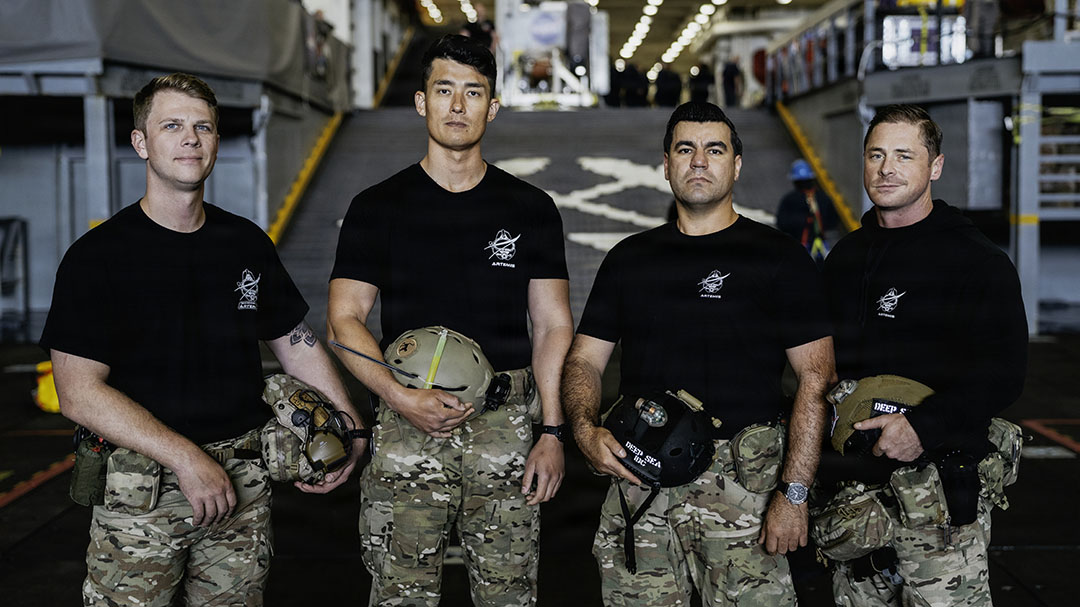
One of the Navy’s dive medical teams, part of Explosive Ordnance Disposal Group ONE, was tasked with greeting the crew. The dive medical team includes Lt. Cmdr. Jesse Wang, Senior Chief Hospital Corpsman Laddy Aldridge, Chief Hospital Corpsman Vlad Link, and Hospital Corpsman 1st Class Steve Kapala. According to the Navy, the team specializes in caring for troops who carry out diving operations. Wang is also an emergency medical doctor.
“Our fellow divers, the sailors on the ship, the helicopter squadron, our partners at NASA, and everyone supporting this mission are ready to bring the Artemis II crew home,” Wang said in a Navy release ahead of Artemis II’s landing.
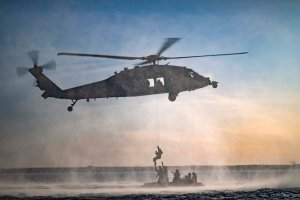
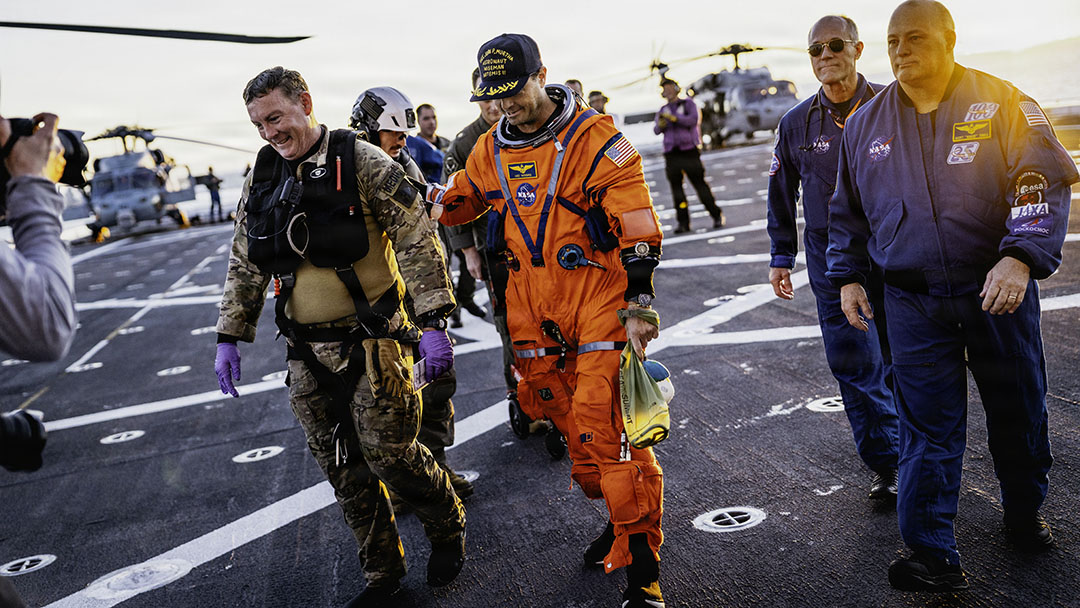
Once the Orion craft hit the water and deployed inflatable ballasts to stay upright, the Navy’s recovery team pulled up with inflatable boats to greet the astronauts. The crew had told NASA that they were all good after landing, but it was up to the Navy team to inspect them one by one to make sure all was okay. Then they were hoisted on at a time onto low-flying helicopters. MH-60S Sea Hawks, flown by the Helicopter Sea Combat Squadron (HSC) 23, ferried the astronauts back to the amphibious transport dock ship USS John P. Murtha, sailing in the area as the designated recovery ship.
Navy teams will then recover the capsule itself.
On the Murtha, the Artemis II crew will undergo more medical tests then fly to NASA’s Johnson Space Center in Houston where more post-mission tests will examine the impact of the 10-day mission on their conditions.
The Artemis II mission was the first NASA mission to travel to the Moon in more than 50 years. The rocket took off on April 1, sending the crew flying around the dark side of the Moon on April 7, setting the record for the farthest any human has been from Earth. The spacecraft flew more than 694,000 miles, according to NASA.
Military teams and dozens of Navy ships played a major part in past space missions, for planned recoveries or emergency rescues. In 1961, Virgil “Gus” Grissom’s landing in the Mercury-Redstone ship Liberty Bell 7 almost killed him. As a Marine helicopter arrived to recover the spaceship, a hatch blew open, sending seawater into the ship, threatening to drown Grissom. He swam out of the capsule, but without a helmet, allowing water into his suit. The Marine crew saw Grissom signaling and saved him.
NASA is streaming the Artemis II landing starting at 6:30 E.T. on its YouTube page.
Update: 4/10/2026; This story was updated after the Artemis II crew successfully landed and was recovered on Friday.