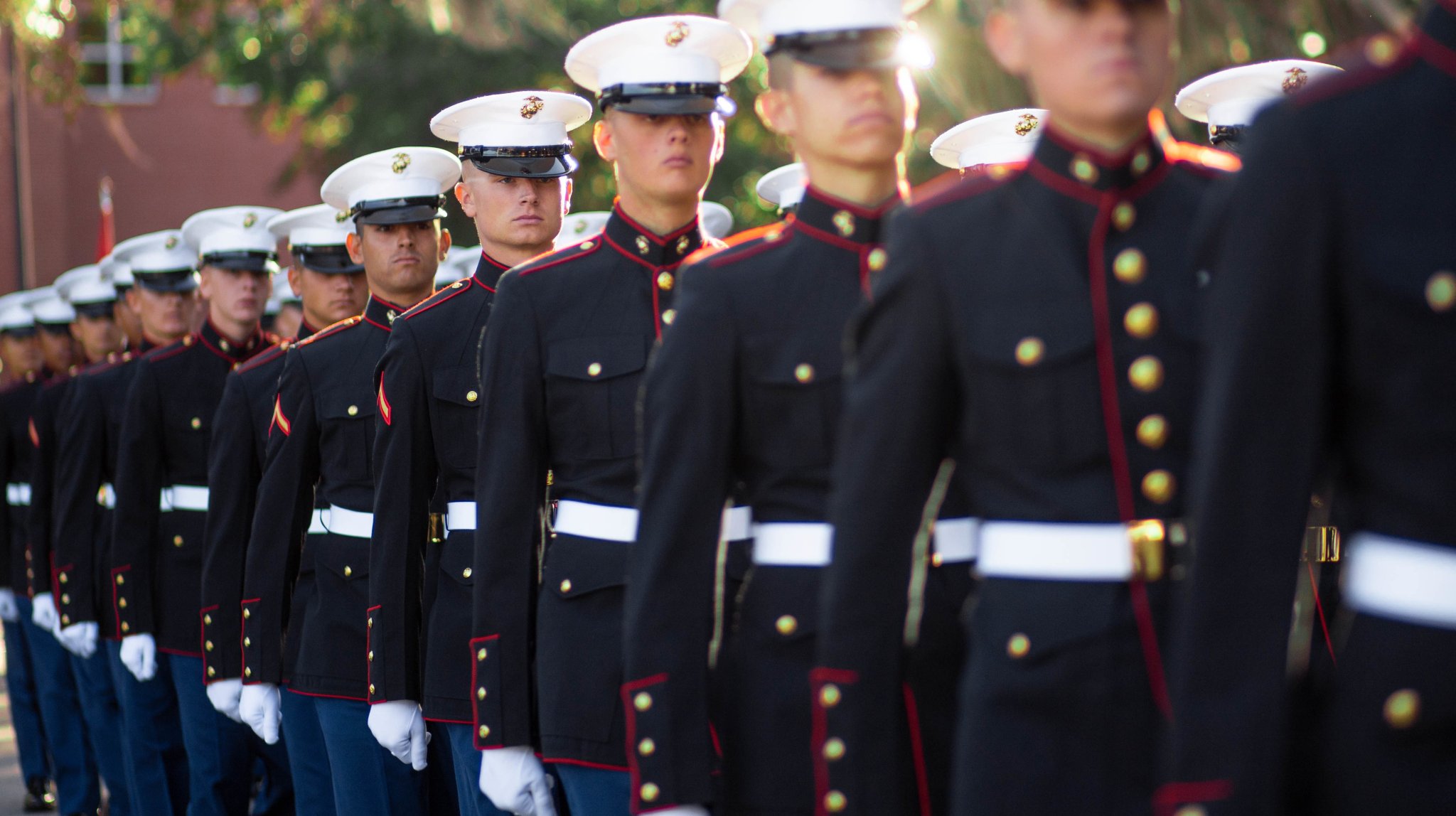
Marines will once again be judged by how they look in an official photograph when they are up for key career opportunities, according to a policy released this week, partially reversing a 2020 rule aimed at removing unintended bias that photos can add to selection boards.
Unchanged is the rule that photographs will not appear in files used by promotion boards, service officials emphasized.
The partial policy reversal will take effect April 1, according to a MARADMIN notice released Thursday. Under the new rule, Marines will submit their official portrait when they apply for command screening boards for lieutenant colonels and colonels, and in selection boards for educational and career opportunities like the Commandant’s Career Level Education Board, Naval Post Graduate School, Expeditionary Warfare School (Captain’s PME) and instructor at the United States Naval Academy, according to Maj. Jacoby Getty, a spokesperson for the Marine Corps’ Manpower & Reserve Affairs.
Photographs will “not be accessible in officer or enlisted promotion selection boardrooms or viewable by board,” service officials said in the notice. Congress outlawed the use of photographs in “promotion selection boards” for both enlisted troops and officers in the fiscal year 2021 National Defense Authorization Act, and the new policy notes that reviewing photographs “remains statutorily prohibited” in those boards.
Returning photographs to other selection boards reverses a five-year-old policy. Defense Secretary Mark Esper, appointed by President Donald Trump in his first term, issued a memo in July 2020 to “take the initiative against discrimination, prejudice, and bias in all ranks” and directed a review of relevant policies by the Under Secretary of Defense for Personnel and Readiness. In August 2020, that office issued a policy prohibiting photos from being used in promotion boards and other selection processes for training, education and command assignments.
Secretary of Defense Pete Hegseth rescinded those memos over the summer, according to the Marine Corps notice.
The 2021 law and subsequent policies were aimed at reducing bias in selection boards that photographs could introduce, according to Joe Plenzler, a retired Marine lieutenant colonel who served as a senior communications advisor to the 35th and 36th Commandants of the Marine Corps.
“There’s that old saying that ‘ducks pick ducks,’ right? In other words, similarity is pretty hardwired into likability in the human mind, so that if I see a picture of somebody that looks like me, without even thinking about it, what the research shows is that I’m more likely to pick that person because they might share the same skin tone, facial features, body builds,” Plenzler said. “Subconsciously, if you’re not aware of those biases, you’re more likely to pick that person.”
And unconscious bias, he noted, can swing both ways.
“If you’ve got some prejudices,” he said, “you might not pick people because of what you see in the photograph as well.”
The purpose of the policy change, according to the Marine Corps notice, is for boards to reflect the service’s “professional appearance ethos, the visible expression of discipline, physical fitness, and strict adherence to height and weight standards.”
In 2021, as the policy took effect, the Marine Corps clarified that the service would still have Marines take official photos, and the service has maintained the use of photos to assess Marines for more prominent roles where appearances were deemed crucial. A 2024 notice for Color Sergeant of the Marine Corps applications noted that Marines needed to have digital photos in their personnel files.
It is up to individual Marines to make sure their photographs are “current” and taken no more than 365 days before a selection board meets that will require it.
Plenzer questioned if using photos for any type of selection falls in line with Secretary of Defense Pete Hegseth’s call for returning the military to standards based on “merit only.”
To build a “true meritocracy,” the Defense Department should look to the Marine Corps band, Plenzler said.
“It’s one of the few places in the Marine Corps where performance is based on performance alone,” he said. “Literally, when they audition for that band, [they] step behind the screen and play the audition piece and the audience doesn’t see who’s playing it. They just hear the performance, and they did that to remove bias from the process.”