
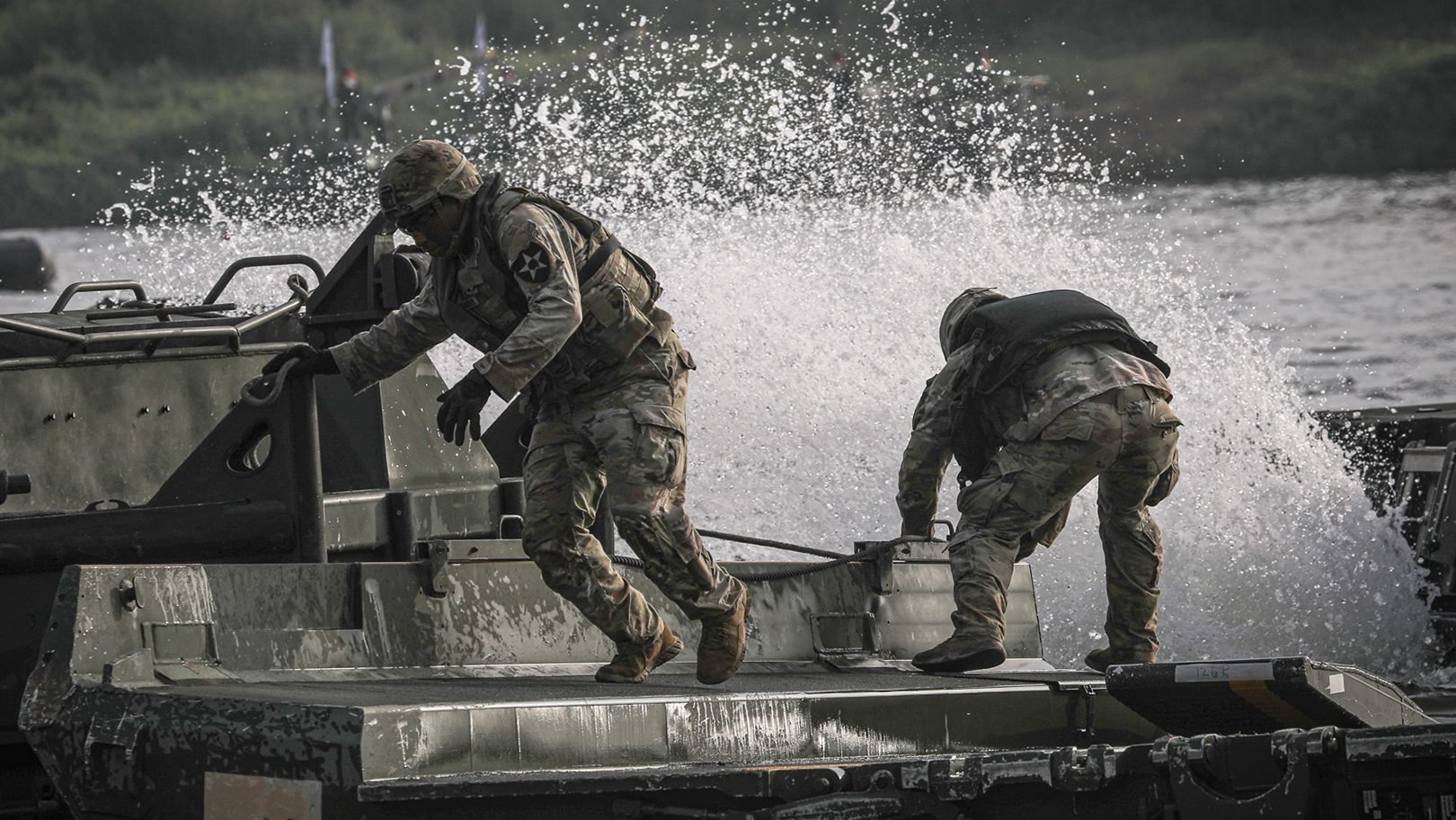
U.S. troops launched a major joint exercise in South Korea on Monday, just hours after a last-minute social media post from President Donald Trump that the annual event would be drastically curtailed.
On Sunday evening, Trump posted on Truth Social — a social media service in which he owns a majority stake — that he had ordered Defense Secretary Pete Hegseth to “substantially reduce” the American involvement in joint military exercises in South Korea. The post came on the eve of a major annual training event on the Korean Peninsula.
“Based on my very good relationship with Kim Jong Un, of North Korea, I am not happy with the fact that the United States has, long ago, agreed to participate in Joint Military Exercises with South Korea,” Trump wrote.
Trump hinted the pullback was tied to lingering hard feelings he maintains over the Iran war, which South Korea has not participated in. He also criticized the costs of the exercises, but said it was too late to cancel U.S. participation.
A Pentagon official said the Defense Department is “actively working on executing the Commander-in-Chief’s directive,” without providing further details, and it was unclear how Trump’s announcement would affect the size and scope of the exercise or when changes might go into effect.
On Monday, a spokesperson for the South Korean defense ministry said that the 11-day exercise, Ulchi Freedom Shield 2026, is “proceeding as planned.”
Ulchi Freedom Shield 2026 is an annual joint exercise featuring elements of U.S. Forces Korea and troops from South Korea. The exercise began Monday and is set to run through Aug. 27. U.S. Forces Korea calls the exercise a “combined, joint, all-domain, and interagency operating environment.” In 2025, about 3,000 U.S. troops were among the 20,000 who participated in the annual exercise.
This year’s exercise was slated to include a greater emphasis on drone warfare, as well as electronic and cyber operations, according to U.S. officials. The exercise will involve roughly 18,000 South Korean troops and thousands of American personnel.
Last week, Col. Ryan Donald, spokesperson for U.S. Forces Korea, or USFK, and the South Korean Combined Forces Command, previewed the exercise and said it would address changing natures of war. He also noted North Korea’s participation in the Russian invasion of Ukraine, saying that North Korean troops have “taken those lessons they learned there and brought them back to North Korea. That changes the DPRK capability, and our training accounts for that threat.”
A spokesperson for USFK directed questions about Trump’s order to the Department of Defense, which in turn directed questions to the White House.
As it often has, North Korea denounced the exercises in the Korean Peninsula. However, a North Korean Foreign Ministry spokesperson said last Friday this year’s drills mark a “new level of a threat” and it intends to respond with a new level of deterrent.
Motive may lie in Iran war
Trump’s post gave further hints to its origin in references to South Korea’s president’s refusal to join U.S. military operations against Iran. The Trump administration has threatened retaliation against allies who have not joined the war or who have denied U.S. forces use of infrastructure, such as Spain in March. In May, the Pentagon canceled some planned deployments to Europe, and said it would withdraw some troops from Germany, following criticisms by German leadership over the Iran war.
The U.S. and partners have regularly drilled around South Korea, including joint air operations meant as shows of force against North Korea. In recent months, the U.S. military has bolstered its presence in South Korea, including creating an Air Force “super squadron” and sending reconnaissance drones. Those measures have been seen as both deterrents against Pyongyang and as part of countering Chinese strength in the region..
During Trump’s first term, the United States and South Korea delayed the 2018 Foal Eagle and Key Resolve joint military exercises. The exercises were canceled the following year. U.S. and South Korean forces resumed conducting large-scale field exercises on the Korean peninsula in 2023.
Loading comments…
Comments couldn’t be loaded. Please refresh the page.