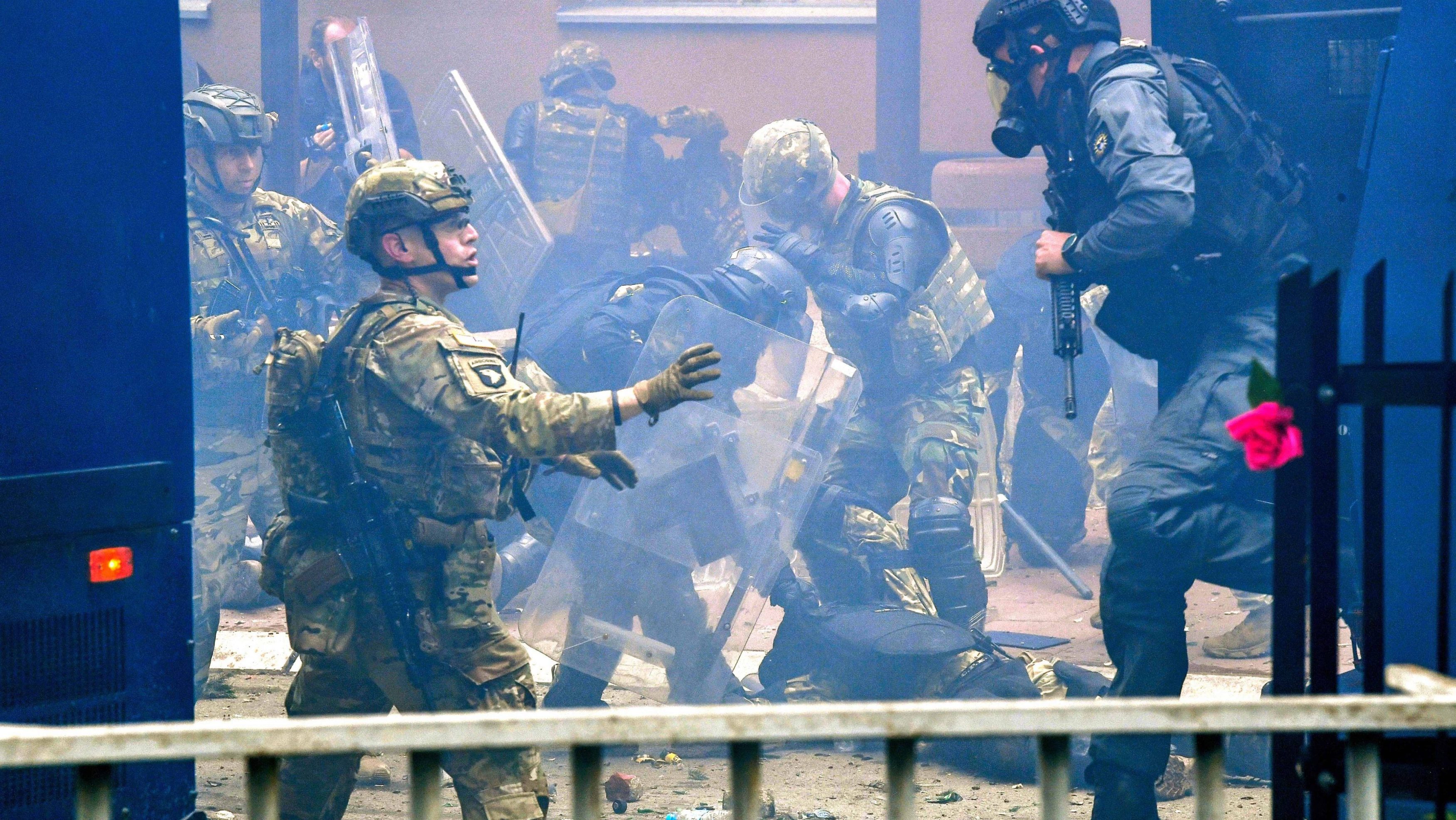
Maj. Brendan Williams looked out over a growing crowd and came to a troubling realization: most of the women had left, replaced by men in hoodies, caps and face coverings. A block away on the tight village streets of Zvecan, Kosovo, the crowd had surrounded two vehicles of police officers. Another American, Lt. Col. Jared Sheets, and dozens of NATO soldiers under a mission known as Kosovo Force, or KFOR, were preparing to wade out into the crowd with riot shields to rescue them.
As peacekeepers formed a shield wall, bottles, rocks and even flash bang grenades began to land, some exploding at their feet.
Violence, Williams realized, was about to erupt.
“I do jujitsu, and I’ve had a couple fights, you know, nothing crazy, but the feeling of, ‘hey, we’re about to get in a fight’ — that was it,” said Williams, who recalled thinking “Yeah, I’m pretty sure we’re going to get in a fight here. This is going to go.”
Within seconds, it did.
On May 29, 2023, Williams — who is now a lieutenant colonel — and seven other Indiana National Guard soldiers, along with three companies of Italian, Polish and Hungarian peacekeepers under their command, suddenly found themselves in the most violent clash involving American soldiers in Kosovo since nationwide riots in 2004. The details of the violence and the actions of the Americans in the center of it have not been previously reported. Task & Purpose spoke with two of the Guardsmen and reviewed after-action reports from the deployment that documented the fight.
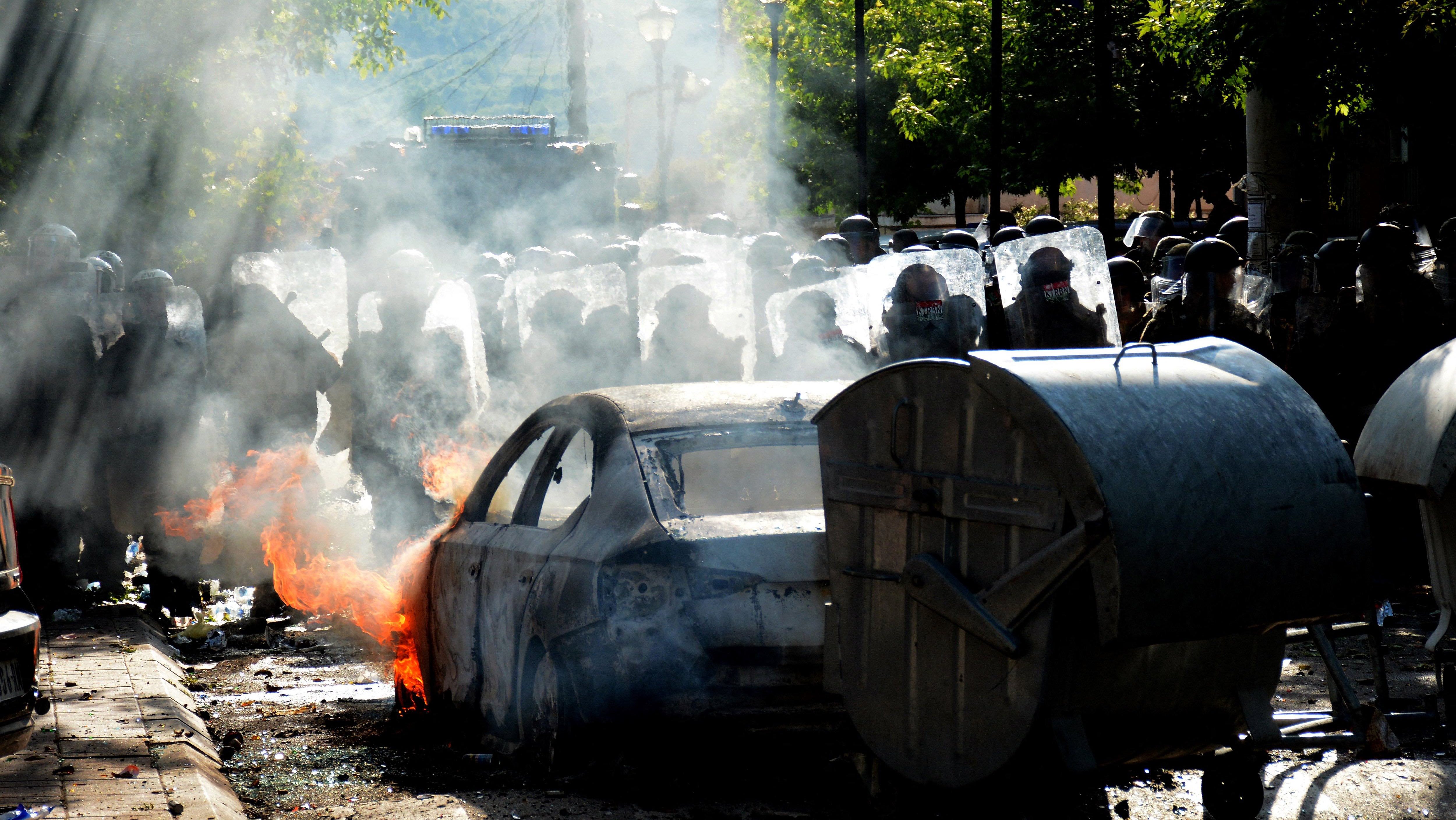
The riot erupted when a large crowd of protesters threatened to set fire to two disabled vehicles with police officers inside, prompting the senior American officer on the scene, Col. Chris Mabis, to order the NATO troops under his command to rescue them.
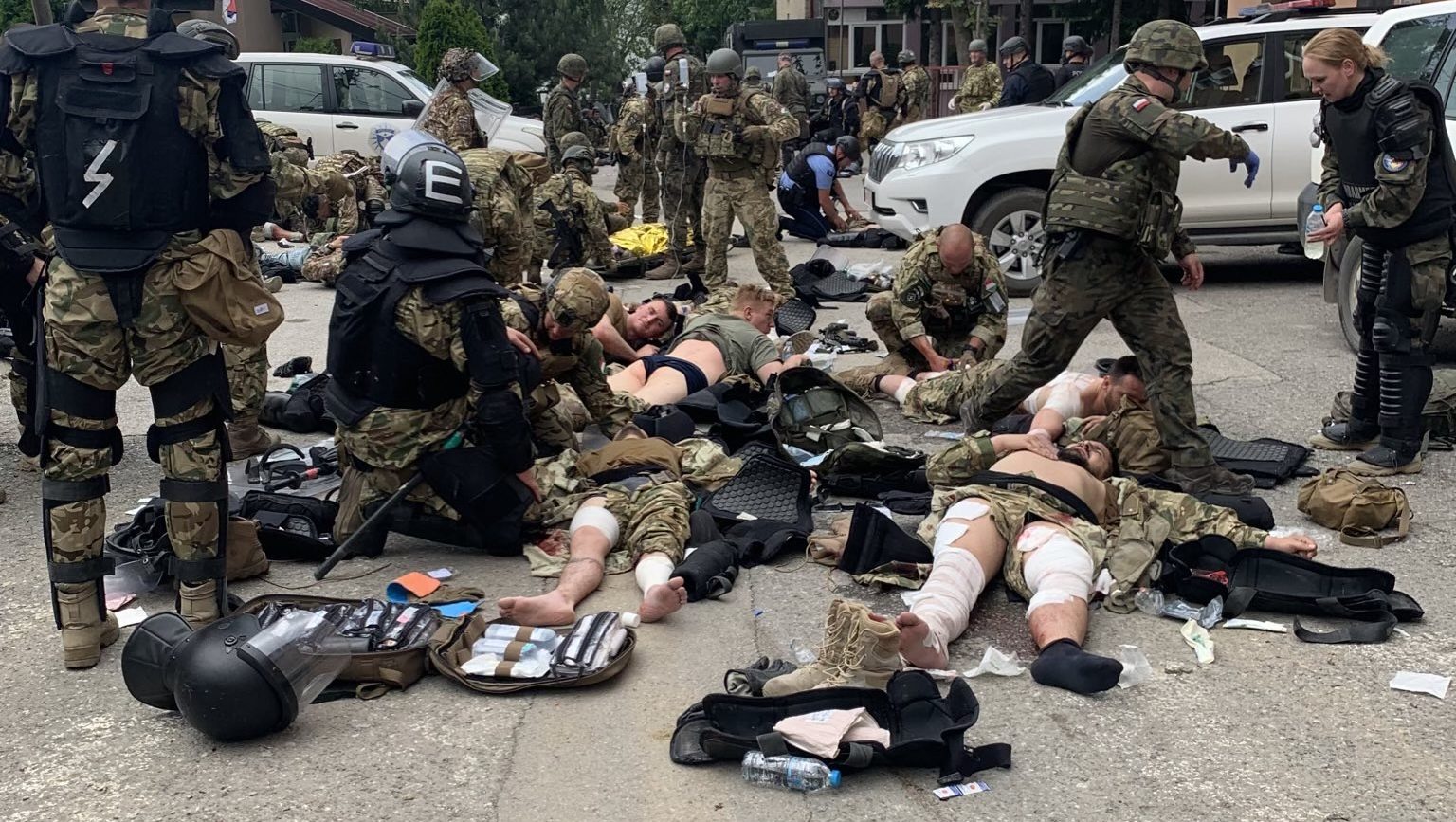
By the end of the riot, the crowd had thrown 56 grenades at the peacekeepers amid a storm of debris and attacks with clubs, injuring over 90, and U.S. Army helicopters had medevacced close to two dozen wounded soldiers from a hasty landing zone a mile away.
The soldiers of the Indiana National Guard’s 76th Infantry Brigade Combat Team arrived in Kosovo in October 2022 to join the long-standing UN-sponsored Kosovo Force, or KFOR, a mission that had been mostly peaceful for close to two decades.
That peace would last less than a week.
As the 76th’s commander, Mabis commanded KFOR’s RC-East brigade with Williams, a supply chain manager in civilian life, as his operations officer. Lt. Col. Jared Sheets, a police officer from outside Indianapolis, was a battalion commander over the three companies of NATO peacekeepers who would be at the center of the melee. As career Guardsmen, the team of officers had known each other for most of their careers, deploying together to JRTC and a major exercise in Asia. The Indiana Guard made up two of the KFOR battalion’s eight companies, while the other six were from Italy, Hungary, Latvia, Turkey, Poland and Austria.
The UN-led KFOR mission has long been used to provide muscle behind peace efforts in Kosovo’s northern region, which splits Serbia to the north and Albania to the south. By late 2022, regional and local police forces had been established in which Serbs and Albanians served side by side, serving as a social glue against ethnic tensions.
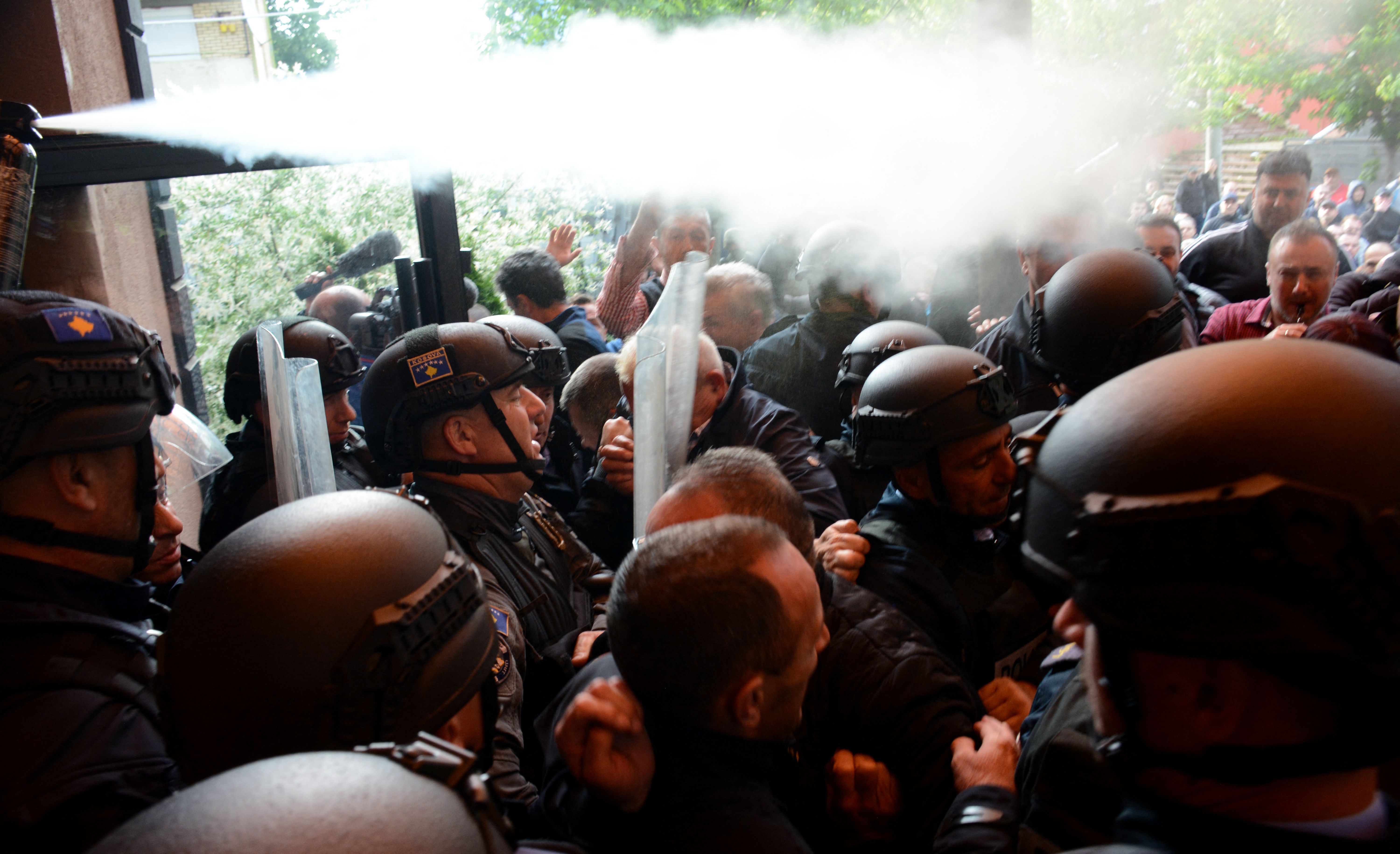
On Nov. 6, 2022 — a week after 76th arrived — Serb police officers across the country resigned en masse amid a political fight over license plates and immigration documents between Serbia and Kosovo.
“A lot of the work over a decade had been to enhance the presence of Serbs in the Kosovo Police,” Sheets said. “And in a 24-hour period that work was undone.”
By December, Serbian militias created roadblocks in the narrow, winding roads in the country’s northern region with heavy trucks. Along with sowing political strife, the blockades split the KFOR headquarters at Camp Bondsteel in the south from Bravo Company of the 76th’s 151st Infantry regiment at Camp Nothing Hill, farther north. The only way to resupply the camp was by helicopter, but after several weeks of flying in fuel, water, and food, NATO headquarters ordered the road cleared.
As the plan came together, Williams realized it could “get pretty bad very quickly, because we had some pictures of potential explosive devices and things on these dump trucks.”
The night before Bravo company was to roll out of Camp Nothing to clear the roadblocks, the trucks disappeared.
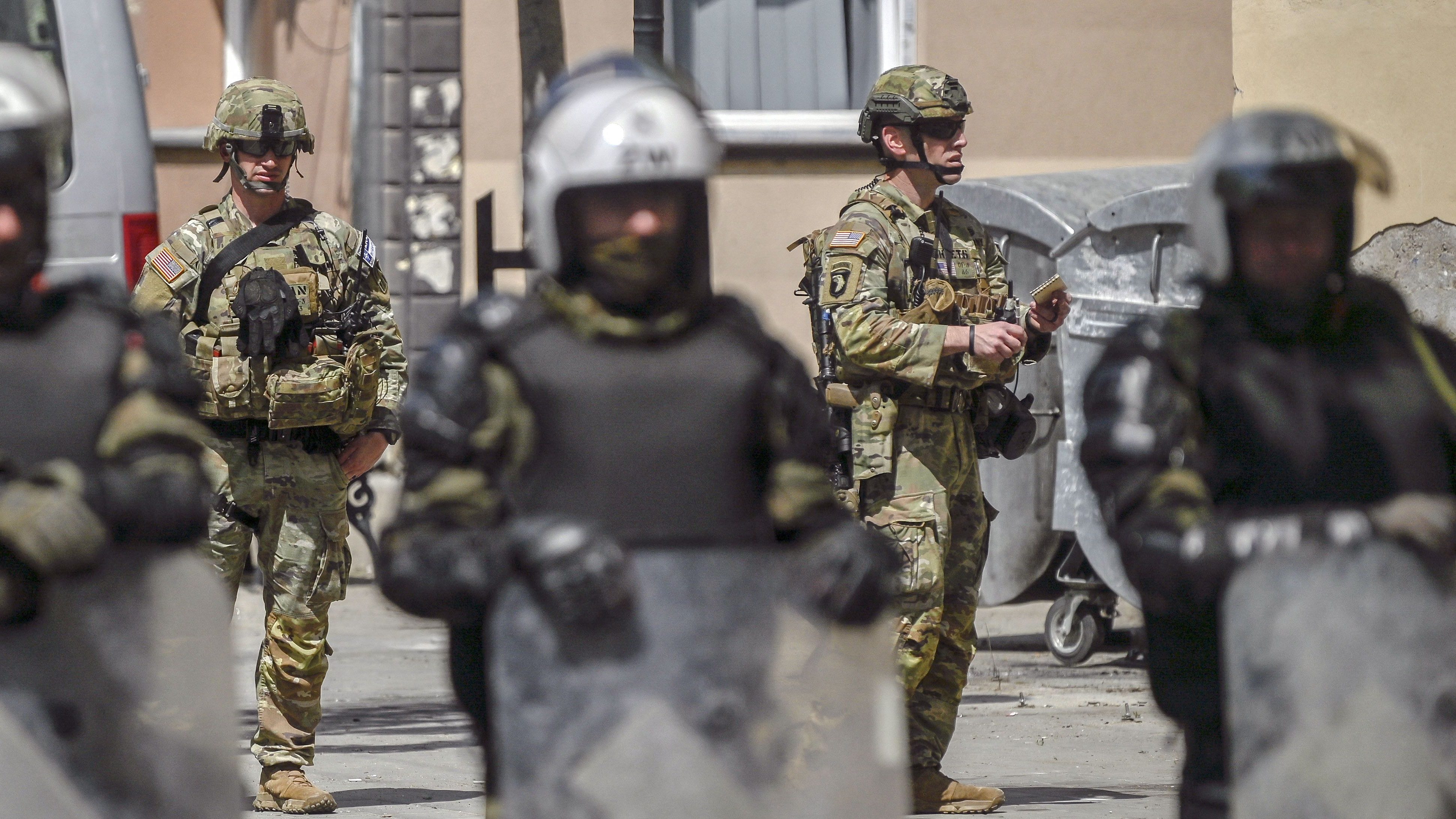
On May 29, KFOR troops were sent to Zvecan to support the arrival of a new mayor. The Italian and Hungarian companies arrived early in the morning, as did the first signs of a major Serbian crowd. As tensions rose, Mabis and the other Indiana Guardsmen drove to Zvecan, navigating the town’s maze of narrow streets, flanked by tight, tall buildings. “I tell you what, rolling with four people through an area where everybody’s looking at you sideways — pretty, pretty interesting,” Williams said.
Early in the day, two armored Kosovo police vehicles, which U.S. troops compared to MRAPS, were surrounded by protesters over 100 yards from the NATO troops. Though the vehicles were safe for the police inside, protesters quickly painted over the windows. But as the day dragged on, the crowd grew larger and morphed, becoming more male and better organized. By mid-afternoon, protesters were spraying flammable liquid on the vehicles and putting burning trash into exhaust and ventilation holes.
As negotiations with leaders in the crowd stalemated, Mabis radioed KFOR command at Camp Bondsteel that they would need to stage a rescue.
As the NATO troops formed shield walls in riot gear and began moving toward the vehicles, the crowd made its first coordinated move.
“They had about two to three layers of people just sit down in front of our crash line,” said Williams. “So as we start moving forward, our guys are kind of helping pick up these people to kind of get them out of the way. And then bottles start getting thrown, rocks, bricks, you name it. I have a bottle whiz past my head, it was like dodgeball.”
As rocks and bottles pelted the peacekeepers, Serbs at the front of the crowd began rolling police-style flash grenades and battlefield fragmentation grenades under the shields.
“I’m a SWAT guy by trade here, so I’ve thrown and eaten plenty of flash bangs,” Sheets said. “These flash bangs were intense. They’re landing at your feet. I also know the difference between the sound of flash bangs and fragmentation grenades.”
As the KFOR troops pushed forward — “almost like a phalanx back in the olden days,” said Sheets — troops on the shield wall began to fall with severe wounds from the fragmentation grenades.
“I start seeing Hungarians getting pulled out,” Sheets said. “I see Italians with like, their fatigues open to their thigh or ripped and open and covered in blood.”
Williams found himself dodging grenades.
“I get rocked by two of those concussions, ” said Williams. “One landed on one side of me, and I’m like, ‘fuck.’ So I go one way, and then another one lands on the other side. So I have to turn, like the duck [game], you know, you’re shooting the duck, and it keeps going back one way or the other.”
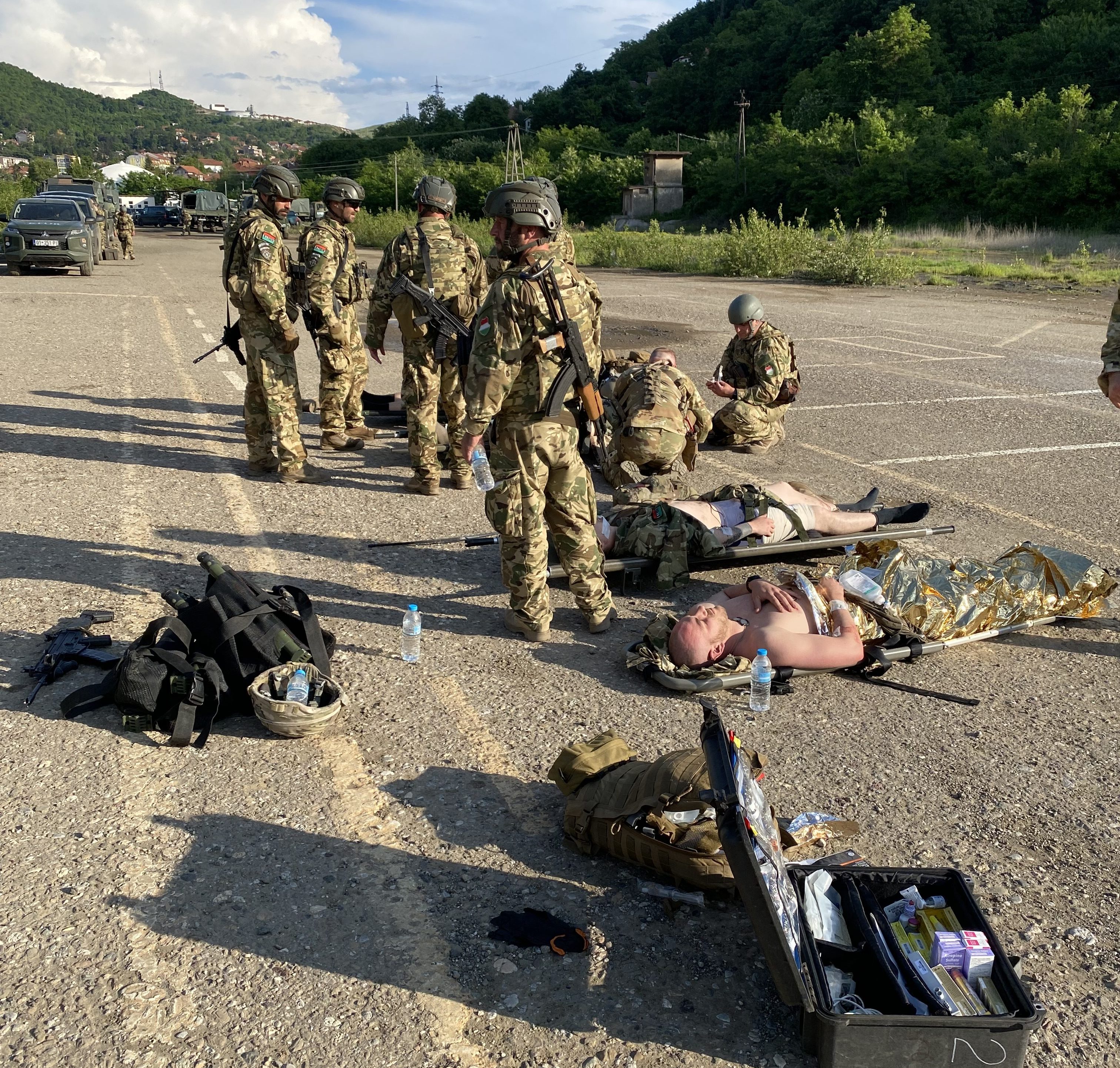
As Sheets moved forward with the shield wall, Williams took over triaging casualties.
“I go take a knee behind a vehicle, just to kind of get my bearings,” Williams said. “My head’s ringing and I hear somebody screaming bloody murder. It’s kind of like that scene, not as drastic, but, you know, ‘Saving Private Ryan,’ sitting there and his ears are ringing and he’s kind of looking around. And I look at this guy from the crash line getting drug out, he’s just screaming. And I think to myself, ‘well, we in it now.’ So I run out and grab them and help pull this guy behind the corner.”Williams immediately recognized that the wounds were from fragmentation grenades.
“Guys were getting their legs all torn up,” said Williams. “So we just start treating people coming in. By this point, there’s probably like 10 to 15 people piling up there.”
Sheets and the shield wall eventually reached the police vehicles. The American officer knocked on the rear window of the vehicle, and the trapped police piled out. But behind the line, as the stream of casualties increased, Williams realized they’d reached the critical point of a mass casualty event.
“I need to start thinking of the next step. And we’re going to start medevacing people,” Williams said. “We got the ambulances up to the north where we parked, so we just got to start moving people to those ambulances.”
Top Stories This Week
Williams established a landing zone just outside the village on an open field. The volume of patients, most of whom had deep punctures or lacerations from frag grenades, was far greater than the few KFOR medics could handle, and anyone with medical training jumped in.
“It didn’t matter where you were from; everybody was just speaking the same language at that point,” Williams said.
That included Capt. Dylan McLean, a military lawyer with the Indiana National Guard, who had been on the scene to advise Mabis on rules of engagement during the protest.
“Here’s a JAG dude on, like, the front line with a rifle and a law book, right?” said Sheets. “He’s just one of those guys, he’s all about it. He’s like, ‘They tell you this will never happen when you’re in JAG school.’”
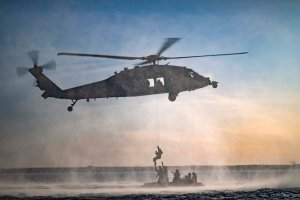
As UH-60 helicopters from the Arizona National Guard arrived from Bondsteel, their flight medics jumped out with extra supplies and joined the treatment. The Alabama crews made multiple trips between Zvecan and nearby hospitals.
In the days that followed the melee, KFOR reported that 93 peacekeepers suffered injuries in the fight. Army investigators found remnants of 56 Eastern Bloc grenades, both flash and fragmentation, some modified to explode with great effect. Of the eight Indiana soldiers, none required substantial medical care, but seven came away with minor injuries, including being stunned during the fight by the explosions.
Last month, the eight Guardsmen who were in the thick of the day’s fighting were awarded Combat Action Badges, while all 300 soldiers who deployed from the 76th Infantry Brigade Combat Team were awarded Shoulder Sleeve Insignia, or combat patches, signifying that those on the deployment had faced combat conditions.
Sheets was pleased that soldiers across the unit were recognized for the deployment, saying the “sleeve insignia is seen as a ‘I’ve done things,’ not necessarily I’ve been in combat, but I’ve deployed in a combat area.”
“My emphasis to my soldiers was complacency is what will kill you more than anything in Kosovo,” Sheets said.
Correction (8/15/2025): The helicopters and aircrews involved in the medevac mission on May 29, 2023 were from C-Company, 2nd Battalion, 149th Aviation Regiment, of the Arizona National Guard. A previous version of this story misidentified the unit as part of the Alabama National Guard. An Alabama unit was the higher headquarters for the mission.