At 10:46 p.m. on Jan. 2, President Donald Trump gave the order for Delta Force special operators supported by more than 150 aircraft to launch a mission to capture Venezuelan President Nicolás Maduro and his wife.
Trump’s message to the force prior to the mission was “Good luck, and Godspeed,” Chairman of the Joint Chiefs of Staff Air Force Gen. Dan Caine later told reporters. Details remain scant, but here’s what we know so far.
Named “Operation Absolute Resolve,” the order came after a U.S. military buildup in the Caribbean that included sending F-35 and F-22 fighters to a recently restored base in Puerto Rico and deploying several warships to the region, including America’s newest aircraft carrier, USS Gerald R. Ford, and 2,200 Marines embarked on the Iwo Jima Amphibious Ready Group.
Top Stories This Week
By early December, the pieces were in place, but it wasn’t until Jan. 2 that the weather was good enough for the raid to commence, Caine said during a Jan. 3 news conference.
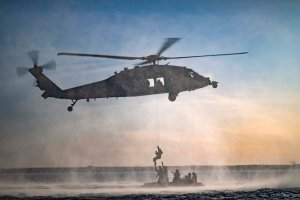
While U.S. government officials have released few specifics of how the mission unfolded, Task & Purpose has confirmed that the 160th Special Operations Aviation Regiment, known as the “Night Stalkers,” flew the special operators tasked with carrying out the raid.
Specialized agents with the FBI and Drug Enforcement Agency were also involved with the mission, Attorney General Pamela Bondi posted on social media, though the exact nature of their involvement and to what degree remains unclear, as does the question of whether the mission was principally a military operation, or, as the Trump administration has claimed, a “law-enforcement mission.”
Caine said the air component included helicopters that transported the raid force along with fixed-wing aircraft, ranging from F-22s, F-35s, F/A-18s, B-1 bombers, EA-18 electronic attack aircraft, E-2 command-and-control aircraft, and drones, possibly including the stealthy RQ-170 Sentinel.
The F-22s were likely tasked with protecting the raid force against Venezuelan aircraft, while F-35s have proven valuable at suppressing enemy air defenses, as they did during the Operation Midnight Hammer strikes against Iran in June.
Backing them up were F/A-18E/F Super Hornets, most likely from the Ford’s Carrier Air Wing 8m along with EA-18 Growlers to degrade Venezuelan radar, E-2D Advanced Hawkeyes to coordinate operations.
During the raid, U.S. forces took fire. Caine said the helicopters carrying the ground force responded with “overwhelming force.” One helicopter was damaged but stayed operational.
Maduro and his wife were both taken into custody by law enforcement agents and the force prepared to leave, Caine said at the Jan. 3 news conference.
“Helicopters were called in to exfiltrate the extraction force, while fighter aircraft and remotely piloted aircraft provided overhead coverage and suppressive fire,” Caine said. “There were multiple self-defense engagements as the force began to withdraw out of Venezuela. The force successfully exfiltrated and returned to their afloat launch bases, and the force was over the water at 3:29 a.m. Eastern Standard Time, with indicted persons on board, and both Maduro and his wife were embarked aboard the USS Iwo Jima.”
Although no U.S. troops were killed, seven service members were wounded in the mission, the Associated Press reported. They received gunshot and shrapnel wounds. Five of the troops have returned to duty while the remaining two are still being treated.
The San Antonio Express-News has reported that the wounded service members may have been transported to Brooke Army Medical Center, Texas, for treatment.
Since arriving in New York on Jan. 3, Maduro and his wife, Cilia Flores, have pleaded not guilty in federal court to charges of narco-terrorism conspiracy, cocaine importation conspiracy, and other offenses. Their next court appearance is scheduled for March 17.
This week on our YouTube channel, Task & Purpose’s video producer, Kyle Gunn, goes deeper into what we know about the Maduro raid and the questions about what might happen next.