
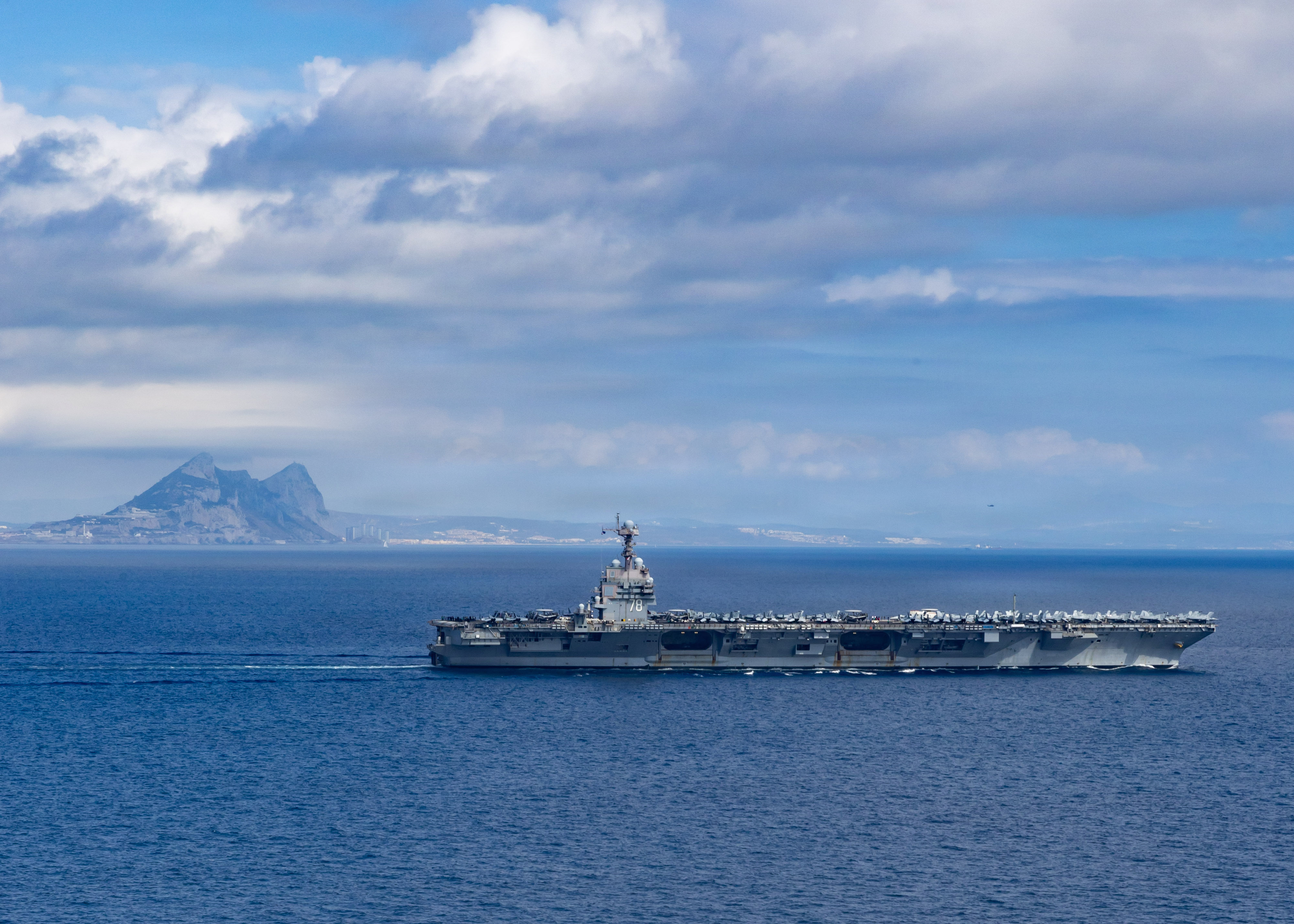
The U.S. Navy’s newest and most advanced aircraft carrier, the USS Gerald R. Ford, has left the Mediterranean and is now on its way to the Caribbean, an unusual move that expands on an already significant military buildup in the region.
Officially, the Pentagon says the deployment supports President Donald Trump’s directive to “dismantle transnational criminal organizations and counter narco-terrorism.”
The Ford’s redeployment adds a massive amount of American firepower to the U.S. Southern Command’s area of responsibility, where roughly 10,000 personnel are already forward-deployed. That force includes Air Force B-1 and B-52 bombers, Marine F-35Bs, and MQ-9 Reaper drones now operating from Puerto Rico, as well as the Iwo Jima Amphibious Ready Group with the 22nd Marine Expeditionary Unit, and several U.S. warships and an attack submarine. All of that is now being brought under one roof, or in this case, one floating city with a small air force aboard. (Yes, yes, we know it’s not the actual Air Force, spare us your angry comments.)
Top Stories This Week
Pulling even part of a carrier strike group from Europe to Latin America is rare. It underscores how flexible these formations are, and how much Washington’s attention has shifted toward the Western Hemisphere. The Ford serves as the flagship of Carrier Strike Group 12 (CSG-12), which includes Carrier Air Wing 8, four Arleigh Burke–class destroyers under Destroyer Squadron 2, and potentially an undisclosed attack submarine.
According to the Navy’s Naval Doctrine Publication 1, the purpose of a strike group is to “gain and sustain maritime superiority, project power ashore, and support joint operations.” In simpler terms, it’s the muscle behind American foreign policy.
The Ford carries a full air wing of around 70 aircraft that fall under Carrier Air Wing 8, including F/A-18 Super Hornets, EA-18G Growlers, E-2D Hawkeyes, C-2A Greyhounds, and MH-60 Seahawk helicopters. Those aircraft can conduct air strikes, electronic warfare, surveillance, search-and-rescue, logistics operations, and anti-submarine missions across thousands of square miles.
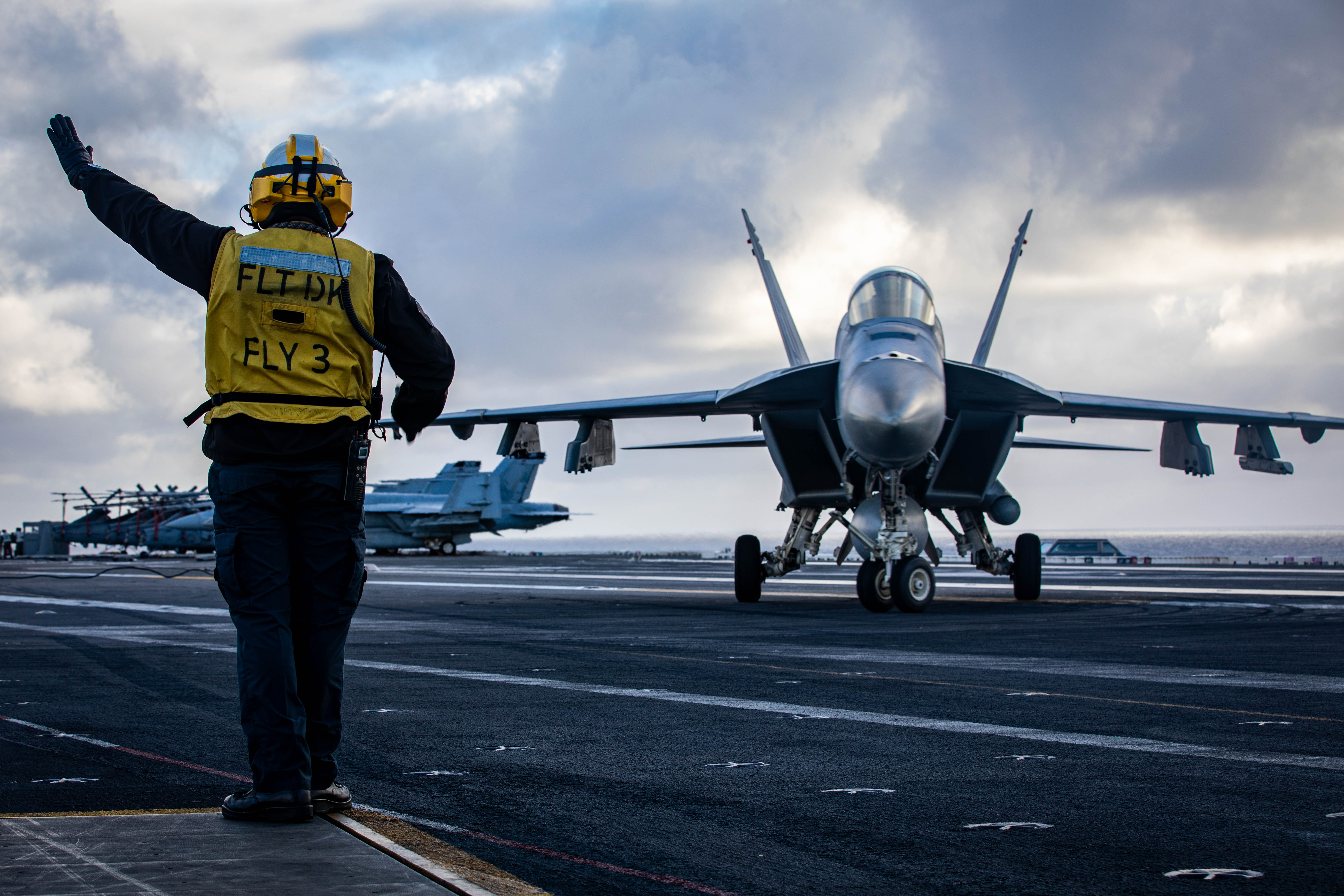
Its destroyers bring their own capabilities. Each Arleigh Burke–class ship has up to 96 vertical launch cells that can fire Tomahawk cruise missiles with ranges of more than 1,000 miles, as well as SM-2 and SM-6 interceptors for air and missile defense. The attack submarine that likely shadows the group adds another layer of stealth firepower.
A regional show of force
Since early September, U.S. forces have carried out at least seventeen strikes on suspected smuggling vessels in the Caribbean and eastern Pacific. The White House has linked many of those targets to Venezuelan-aligned networks. At the same time, U.S. bombers have conducted show-of-force missions near Venezuela’s coast, and the CIA has reportedly stepped up covert operations targeting narcotics routes tied to the Maduro regime.
The Ford’s presence gives Southern Command (SOUTHCOM) a new command node and a sustained overwatch capability. From the Caribbean, its aircraft can operate alongside assets based at Muñiz Air National Guard Base and Roosevelt Roads Naval Station in Puerto Rico or refuel from tankers staged at Guantánamo Bay, which offers a deep-water port and an eight-thousand-foot runway for heavy logistics aircraft. Together, those facilities could allow the Ford strike group to maintain a near-constant tempo without needing new basing agreements, a politically useful advantage in a region wary of foreign troop presence.
The bigger picture
Carriers like the Ford remain central to how the U.S. projects global power, even as critics question their vulnerability and cost. China is now testing its first Type 003 Fujian supercarrier and reportedly working on a nuclear-powered Type 004, which makes continued U.S. investment in the Ford class a strategic necessity as much as a political one.
For a deeper look at what a Carrier Strike Group can actually do, how its air wing works, what its destroyers bring to the fight, and how they’ve been used in the past, check out our full video on the Task & Purpose YouTube channel here.
Loading comments…
Comments couldn’t be loaded. Please refresh the page.