
In the next war, soldiers may look through a digital lens and see a landscape and a heads-up display that looks familiar to gamers: directional markers on a compass, messages from their command, and other icons and tags marking key individuals or locations in their field of vision.
EagleEye is Anduril’s new headset that the company says will give soldiers “immediate battle space in a dismounted way,” Grant Hartanov with Anduril told Task & Purpose. The idea is that troops can see everything in front of them, plus other helpful features like a navigation compass or battlefield alerts.
“We used to be able to see what our adversaries couldn’t see. Right now, there’s full parity on the battlefield. Our adversaries have night vision,” Hartanov said. “You can see beyond the line of sight now. You can know what your enemy doesn’t know through battlefield alerts, counter UAS detection, everything like that.”
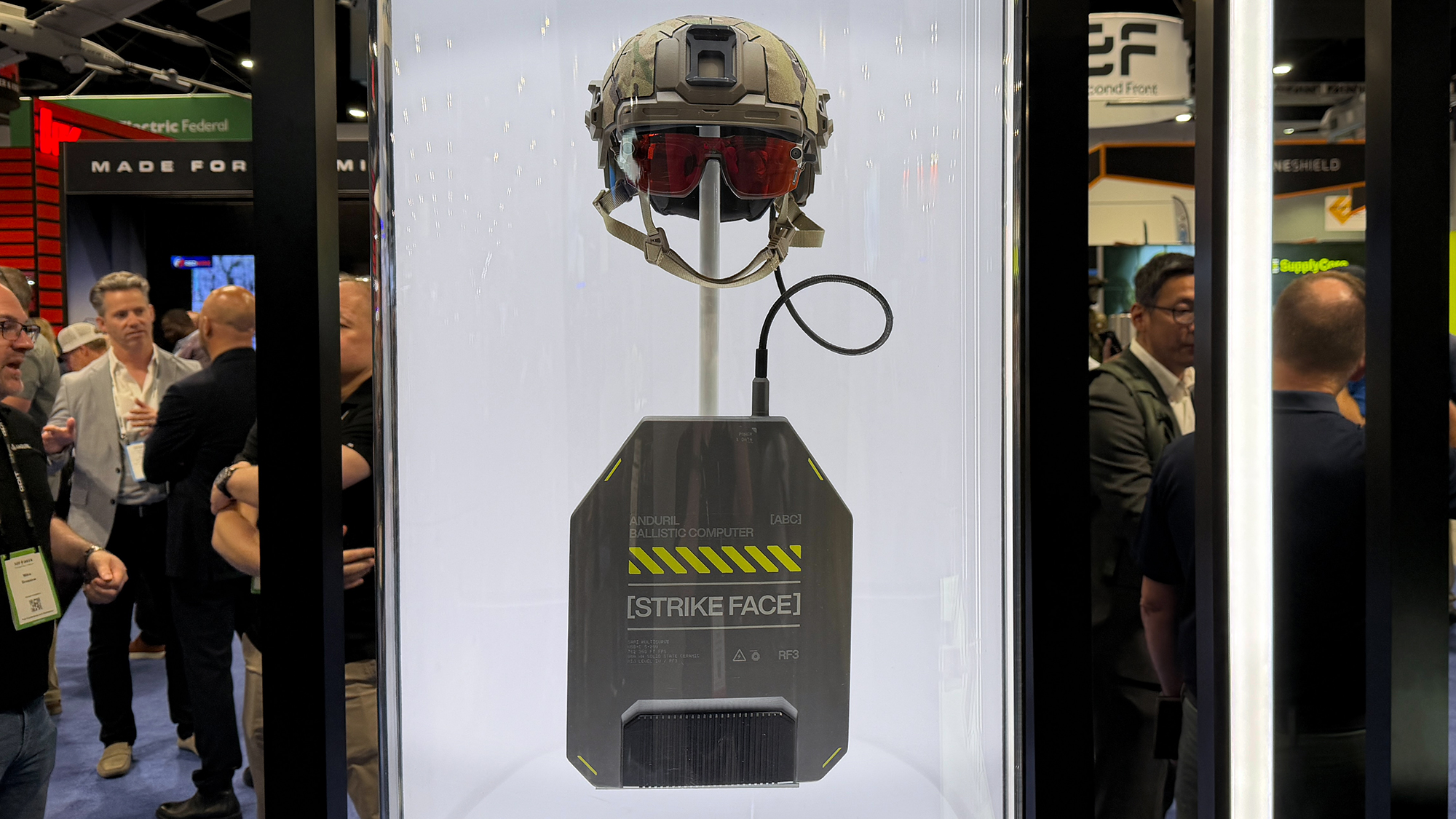
The new EagleEye was designed with features that improve upon critiques from older IVAS models, including the weight distribution on soldiers’ heads. Instead, the company puts the headset battery into a ballistic chest plate.
“Traditionally, placing the battery in the helmet is putting more burden on the operator. By putting it in the plate, that’s where the body naturally carries the weight more conveniently,” Hartanov said. “The real focus there is driving that ergonomic benefit of taking weight off the head and putting it where the body naturally carries it.”
The video below, which was recorded at SOF Week in Tampa, Florida, offers a view looking through Anduril’s EagleEye system. The helmet pictured in the clip is of a different helmet sporting a pair of “cat ear” acoustic sensors on top, while the helmet on display at the expo had a different design.
The headset has daytime and nighttime vision settings and shows users a wider, 90-degree field of view, which Hartanov described as an “expanded perception.” The larger field of view is akin to a video game display where players can see farther than the left and right limits of the human eye.
The headset also intends to give soldiers the ability to make decisions without taking their eyes off what’s in front of them. The system uses something called “lattice,” which brings in data from different sources and sensors, Hartanov said. That data is synchronized through the lattice system and is shown through the headset display.
“If there’s a need to hit a kill switch, you have a full kill switch,” he said. “You’re not looking at a tactile, you’re not looking down at your chest. You’re alert, aware on the battlefield, your hands are on your rifle, your head is up. But you’re still being able to have that full situational awareness without being distracted on the battlefield.”
Top Stories This Week
Separately, Anduril is working on the Army’s Soldier Borne Command System, the replacement for the Integrated Visual Augmentation System, also known as IVAS. Hartanov said the company intends to push EagleEye out to special operators first, with the hopes that it could be used by conventional forces.
“We eventually hope the U.S. Army adopts EagleEye, but we’re very committed on delivering on the work right now through Soldier Borne Mission Command,” he said.
Loading comments…
Comments couldn’t be loaded. Please refresh the page.