
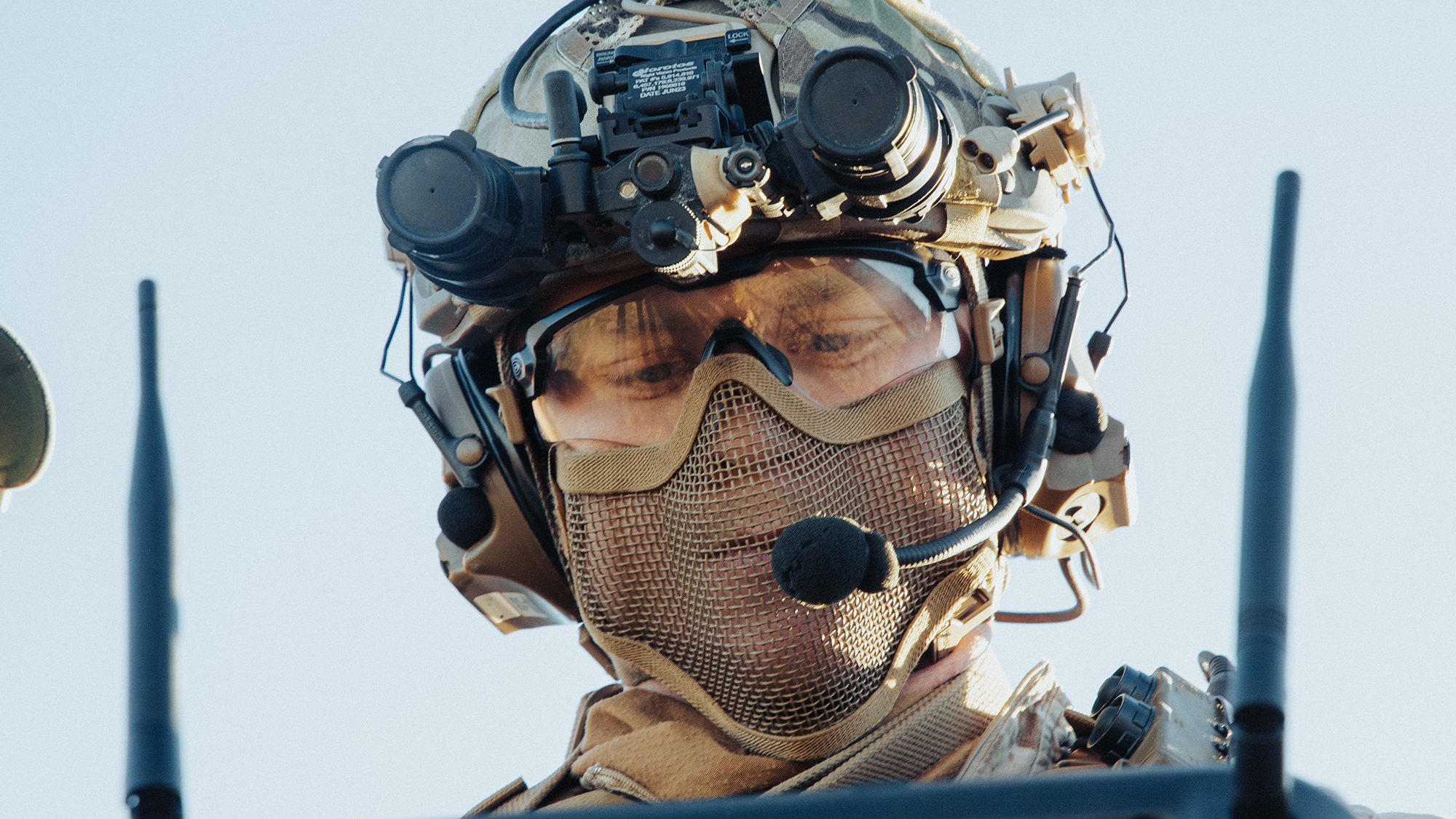
After a suggestion that AI might be the “holy grail” of future special operations, the general in charge of the U.S. military’s most elite combat forces had another pre-modern metaphor for the technology.
“This extends all the way back from the first stone thrown from the first sling,” Navy Adm. Frank M. Bradley, the commander of U.S. Special Operations Command, told an audience at SOF Week Tuesday in Tampa, Florida. “That the person who threw that stone from that sling had to have confidence that stone was going to go where it was going to go and hit the target that he intended it to hit.”
Bradley’s comments came at the end of a wide-ranging panel discussion. He was asked about the current and future use of AI to find targets for his troops, a development the moderator referred to as a “holy grail.”
“There will always be a human in the loop of that delivery of violence,” said Bradley. “The human that decides to use lethal violence has to have the trust and confidence that that lethal violence will be delivered within the confines of that contract, established internationally, as a law of armed conflict.”
Bradley’s comments reflect a tension around the ethics and limits of advanced computer systems that comb through data for targets, technology for which the term “AI” is often a widely used shorthand. Drones used on battlefields in Ukraine are now rumored to autonomously track human faces, and Defense Secretary Pete Hegseth has feuded publicly with Anthropic, a major developer of AI surveillance systems, over safeguards around the technology.
Top Stories This Week
But the tension is not new. As far back as 1979, IBM employee manuals reflected Bradley’s concerns over human control, telling engineers, “a computer can never be held accountable, therefore a computer must never make a management decision.”
In 2020, the Joint Special Operations Task Force-Afghanistan deployed an AI-prediction system known as Raven Sentry that used satellite images, news reports, social media and other open-source data to predict insurgent attacks in the final months of that war (the innovation office behind the system was referred to as “the nerd locker,” according to an Army War College paper on the project).
Earlier this month, The Los Angeles Times reported on Israeli AI-powered targeting systems that tracked a 62-year-old man in Lebanon who had once been a Hezbollah fighter but was now in an “administrative role” rebuilding a village. A final drone strike, overseen by human operators, killed the man outside his family home, the paper said.
Bradley said Tuesday that Special Operations Command tests its AI tools before they are deployed to ensure they meet the command’s requirements. And he insisted that the command does not put computers in the position of ordering or executing lethal actions.
“There’s no doubt that [AI is] changing and impacting and making us more efficient in many ways, but we have to also have a bit of a reality check,” Bradley said. “We, as humans, have that confidence that the delivery mechanism is going to behave as we intended it to behave. It’s going to deliver violence only to where we intended it to be delivered.”
Loading comments…
Comments couldn’t be loaded. Please refresh the page.