
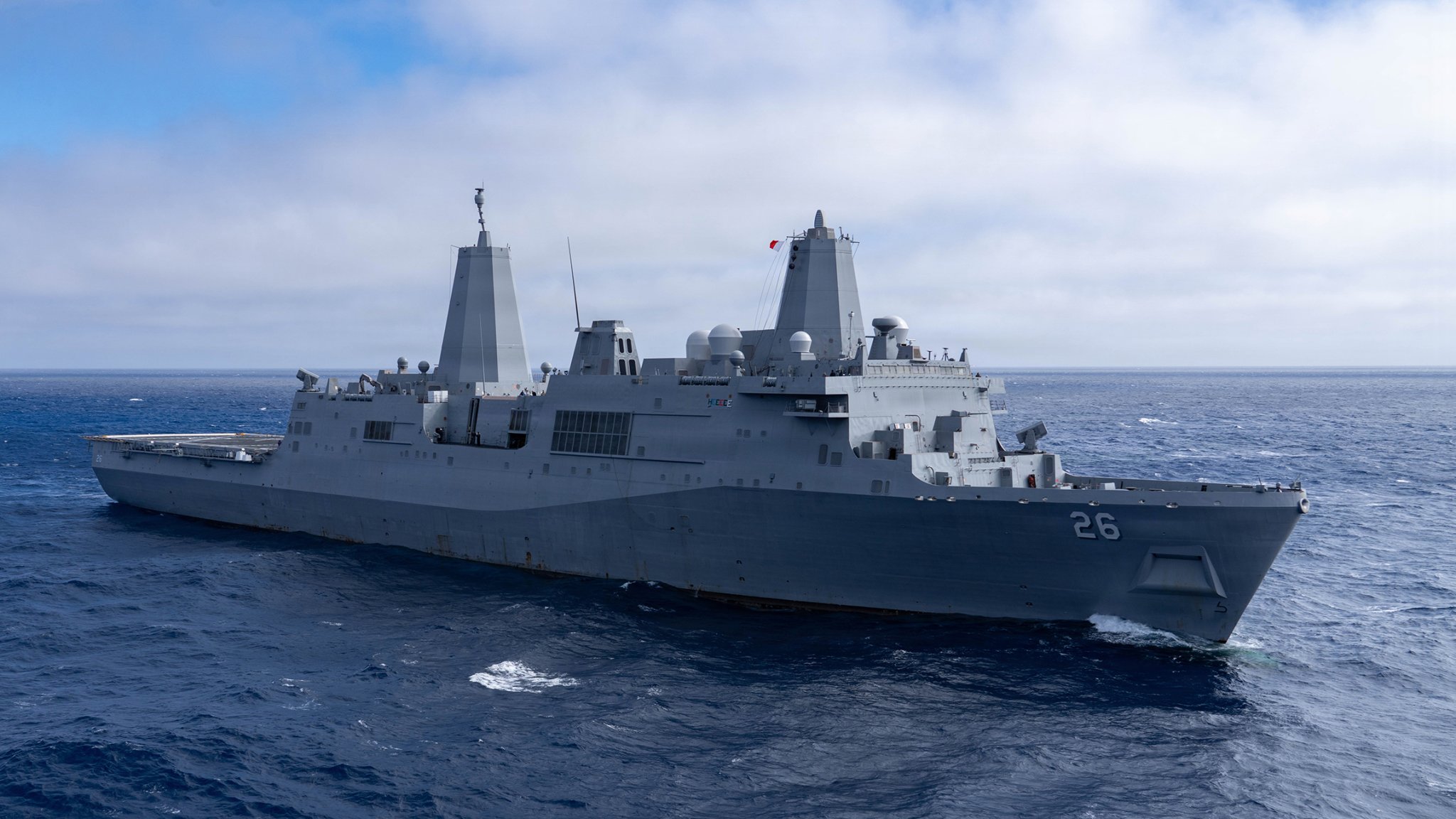
The Marines will probably need at least eight more amphibious warfare ships to meet their goal of roughly 40 in order to keep three Marine Expeditionary Units deployed at the same time.
An ongoing analysis has not yet determined exactly how many such ships the Marines need, but the number is “probably going to be around 40,” said Marine Lt. Gen. Jay Bargeron, deputy commandant for plans, policies, and operations. “It could be a little more.”
Bargeron discussed the ship needs on Wednesday at the Modern Day Marine exhibition in Washington, D.C.
Marine Expeditionary Units, or MEUs, are typically embarked on Amphibious Ready Groups, which consist of three ships: Big deck amphibious assault ships, which carry Marines and vertical-take off aircraft like the MV-22 Osprey, helicopters and F-35 fighters; amphibious transport dock ships, such as the USS John P. Murtha, which recently recovered the Artemis II astronauts; and dock landing ships.
The Navy currently has a total of 32 amphibious warfare ships, and it is required by law to maintain at least 31 of those ships. Fewer than half are generally deployment-ready at any time.
Top Stories This Week
“The Navy and the Marine Corps are aligned on this: 31 is not the right number,” Bargeron said. “It’s a floor, as was described.”
Bargeron spoke during a panel discussion on Marine Corps Commandant Gen. Eric Smith’s priority of having three MEUs deployed simultaneously, which the Corps refers to as a “3.0” presence.
“Three continuous, consistent, and simultaneously deployed [Amphibious Ready Groups and Marine Expeditionary Units] provide lethal response options, creates dilemmas for our adversaries, forward-postures forces to deny adversaries decision space and supports campaigning alongside our allies and partners,” Smith wrote in a May 2025 statement to Congress.
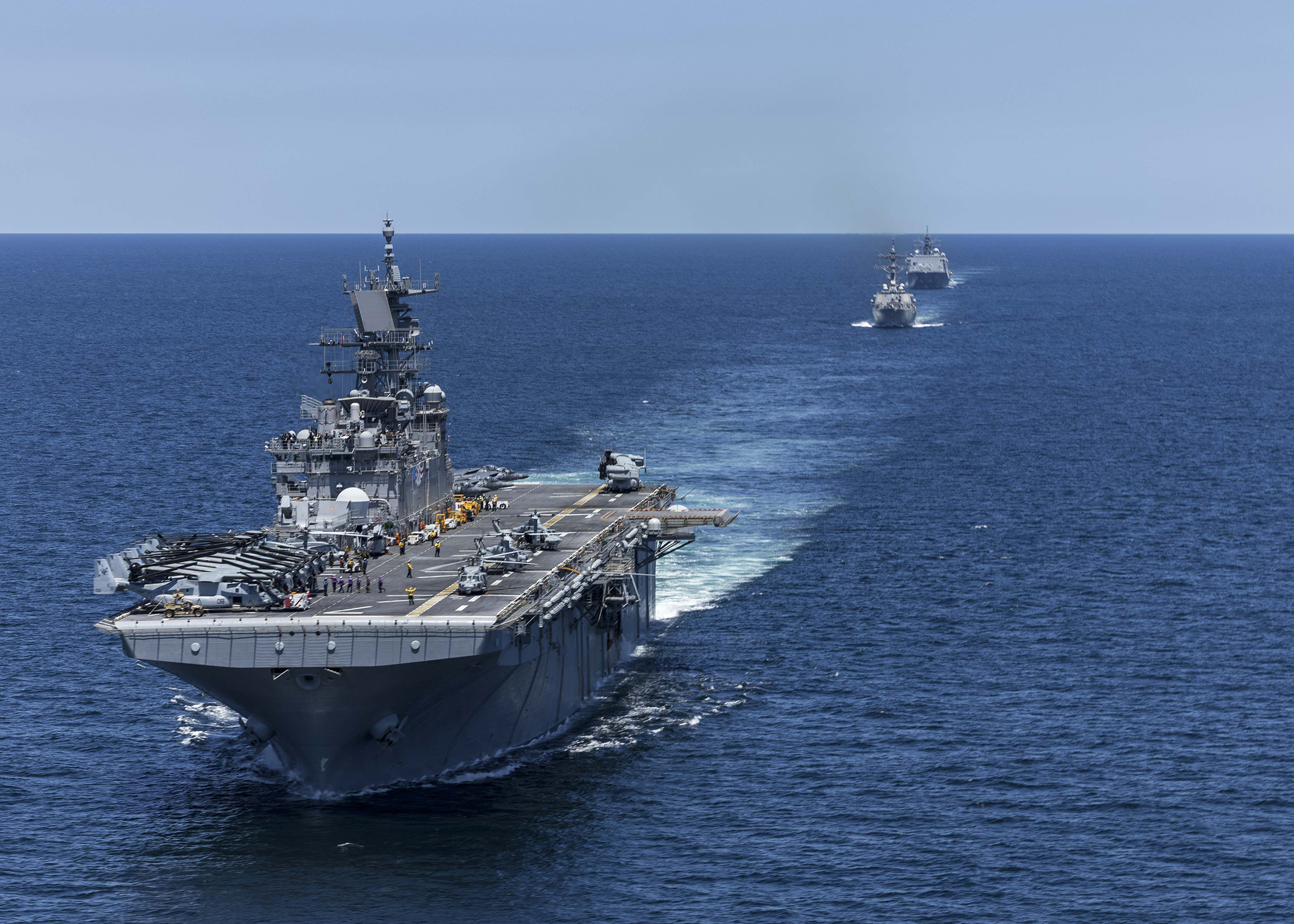
But that effort has been hampered by amphibious warfare ships’ relatively low readiness levels.
At an April 15 House Armed Services Committee hearing, Navy Adm. James Kilby, vice chief of naval operations, testified that only about 45% of amphibious ships are “combat surge ready,” or available to deploy soon for their mission in a crisis, compared with 63% of surface ships and 65% of submarines.
The amphibious warfare ships’ low readiness rates can make it difficult for the Marines to respond to crises. In February 2022, the 22nd Marine Expeditionary Unit was unable to deploy from Camp Lejeune, North Carolina, to the European theater ahead of Russia’s invasion of Ukraine due to maintenance problems with its ships.
On Wednesday, Bargeron said that even if the Marine Corps already had three MEUs deployed, recent military demands have been even higher.
“There is a [combatant command] demand signal that is in excess of 3.0,” Bargeron said. “If you look at the raw data that comes into the Global Force Management process, it’s been somewhere around six [in the] last few years.”
Other military leaders taking part in Wednesday’s panel discussion echoed Bargeron’s comments about the need for more amphibious warfare ships.
“We’re aligned,” said Navy Vice Adm. John Skillman, deputy chief of naval operations for integration of capabilities and resources. “It’s more than 31. We actually don’t know the numbers yet.”
Loading comments…
Comments couldn’t be loaded. Please refresh the page.