
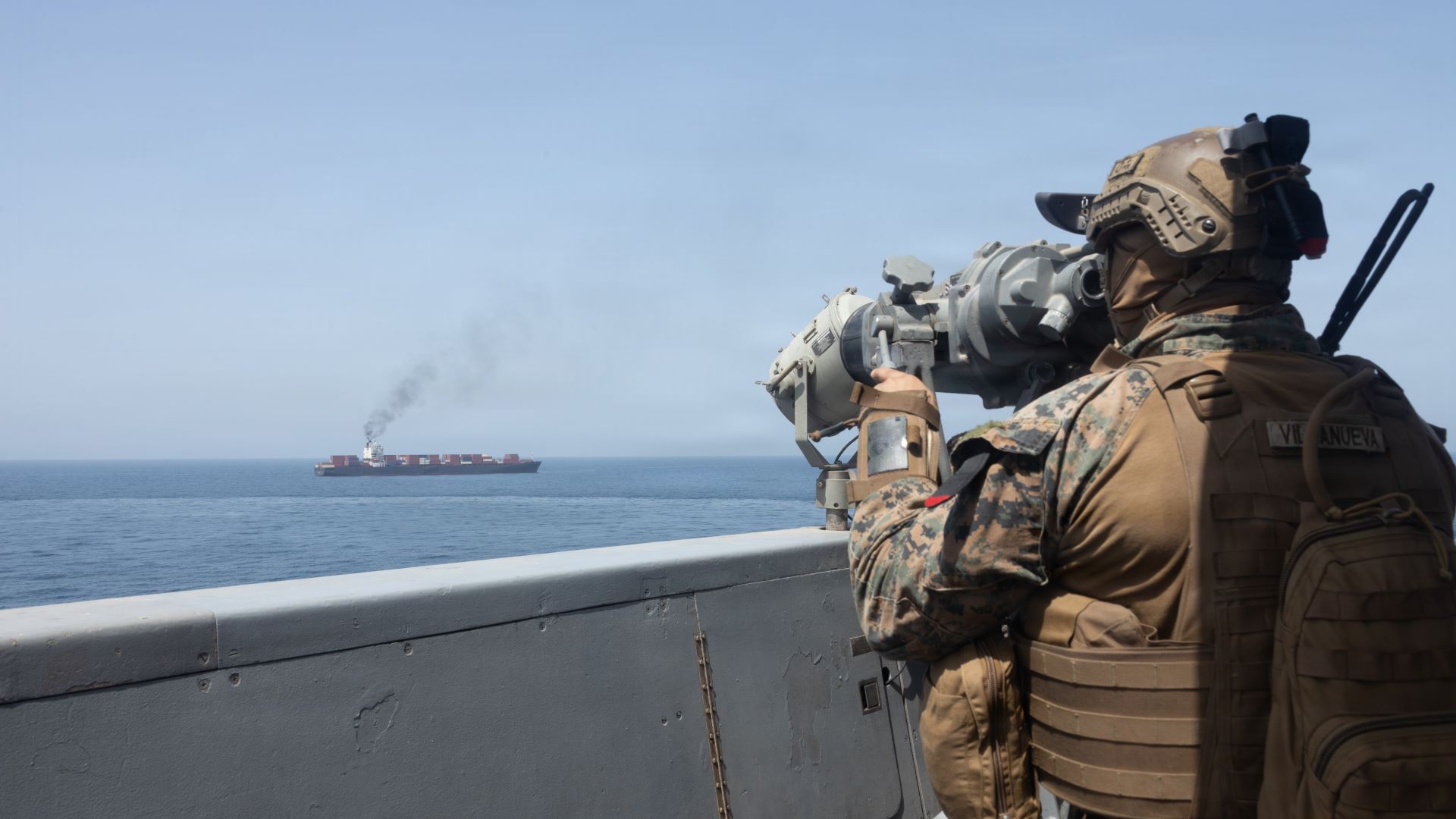
American forces will start guiding merchant ships out of the Strait of Hormuz on Monday, as President Donald Trump said the U.S. will “help free up” vessels trapped between dueling American and Iranian blockades around the strategic waterway.
Trump announced in a Sunday afternoon social media post, saying that “Project Freedom” would start on Monday morning “Middle Eastern time.” Trump said that the United States will “guide” the trapped ships out of the strait. Soon after, U.S. Central Command confirmed it would be supporting the project, with a force that includes more than 100 aircraft, several guided-missile destroyers and 15,000 troops.
Trump’s announcement was vague on what the effort would look like in practice. CENTCOM’s statement did not specify what specific actions U.S. forces would take, instead saying that the “defensive mission” would involve coordinating the transit of the merchant vessels through the strait “to restore freedom of navigation for commercial shipping.” CENTCOM chief Adm. Brad Cooper said in the release that the U.S. will still “maintain the naval blockade.”
Top Stories This Week
The effort marks a major shift in the actions around the important waterway — a major point of transit for oil and important chemicals — after both Iran and the United States enacted blockades around the strait in the wake of the U.S. and Israeli war with Iran that started on Feb. 28. A temporary ceasefire has been in effect since April 7. Diplomatic efforts to end the war have been ongoing over the weekend, with the two countries discussing an Iranian peace proposal.
After Trump’s announcement, Ebrahim Azizi, the head of the Iranian Parliament’s National Security Committee, said in a social media post that American involvement in managing traffic in the strait would violate the three-week-long ceasefire.
Iran began blocking maritime traffic through the Strait of Hormuz in March. The United States enacted a blockade of Iranian ports — redirecting ships heading to or from those destinations from passing through the strait — on April 13. That came two days after two Navy destroyers crossed the strait to prepare for a mine-clearance operation. As of May 3, the U.S. has redirected 49 commercial ships as part of the blockade, CENTCOM said in a social media post on Sunday, prior to the announcement of the new project. U.S. forces have also boarded and seized ships since enacting the blockade, including one instance on April 19 when the destroyer the USS Spruance fired on and disabled an Iranian-flagged ship after it refused to comply with the Navy.
There have continued to be minor incidents around the waterway, with a number of ships reporting having been fired on, although not severely damaged. The United Kingdom Maritime Trade Operations, a British agency that monitors sea trade, reported that a cargo ship had been attacked on Sunday on the northern side of the strait. A second ship, a tanker, was hit off of the coast of the United Arab Emirates in the early hours of Monday, the UKMTO said.
Two aircraft carriers — the USS Abraham Lincoln and USS George H.W. Bush — are operating in the Arabian Sea, alongside more than a dozen guided-missile destroyers. Additionally, the Tripoli Amphibious Ready Group, led by the amphibious assault ship USS Tripoli, is also in the area. That is carrying elements of the 31st Marine Expeditionary Unit including aircraft.
Loading comments…
Comments couldn’t be loaded. Please refresh the page.