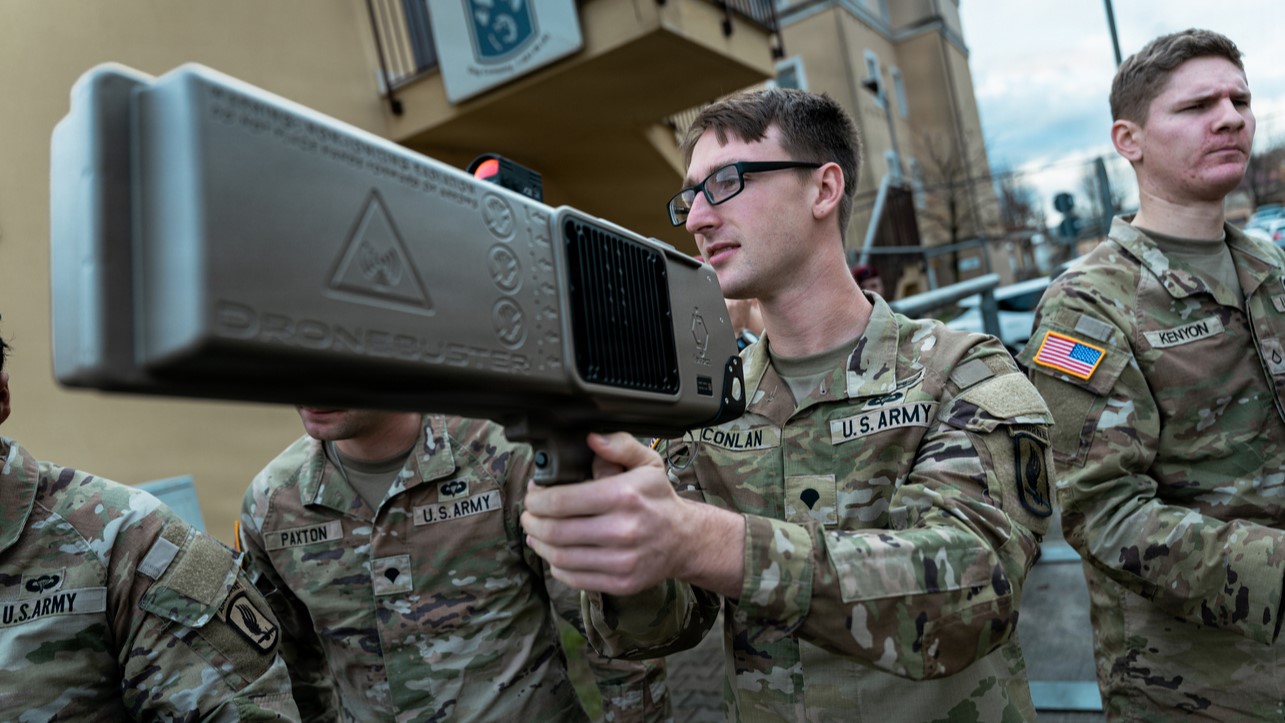
Base commanders are getting more power to directly respond to threats from drones flying over military installations, the Pentagon announced this week.
Joint Inter-Agency Task Force 401, the military body set up this past summer to coordinate various defenses and tactics against aerial drones, released its new “Guide for Physical Protection of Critical Infrastructure.” The updated policies were approved by Defense Secretary Pete Hegseth in earlier December, but the guide was only announced and released late this month. Several of the measures in it are meant to streamline how the military identifies and addresses a drone threat, and as such it gives base commanders “expanded authority and flexibility needed to dominate the airspace above their installations.”
The new policy was signed off on in December, but the announcement comes a few days after a Department of Defense Inspector General’s report found that the military was failing to meet requirements for counter-drone operations at bases. Investigators visited 10 department sites that had seen aerial drone incursions and found that several installations were not designated “covered assets” (a designation typically used for special operations facilities, nuclear sites and other explosive facilities), leaving them unable or limited in their ability to respond to drones. Additionally the report found confusion from leaders over what was and was not designated covered, plus a lack of a clear policy on drone defense guidances stemming from a lack of standardization across military branches
Under JIATF-401’s new guidance, commanders are not limited just to the perimeter or “fence line.” They now have a larger area to defend, but more space in which to make decisions, the task force said. The task force’s director, Brig. Gen. Matt Ross, described unauthorized drone flights as “a surveillance threat even before they breach an installation perimeter.” As such, base commanders also can make threat determinations on a holistic level based on the “totality of circumstances,” the department said.
Top Stories This Week
“Today, individuals outside a facility, with no intent to gain access, can surveil or threaten facilities and events from significant stand-off distances. Security is no longer defined solely by who gets in, but by how effectively threats from outside the facility are mitigated,” the release notes.
The guide focuses on several aspects for defending installations, including what constitutes the most high-risk areas (such as critical power infrastructure and areas with a high concentration of people). It also suggests “hardening” these spots, with options including layered perimeters, screening outer zones and patrols. with physical barriers such as nets or roofs, as well as reducing visibility from the outside in.
Ross also told reporters this week that the task force wants to put “low-collateral kinetic interceptors” at every Department of Defense installation inside the United States. Those include “kinetic energy” weapons as well as net guns, Defense Scoop reported.
Drones flying near bases has been a growing issue in the United States and abroad. Over the last two years, sightings of drones near bases and other military facilities rose, leaving some officials stumped. Policy at the time dictated that they could not be shot down unless they posed a “direct threat.” Late last year there were multiple sightings of drone swarms near European military bases, including a French nuclear submarine station.