
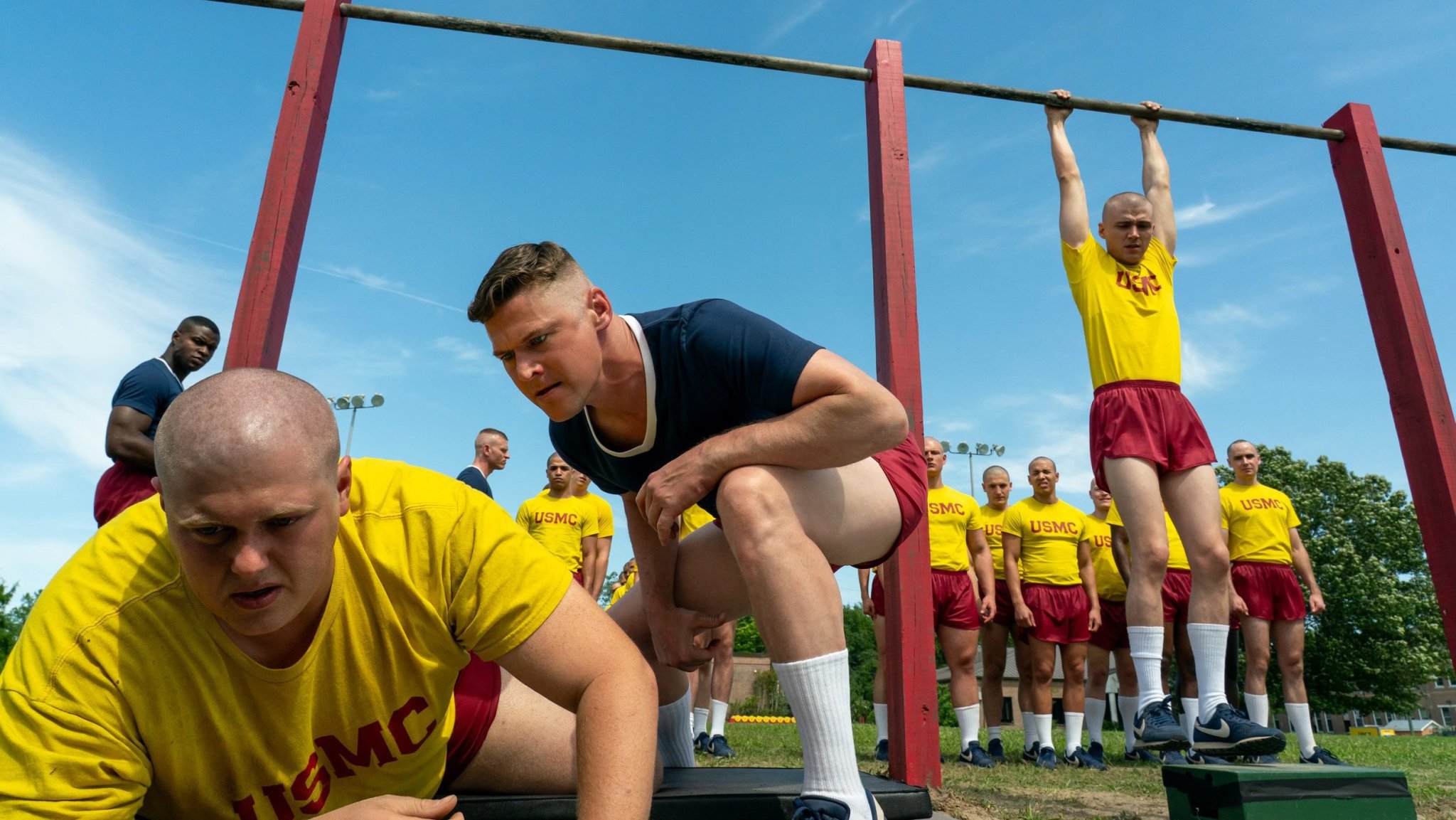
A new Netflix show tells the coming-of-age story of a young man who joins the Marine Corps looking for a shot at a new future, but goes in hiding a secret that if it gets out, would see him brought up on charges: He’s gay.
“My life needs a change, sir. I want to be somebody else,” Cameron Cope tells the recruiter.
“Son, boot camp is the machine that turns boys into men. In 13 weeks you won’t even recognize yourself. Are you sure you’re ready for that?” the recruiter responds.
“Boots” follows Recruit Cope (played by Miles Heizer) through the trials and tribulations of Marine Corps boot camp in 1990, four years before the implementation of “Don’t Ask, Don’t Tell,” a policy that allowed gay, lesbian, and bisexual troops to serve without disclosing their sexuality, which would result in a discharge. For Cope, he’s serving at a time when the services questioned troops about their sexual orientation, which prevented them from serving, or could have them discharged if it was discovered that they were lying.
Beyond its specific moment in time, and the political and cultural subtexts illustrated in “Boots” highlights details that Marines young and old can relate to: The yellow footprints, shaved heads, forced burpees and push ups, bay tossing, “The rifle is my best friend” motto, harsh nicknames handed down by drill instructors, and of course, the Crucible.
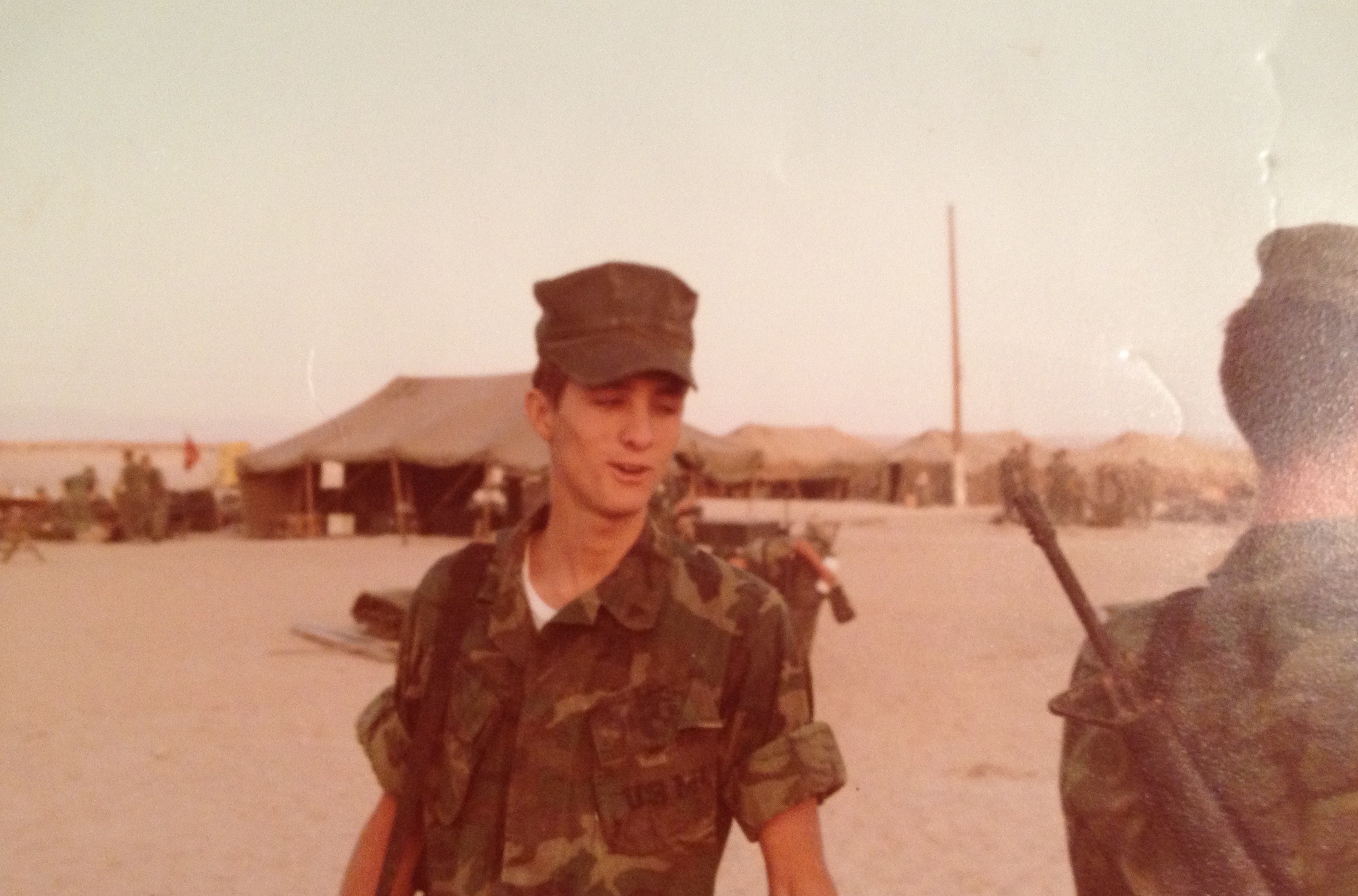
The series is based on the real-life story of Greg Cope White, who chronicled it in his book “The Pink Marine.” White published the book in 2016, and the adaptation “Boots” premiered earlier this month. The show changes some names — White is now Cameron Cope — and updates the setting to the 1990s — White served from 1979 to 1985, getting out of the Marines as a sergeant — but it draws from White’s real memories and experiences.
White spoke with Task & Purpose about his book, the show, and his experience as a young gay man walking into a new world that didn’t exactly welcome him with open arms.
“The hostile running around and yelling made it difficult to think anything except what have I done? That remained the foremost question in my mind for the next thirteen weeks. What had I done?” White wrote in “The Pink Marine.”
White arrived at Marine Corps Recruit Depot Parris Island, South Carolina, in 1979, when being gay was punishable under the Uniformed Code of Military Justice as a criminal offense for sodomy; consensual sodomy was repealed as a UCMJ offense in 2013.
“I was watching lives destroyed with a stroke of a pen, and it didn’t make any sense to me,” White said. “We’re in an all-volunteer military. We ask people, young men and women from all across the country and all walks of life, to be willing to sacrifice their life in order to protect our Constitution. Anybody willing to do that and wanting to do that should be absolutely embraced and celebrated.”
Enlisting in the Marine Corps as a gay man at that time was simply “exhausting,” White said. It began with having to lie when the recruiter asked him point-blank if he was gay and then keeping up with heterosexual norms — like performing the most subtle mind tricks to change pronouns when he told stories of his previous “conquests” and dreams for the future.
Top Stories This Week
“I had just as much desire as the next guy, but this is the last place I was going to act on any of that, because I was here to do a job,” he said. “I have to get back to the constant fear of this being taken away from me. Nobody had ever given me a chance — society was telling me that I was wrong and that my basic human nature had no place in society, and here I was finding it.”
White arrived at boot camp 15 years before “Don’t Ask, Don’t Tell” became law. When the topic was included in President Bill Clinton’s campaign platform, White thought it was a step forward on a longer road.
“While it wasn’t good, I thought, okay, we’re talking about it at least, and there’s something on paper,” he said. “When you go from absolutely illegal to just keep it quiet — at least we’re being seen and not criminalized instantly and prejudiced against. They’re acknowledging that we’re there.”
In the television series, Cope, like White in real life, enlisted in the Marine Corps under the buddy program, which was designed to have best friends join and train together. Ray on Netflix, and Dale in the real world, is a straight man who had gotten an appointment to the Air Force Academy, but his declining vision from the stress of school interrupted his dreams of becoming a pilot, so he decided to enlist in the Marines.
As shown in the series, White routinely worried about what would happen during boot camp if his secret came out, and whether someone “would beat me to a pulp,” and if it would jeopardize his best friend’s career.
“If anybody cares, we’re still best friends to this day, even closer than ever,” White said. “He lives here in L.A. We talk or text every day. He was with me on set a ton.”

While it’s now legal to be ‘out’ in the military, White said the themes that the series touches on are still just as applicable today, like joining the military to leave an old life behind.
“We’re showing a group of boys that are all fighting for the common cause and they’re from every walk of life,” he said. “Both in the book and show, we show characters that are hiding something, not just their sexuality.”
The show also comes amid new policies under President Donald Trump’s administration that are having an effect on the LGBTQ community. Some changes have had more direct impacts, such as the decision to separate all transgender service members, while others have been more symbolic, like the renaming of the USNS Harvey Milk, originally named after the gay civil rights activist.
“I want people to understand that these are people from all walks of life, that the only thing they have in common is the fight for our Constitution. That’s it,” White said.” I know people are passionate and inflamed on both sides, but when you get down to it, if you’re willing to step up and defend our Constitution, hell yes, stand beside me.”
When asked about the series, the Pentagon Press Secretary Kingsley Wilson told Entertainment Weekly that it did not support Netflix’s “ideological agenda” and that “the weight of a rucksack or a human being doesn’t care if you’re a man, a woman, gay, or straight.”
White finished boot camp in 1979 during an era of relative calm for the U.S. military, but in the show, Cope enlisted in 1990. Just as the newly minted Marines celebrate their graduation at a bar, Cope looks up at a TV screen to see then-President George H. W. Bush announcing that troops are going to Saudi Arabia — indicating that he and his friends would be part of the nearly 45,000 Marines sent to the Persian Gulf for Operation Desert Storm. With an unnerving look on his face, Cope remarks: “Just like summer camp.”
In real life, White enlisted and became a field wireman. He attended Officer Candidates School at Marine Corps Base Quantico, Virginia, while a student at the University of Texas at Dallas, but decided not to take his commission. His plan had been to go to law school and serve as a Marine Corps lawyer, but the toll of living a double life in the service increasingly weighed on him.
“I thought, I just can’t. I love these people so much. I can’t lie to them anymore, to their face, and I respected them too much,” White said. “It wasn’t fair for either party. So sobering and sad as it was, that was what kept me from reenlisting.”
Loading comments…
Comments couldn’t be loaded. Please refresh the page.