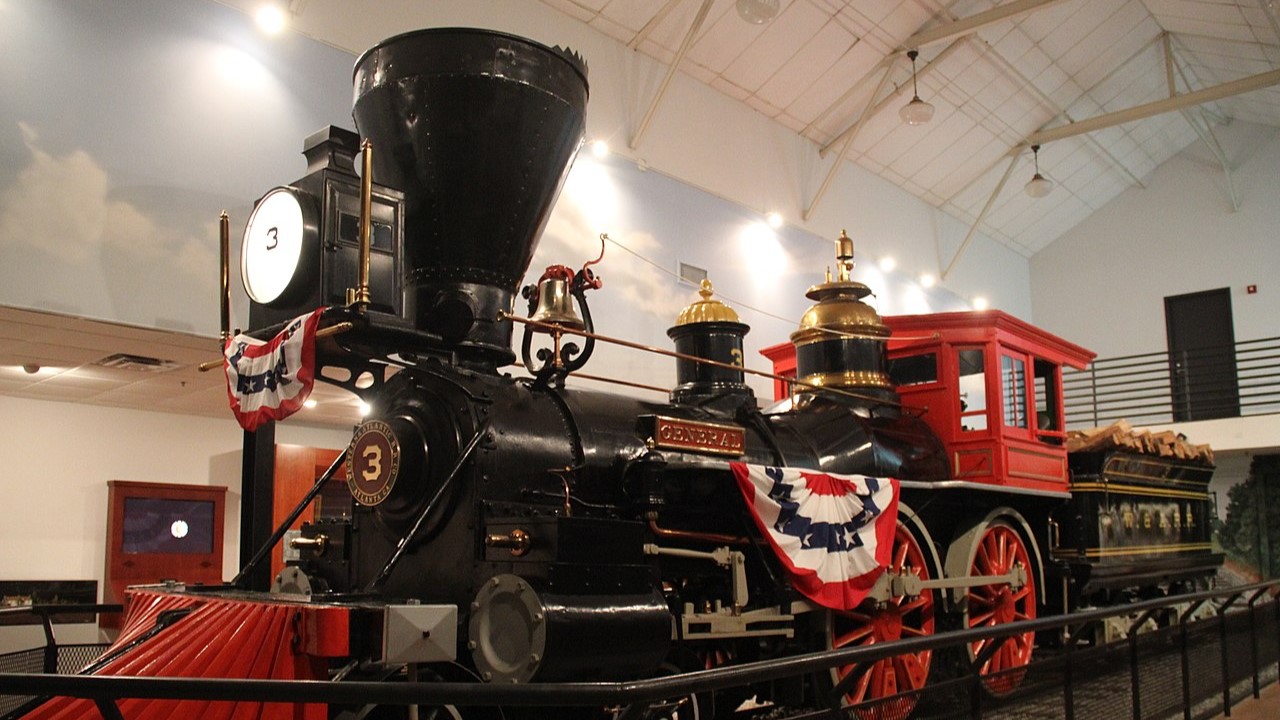
At the height of the Civil War, a smuggler-turned-Union spy came up with a daring plan. Leading a team of two dozen Union soldiers from Ohio, James Andrews would sneak behind enemy lines, steal a Confederate train, and use it to destroy some of the South’s limited railroads, hurting the ability to resupply Chattanooga as the Union army prepared to advance on the city.
It partially worked. Andrews’ raiders stole a train known as “the General” and used it to tear up tracks and damage telegraph wires inside through Georgia and Tennessee as they rode toward Chattanooga. The bold, wild plot eventually came to be known as the “Great Locomotive Chase,” and resulted in the first Medals of Honor being awarded to 19 of the 24 raiders. Two more were given the award in 2024.
Now more than a dozen living Medal of Honor recipients and the Congressional Medal of Honor Society will recreate the Great Locomotive Chase, joining with CSX railroad to stage a re-enactment of the chase. The event, held along with the Coolidge National Medal of Honor Heritage Center in Chattanooga, will bring together historians, reenactors and recipients on a train ride retracing the path of Andrews’ Raiders.
The event, organizers say, will be the first-ever immersive recreation of the historic heist.
The organizers have spent more than a year and a half trying to figure out how to recreate a train chase bent on sabotage, according to Vince Butler, the director of the 2025 Medal of Honor Celebration being held in Chattanooga. The chase, which later inspired Buster Keaton’s film ‘The General’ and a 1956 Disney film, involved multiple trains, two dozen Union operatives, Confederate troops and one very dedicated train conductor.
It’s such a wild case of military espionage and sabotage, Butler said, that the event is being done in part to share how complex and risky it was.
“It’s a story we all know down here, Civil War historians know it, but a lot of Medal of Honor recipients might not know all of the details of it, or how crazy it was,” Butler said.
The Raiders and the General
And it was wild. Union raids along Confederate supply lines weren’t uncommon, and by this time in the war, naval blockades choked off Confederate ports. But Andrews’ plan called for a lot of things to go right. He and his men — one civilian and 22 soldiers from Ohio — moved into the South, posing as Confederate civilians. Andrews had experience on his side — an earlier attempt at stealing a Confederate train had backfired spectacularly when no one was available to actually operate the train. The raiders moved toward the town of Big Shanty, Georgia (now Kennesaw). The plan was to steal a train while the crew was getting food.
They found the General. That part of the plan was going well. Unfortunately for Andrews and his men, Big Shanty was full of Confederate troops. They would have to get the train moving quickly to get away and cut telegraph wires to avoid alerts down the line.
On the morning of April 12, 1862, Andrews and his team stormed aboard the General and got moving, unhooking empty passenger cars.
They soon found themselves being chased. Not by a garrison or a cavalry unit, but by the General’s conductor, William Fuller. Fuller, possibly the most dedicated train crewman of the American Civil War, was chasing them on foot. He soon switched to a handcar, following the General as it moved along the track.
The crew began its sabotage, tearing up the track and stopping to disable telegraph wires. But every time they stopped, Fuller got closer.
Fuller soon ditched his handcart for his own stolen train. Fuller, in fact, commandeered three separate trains, including the Texas, driving it in reverse in pursuit of Andrews’ raiders.
Eventually, the General came to a stop at Ringgold Depot, only 18 miles from Chattanooga. The Union troops were eventually all captured. Eight of the raiders, including Andrews, were executed by the Confederacy. Eight more broke out and escaped to Union lines. The remaining crew were eventually exchanged in March 1863.
That month, the first ever Medals of Honor would be awarded. Eventually, almost all of Andrews’ raiders would receive the military’s highest honor. Andrews and the other civilian on the crew, William Hunter Campbell, were ineligible and two other soldiers wouldn’t receive the award for decades. Pvt. Philip G. Shadrach and Pvt. George D. Wilson, who were executed, were finally awarded the Medal of Honor in 2024 by President Joe Biden.
Top Stories This Week
Same route, different trains
This month, service members and Medal of Honor recipients will retrace that same route. The exact list of recipients involved is still being determined due to travel logistics, but according to organizers will include veterans and service members from the Navy, Army and Marine Corps, with a range of service from the Vietnam War to the Global War on Terror. The Western and Atlantic Railroad that the General took is still active, mainly for freight trains, and the reenactment will follow it. Because it remains an active commercial route, they cannot use a vintage train.
The chase will start at the Atlanta History Center on Sept. 30, where the Texas train is kept. They’ll then go to the Southern Museum of Civil War & Locomotive History in Kennesaw, where the General is on display. In Kennesaw, they’ll board a train with eight historic reenactors playing Andrews’ raiders, who will act as tour guides as the train moves north.
The train will make stops along the route, simulating the sabotage mission.
Unfortunately, Butler said, the event will only feature one train. No one will be taking the place of Fuller, nor will any handcar or pursuing trains be involved. However, Fuller’s pursuit will be highlighted, Butler said, as will some of the actions of the raiders, specifically Jacob Parrott, the first-ever recipient of the Medal of Honor. After being captured following the chase, he was imprisoned and severely beaten by Confederate captors. He would eventually be exchanged and awarded the Medal of Honor on March 25, 1863.