
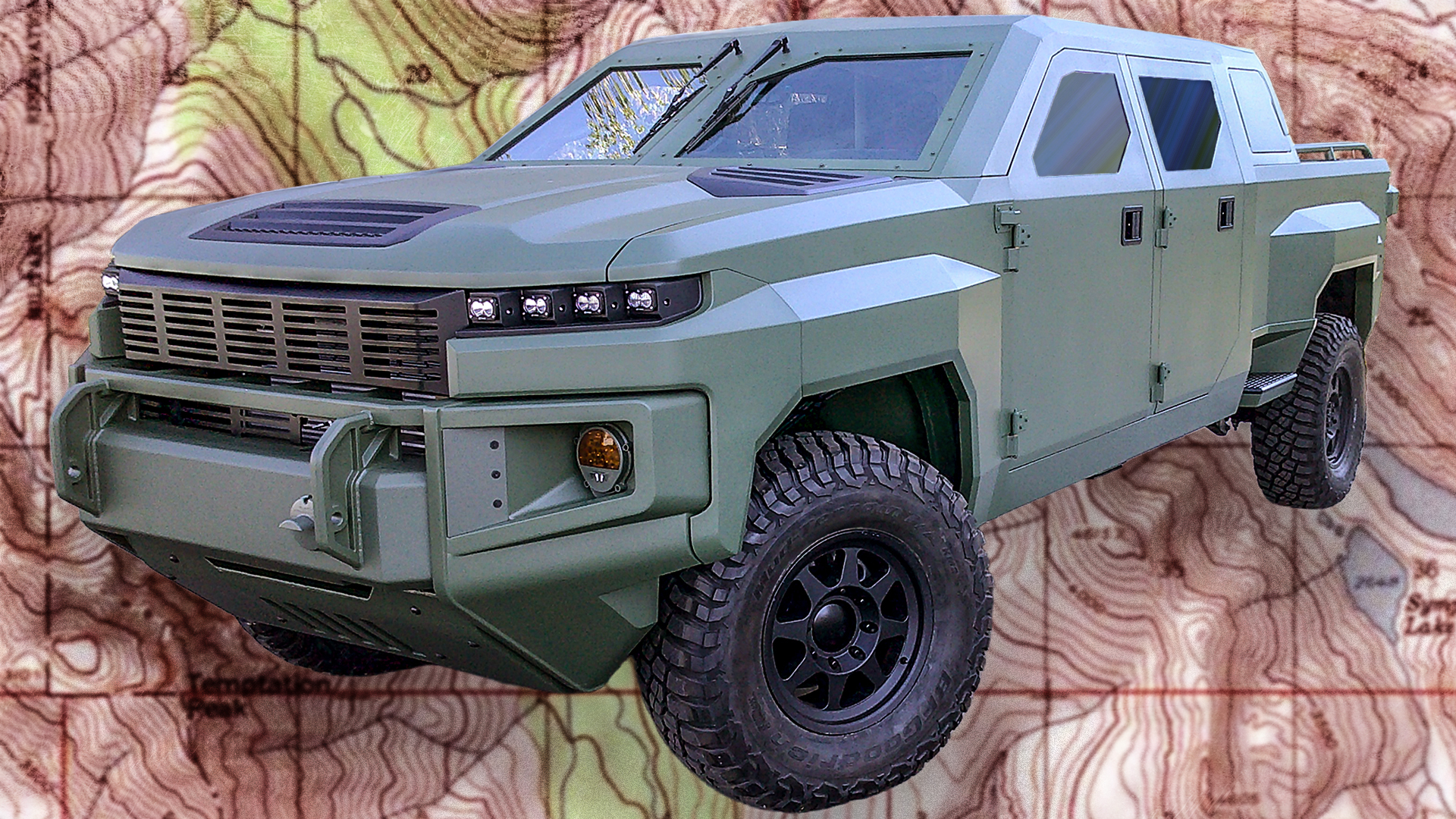
As the Army retools many of its top-tier infantry units around the buggy-like Infantry Squad Vehicle, or ISV, it’s already looking for a new, beefier version of the truck, dubbed the ISV-Heavy.
Despite the “Heavy” name, that variant won’t be inherently more rugged or armored than its open-sided predecessor. Instead, the trucks will carry a suite of batteries and generators to produce power for electricity-hungry drones, communications equipment, and even a “Directed Energy Weapon Systems,” according to Army contracting requirements released in late March.
An Army official said last week that the ISV-Heavy is designed to fit a “niche requirement” to act as a roving power station for modern, electricity-hungry infantry units. Jesse D. Tolleson Jr., the principal deputy assistant secretary of the Army for acquisition, logistics and technology, said during a Senate subcommittee budget hearing last week that the ISV-Heavy is “really going to be focused on the power generation part. One of the things that we do have a critical capability gap on right now is power generation at that mobile brigade combat team level,”
Like the standard ISV, the Heavy version won’t be an assault vehicle, according to Army contracting documents released in April. Instead, it will be closer to a rugged Tesla car charging station on wheels. The contracting requirements, which have not been finalized, called for the vehicle to carry electric systems that can generate 60 kilowatts of continuous high-voltage DC power, roughly akin to the power output of a commercial electric vehicle charger like one a car dealer or Walmart might install in a parking lot.
In addition, the truck will generate enough power to run roughly 100 laptops or 10 full-size refrigerators.
The Army also wants the Heavy to have a “Sustained Silent Operations” mode, in which its internal systems will “minimize the acoustic, thermal, and electromagnetic emissions of the system,” running on a 60-kilowatt-hour battery rather than its main engine.
Getting to a fight, not into one
The mobile brigade combat team, or MBCT, is the structure the Army is adapting across its infantry formations, with the light and fast, but largely unarmored, ISV at the center of those units. The Army has already put about 1,000 ISVs in the field with top infantry units. The 25th Infantry, 82nd Airborne, and 101st Airborne Divisions, as well as the 75th Ranger Regiment, have close to 200 each, according to numbers released by the Army last November.
The Army even commissioned three tech companies last year to deliver autonomous ISVs after 101st troops used an early prototype during a Joint Readiness Training Center rotation.
The standard trucks got a very public real-world test in 2025 with the 101st — albeit not in combat. Instead, more than 100 of the vehicles were deployed into suddenly roadless regions in North Carolina and Tennessee after Hurricane Helene.
Top Stories This Week
This month, three of the first National Guard units to convert to ISVs, in Pennsylvania, Idaho, and Indiana, began initial training with the trucks. The Pennsylvania Guard’s Mobile Brigade Combat Team 56th and Indiana’s 76th Mobile Brigade Combat Team both were formerly Stryker units, while Idaho’s 116th Cavalry Combat Team was previously an armor unit with Abrams tanks and Bradley Fighting Vehicles.
First developed in 2019, the ISV was given a scathing report card in 2021 in an Army report that called the doorless, lightly armored truck “not operationally effective for employment in combat and [engagement, security cooperation and deterrence] missions against a near-peer threat.”
But by 2023, the Army had redefined the ISV’s role away from frontline contact, insisting its job was not to drive into a fight or directly assault an objective.
Instead, the truck — which is built on the frame of a Chevrolet Colorado pick-up — is designed to get soldiers to an objective faster than marching or piling into heavy, slow armored vehicles like Strykers or Joint Light Tactical Vehicles (JLTVs).
Army leaders have said that quicker-moving infantry units mirror the tactics found to be most effective in Ukraine, as small units rush to and from firefights, surviving with speed on a battlefield contested by drones, artillery and air strikes.
The Army also found in 2023 that General Motors had made strides in improving its reliability.
Loading comments…
Comments couldn’t be loaded. Please refresh the page.