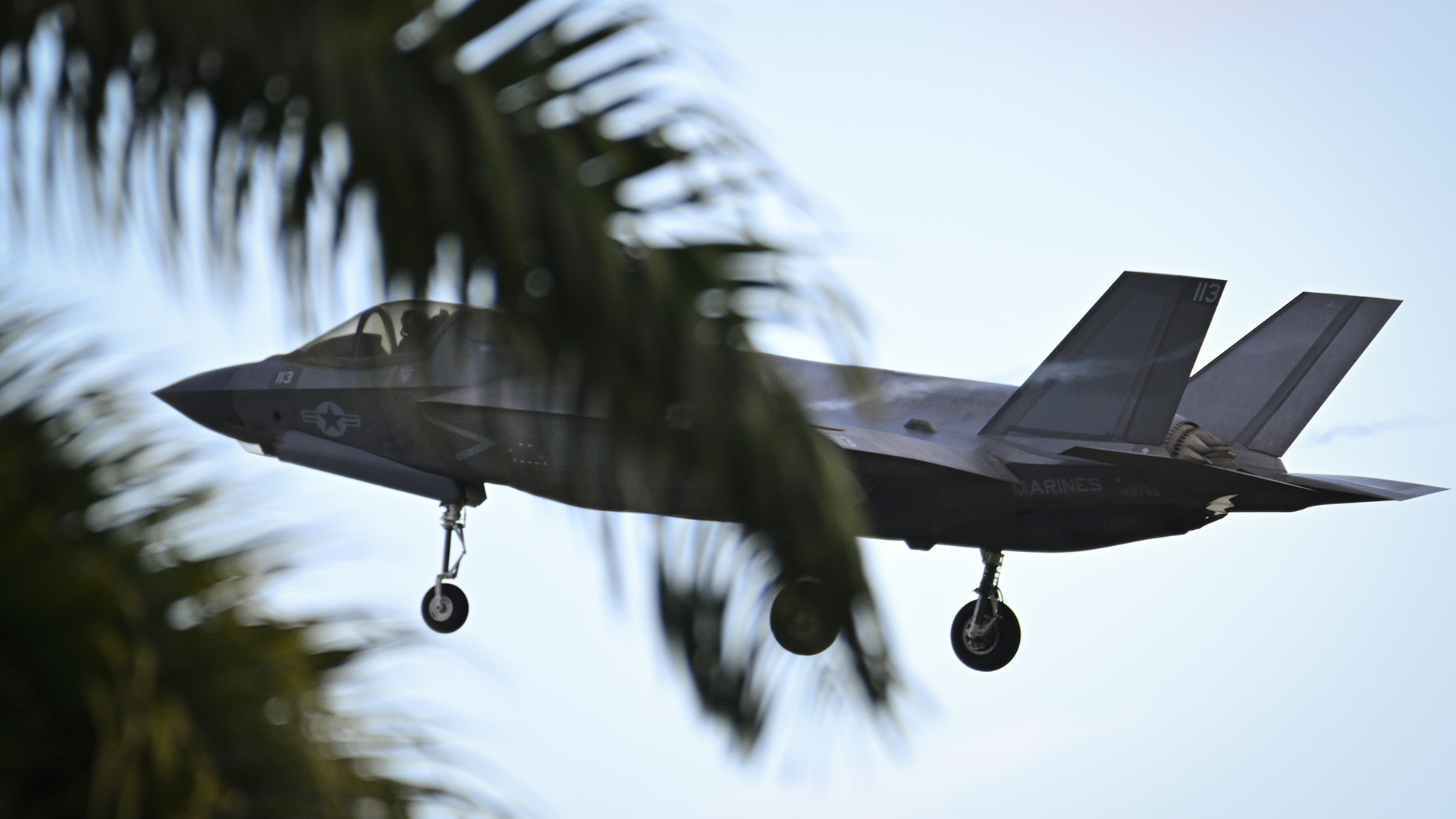
The F-35 Lightning II is the U.S. military’s most advanced fighter aircraft. Designed to defeat state-of-the-art air defense systems and destroy high-value targets, it would play a key role in a war with China.
But right now, the F-35 is being used against a new target — drug cartels — and it has some experts wondering: why?
On Thursday, F-35s from Marine Fighter Attack Squadron 225 arrived in Puerto Rico, the Pentagon announced on X.
The deployment is part of a major U.S. military effort in the Caribbean to stop drug smuggling that includes about 1,900 sailors with the Iwo Jima Amphibious Ready Group — which consists of assault ship USS Iwo Jima, the amphibious transport docks USS San Antonio and USS Fort Lauderdale — and another 2,200 Marines with the 22nd Marine Expeditionary Unit, who are embarked on the three ships.
So far, U.S. forces have destroyed two boats in the Caribbean that it claimed were being used by “narco-terrorists,” killing 14 people. Defense Secretary Pete Hegseth has described drug cartels as “no different than al-Qaida.”
The deployment of F-35s to Puerto raises the question of why the U.S. military would use such sophisticated aircraft against drug cartels, which have relatively low-technology defenses when compared with potential adversaries such as China and Russia.
Top Stories This Week
“The Department has a suite of capabilities to defend our homeland against threats such as narco-terrorists seeking to harm American citizens,” a Pentagon official told Task & Purpose on Friday. “Secretary Hegseth directs forces and capabilities as required to meet national security objectives as directed by the president.”
But military aircraft expert Richard Aboulafia said it is unclear why the U.S. military is using F-35s for counter-narcotics missions because “they are an expensive form of overkill.”
“The F-35 is most useful when there are sophisticated enemy ground-based air defenses and aircraft to evade,” said Aboulafia, managing director of AeroDynamic Advisory, a consulting firm for the aerospace industry. “Otherwise, these capabilities are merely expensive.”
It’s possible that the U.S. military is using the deployment of F-35s to the Caribbean as an opportunity for testing and training in realistic conditions, or perhaps the Marine F-35s were the most easily deployable aircraft available, Aboulafia told Task & Purpose.
So far, American F-35s have flown combat missions against the Islamic State group, or ISIS, and Houthi rebels in Yemen, but the U.S. military has yet to use them against their intended adversaries.
F-35s are classified as “fifth generation” fighters — a term that describes the most technologically advanced planes in the world that are stealthy and feature a suite of sensors that allow pilots to detect threats and strike targets in ways that surpass all other aircraft’s capabilities.
One former official said there is “absolutely no reason” for F-35s to be deployed as part of the U.S. military’s mission against drug cartels, adding, “It’s a gross application of an exquisite technology.”
F-35 fighters are designed to fly in a “high-intensity battlespace” by absorbing and transmitting vast amounts of data for split-second targeting, a former defense official told Task & Purpose. They are also built to cloak their signatures and go toe-to-toe against other fifth-generation fighters, missiles, and drones.
“None of those factors apply in the Caribbean,” said the former defense official. “It would be a lot more effective in Europe, or the Middle East, or against China. Any one of those areas is a far more reasonable application of the weapon than where it’s being used now.”