
Insiders with access to U.S. military war plans may be placing many more bets on real-world operations than previously understood, a team of researchers said Thursday.
Researchers studying betting patterns on the Polymarket prediction site found that nearly 52% of “longshot” bets placed on recent U.S. military actions were correct and paid off handsomely to unknown bettors. Similar bets on “political” topics have about a 14% success rate on the site, the team said. That success rate, researchers say, suggests that insiders were behind at least some of the bets.
Overall, bettors on the site have bet nearly $2 billion on military actions during the Iran War.
“Our analysis suggests that certain categories of political prediction markets, especially those tied to military activity, display signs of asymmetric information and potential insider trading,” according to researchers with the Anti-Corruption Data Collective.
The group released a detailed report, published Thursday, that looked at “low-probability outcomes” or “longshot” bets placed on Polymarket back to 2021. The website allows anonymous users to bet on major world events, from pop culture to economic conditions, as well as on details of U.S. military action.
The report comes just a week after a Special Forces soldier was charged with using classified information to place bets on the special operations raid and arrest of Venezuelan President Nicolás Maduro in January. Master Sgt. Gannon Ken Van Dyke, prosecutors say, placed about $34,000 in bets on the timing of U.S. operations in Venezuela through Polymarket and a second similar betting service. Van Dyke, federal prosecutors alleged, was involved in the planning and execution of the raid and was aboard one of the Navy vessels at the center of it.
Van Dyke pleaded not guilty this week.
The bet Van Dyke is accused of placing paid $409,000 — exactly the kind of “longshot” that ACDC researchers tracked.
Military ‘longshot’ bets pay off four times more often
Michelle Kendler-Kretsch, who authored the report, cautioned that many current political events are, well, unusual, since wars and military operations are less frequent than most political events tracked by bettors, like elections and new laws. “Statistically, low-probability events are just happening,” she said. But the successful betting in the military and defense markets is notable.
“Even though going from peace to war is unusual, we would probably overestimate that and overprice that,” she said. “We’re still outperforming that — it’s quite an anomaly in multiple directions.”
While the report does not explicitly examine bets around the Maduro raid, Kendler-Kretsch said it’s reflected in the report’s 2026 Q1 data and is “one drop in the larger set of suspicious transactions from our data set.”
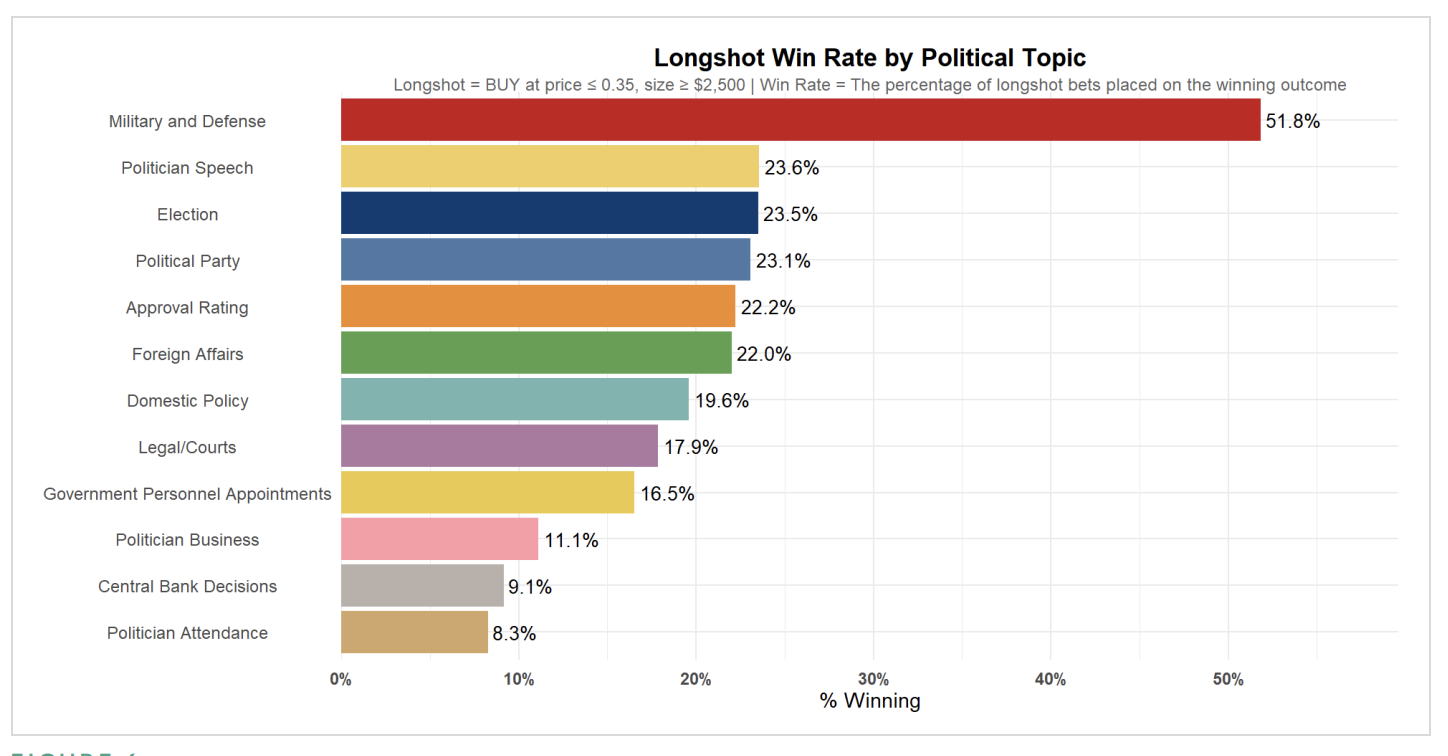
The group said they tracked about $8 billion in bets on political topics that are “determined by the decisions of an individual or small group of individuals in a military, executive branch or central bank,” which account for 10% of all trading on Polymarket.
About $1.9 billion has been bet on military operations since 2021, the majority since the beginning of the Iran War.
The report found that the timing of trades was also suspicious, with longshot winning bets often placed “immediately” before a deadline.
Task & Purpose asked the Department of Defense if the military was conducting a separate investigation into insider trading. Officials referred to the Department of Justice.
Small bets can reveal big secrets
According to the indictment of Van Dyke, the special operations soldier used several common tactics to stay anonymous as he placed his bets. He allegedly created a Polymarket account on Dec. 26 using a private network that appeared to be based outside of the U.S. Then, between Dec. 27 and Jan. 2, Van Dyke placed bets related to Maduro and Venezuela, including a big bet that U.S. forces would enter Venezuela by the end of January.
Bets on Polymarket are published openly under pseudonyms. But many sophisticated bettors, in search of profit rather than military secrets, are watching closely for signs of insider information.
“High frequency traders can identify this possible insider activity and take advantage of it to increase their profits,” according to the report. Kendler-Kretsch said there’s been an “explosion of tools,” some subscription-based, others posted by creators on GitHub, which use AI and direct users to likely profitable bets.
These large-scale bettors could have spotted a single account similar to the one Van Dyke is accused of opening and mirrored his wagers with larger bets. That pile-on of bets, the report said, could create an easily spotted spike of activity around Van Dyke’s bet.
“One insider becomes 50 insider-knowledge-advantaged players,” Kendler-Kretsch said. “That [DOJ] indictment is sort of saying, ‘Okay, finding the one initial person is really important, and we’re going to prosecute them.’ But it’s going to become more and more challenging to actually figure out who is the initial starting point.”
According to the collective’s report, the risks of insider trading on risky political bets are “systematic rather than isolated,” which is why they recommend limiting or outright banning certain markets, Kendler-Kretsch said.
“To the average user, forget the insiders for a second, you are disadvantaged by this market because it’s allowing this sort of behavior in all of this,” Kendler-Kretsch said. “That’s just one takeaway that we’ve also been focused on. For every winner that we’ve been talking about in here, there’s a loser.”

Loading comments…
Comments couldn’t be loaded. Please refresh the page.