
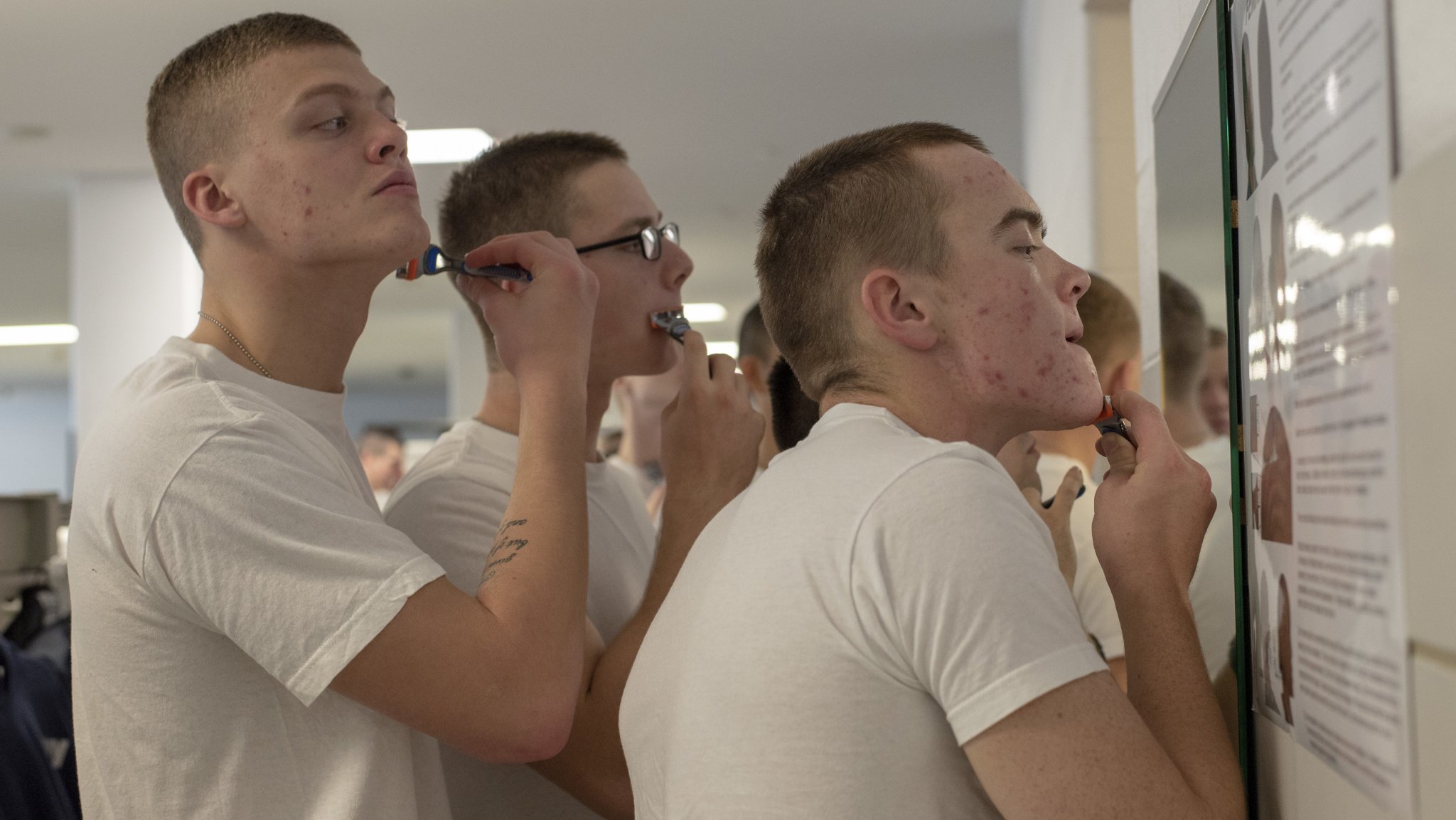
Sailors whose medical conditions make daily shaving painful, or even leave scars, now face being separated if they cannot be clean-shaven after a year of treatment, Navy officials have announced.
The policy update was released in a recent Navy Administrative Message, or NAVADMIN. The changes do not apply to religious waivers to grooming standards for facial hair. The changes implement last year’s direction from Defense Secretary Pete Hegseth that military commanders begin separating troops who require medical waivers from shaving rules.
The new order Navy directs commanders to treat “willful non-compliance” of the Navy’s uniform regulations “as a military justice matter,” the message says.
Hegseth has targeted shaving waivers since his first days in the Defense Department, ordering only temporary waivers for medical conditions such as pseudofolliculitis barbae, or PFB, a painful skin condition common among Black men that is made worse by shaving.
“Today at my direction, the era of unprofessional appearance is over,” Hegseth told hundreds of generals and admirals on Sept. 30. “No more beardos. The age of rampant and ridiculous shaving profiles is done.”
Top Stories This Week
The updated Navy policy makes clear that only commanding officers can authorize medical waivers for shaving as part of a treatment plan. Medical waivers for conditions such as PFB will be evaluated in 90-day increments and cannot be extended beyond one year, according to the Navy message.
“Commands shall process personnel determined to have an unmanageable Permanent Condition for administrative separation due to failure to comply with grooming standards after 12 consecutive months of medical treatment,” the message says,
Such administrative separations will begin one year after the release of the July 7 Navy message.
“This time is necessary to provide commands, medical care providers, and leaders ample time to update and distribute local policies, procedures, training aids, educational materials, and conduct counseling to all affected Sailors,” the message says.
The changes are meant to make sure that sailors’ facial hair does not risk their safety, mission readiness, or hamper their ability to use protective breathing equipment, the Navy message says. Navy leaders have long cautioned that beards can prevent sailors’ gas and oxygen masks from sealing properly.
Those claims have been dubbed “unsubstantiated” by dermatologists with military experience.
As part of the Navy’s policy, commanders will conduct reviews every three months of sailors with medical waivers for shaving who use breathing protection as part of their jobs, training, or the environment in which they are working.
The policy also allows special operations units to request “modified standards” to the Navy’s uniform regulations based on mission requirements. Service members in those units often grow beards when working in countries where beards fall under cultural norms.
But special operators are required to be clean-shaven under the new policy if they are deployed to areas where they face a high risk of a chemical, biological, radiological, and nuclear attack, the message says.
Loading comments…
Comments couldn’t be loaded. Please refresh the page.