
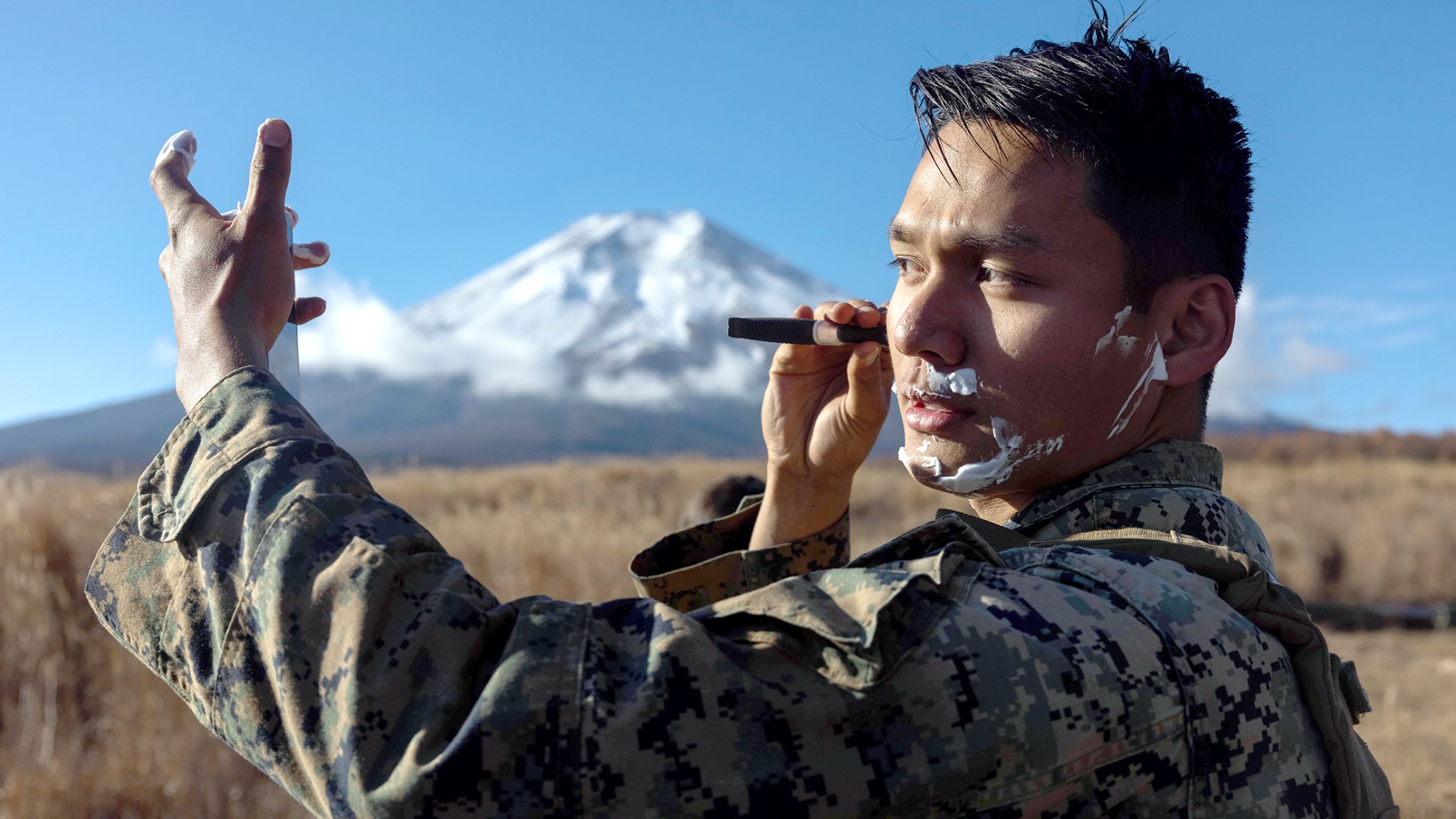
Marines now have 12 months to be clean-shaven, even if they are receiving medical treatment for a skin condition, according to a new policy released Friday.
Those who can’t shave cleanly within a year face separation from the service, regardless of on-the-job performance.
The new no-exceptions shaving rules were released Friday under a Marine Administrative Message, or MARADMIN. The policy, titled “Uniform and Grooming Standard for Medical Conditions,” lays out specific rules for Marines currently on shaving waivers, including those being treated for Pseudofolliculitis Barbae, or PFB, a skin condition that occurs in more than half of all Black men, as well as many Asian men.
Under the new rules, Marines who suffer from PFB and who have requested exemptions from shaving requirements have 12 months to get medical treatment for the skin condition, during which they’ll be reviewed twice by commanders on the progress they’re making, once at the halfway point and again at the end, if the process lasts the full year.
“Marines requiring a uniform or grooming exception due to a medical condition for more than 12 months will be evaluated for administrative separation,” the notice says.
The treatments, which can include laser hair removal, are covered by the military.
After 12 months, the rule says, commanders will “consider initiating separation proceedings if the Marine’s medical condition has not improved, is not classified as a disability, and adversely affects good order and discipline.”
The policy does not indicate if a commander can or should consider a Marine’s job performance or other merit-related criteria in that decision.
Top Stories This Week
The Marine Corps’ new policy follows August and September directives from Defense Secretary Pete Hegseth that required services to limit shaving waivers and treatment to 12 months. Hegseth has repeatedly pushed for a clean-shaven military, implementing restrictions and requirements for shaving waivers tied to medical issues as well as religious beliefs.
Laser treatments can leave permanent scars
Pseudofolliculitis Barbae, or PFB, affects up to 60% of Black men, according to the American Osteopathic College of Dermatology. Commonly referred to as “razor bumps,” PFB causes facial hair to grow back into the skin after shaving. The condition causes irritation, inflammation, and, in some cases, scarring.
The group has long recommended that primary treatment of the condition is to allow facial hair to grow suitably long for the hairs to extend away from the skin, and medical studies of the condition note that shaving is known to make the condition worse. Other treatments, like topical medicines and laser removal, researchers say, vary in effectiveness and come with serious side effects.
Marines seeking to address PFB undergo four phases of treatment, with laser treatment the final one if prior methods fail.
“Side effects from lasers include pain, erythema, and scab and scar formation,” according to one 2019 study on PFB treatment published in the National Library of Medicine.
Separations already submitted, the memo said, will not be enforced before Oct. 1, 2026.
Loading comments…
Comments couldn’t be loaded. Please refresh the page.