
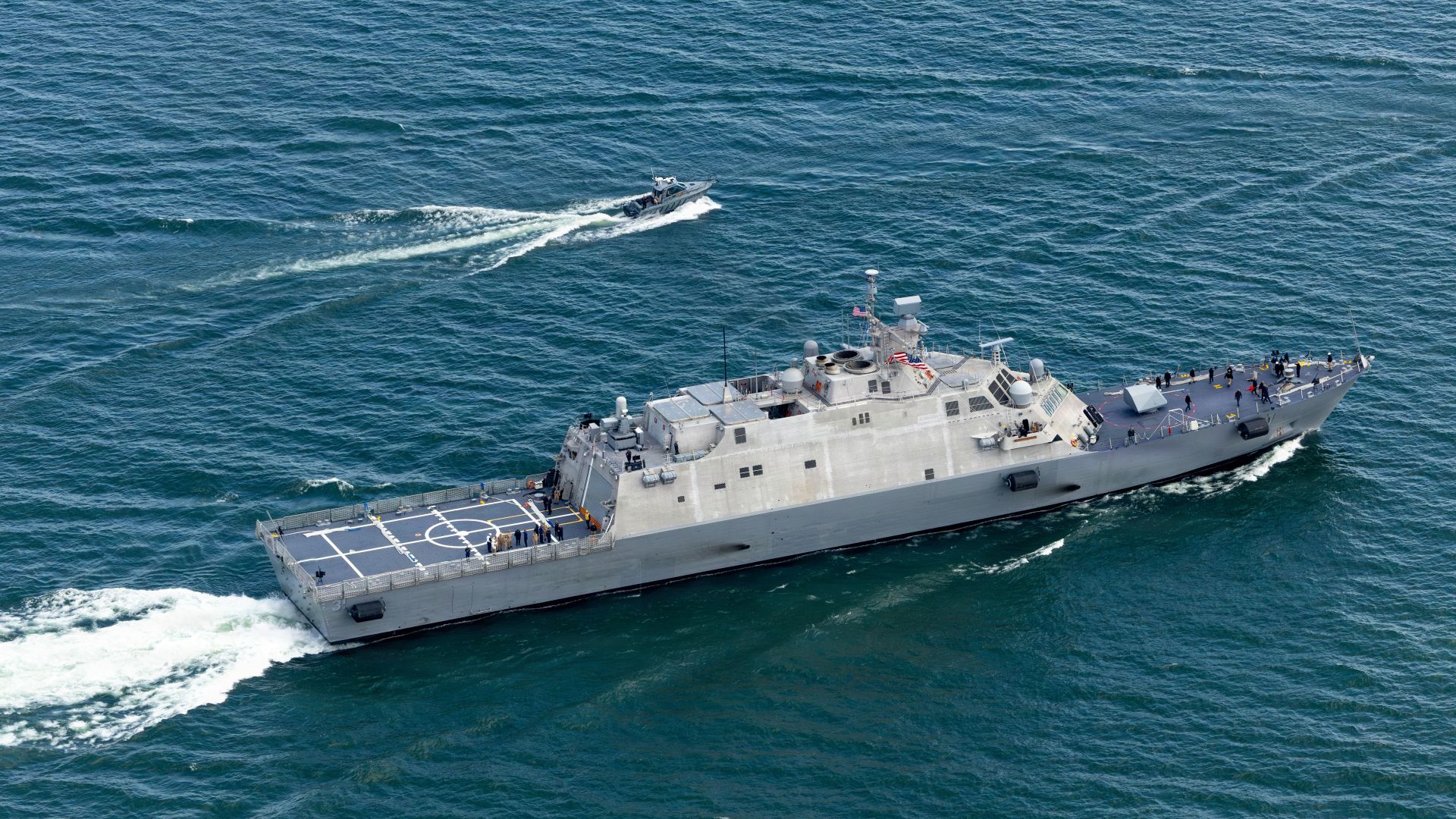
Nearly two decades after the first littoral combat ship entered naval service, the final one was commissioned this weekend.
The crew, shipbuilders, officials and family gathered Saturday near the banks of Lake Erie in the city of Cleveland for the commissioning of the USS Cleveland, the Navy’s newest ship . The Cleveland is a 378-foot long ship, with a crew of roughly 90 sailors. It’s the 16th and final Freedom-class ship to enter service.
The speakers at the ceremony were upbeat, with the ship’s captain, Cmdr. Bruce Hallett, leading the event, with speakers including Cleveland Mayor Justin Bibb and Acting Secretary of the Navy Hung Cao, among others. Hallett praised his crew for their work leading up to the commissioning.
Top Stories This Week
“You are not simply serving aboard this ship. You are writing the first chapter of her history,” Hallett said. “You are forging a legacy that will endure long after all of us have left these decks,”
However, the Cleveland joins the fleet as the last of a line of ships the Navy has been steadily trying to get rid of.
At the turn of the century, the Navy began looking at a new design — a smaller ship meant to be fast, operate close to shores and be able to launch helicopters for support missions. The first one, the USS Freedom, commissioned in the fall of 2008. The Navy began acquiring and commissioning two kinds of littoral combat ships, the Independence class and the Freedom class, the latter being smaller. While fast and armed, these ships were meant to take on smaller threats rather than enemy navies, with their loadouts and variety of sensors making them ideal for support missions.
That was the idea, however that never truly became the reality as U.S. strategy shifted. Instead of coastal fights against insurgents, the Navy began planning for large-scale, peer-on-peer fights, which required larger warships, not shallow-water vessels. That, plus ongoing mechanical issues, left littoral combat ships increasingly unwanted.
In the years prior to the Cleveland’s commissioning, the Navy had already started decommissioning early littoral combat ships. Several of the Navy’s nearly three dozen littoral combat ships have already been mothballed. The military has found unexpected uses for the unwanted vessels though, with some being used for drug interdictions and others being used for minesweeping operations. Several are currently active in the Middle East near the Strait of Hormuz, where they’ve supported near-shore missions during Operation Epic Fury.
As for the final Freedom-class ship, the USS Cleveland is the fourth Navy vessel to be named for Ohio city. Previous ships include a protected cruiser that spent much of the 1910s and 1920s patrolling Latin American waters, and a light cruiser that saw extensive action in the Pacific theater of World War II. An amphibious transport dock named the USS Cleveland entered service in 1967 and was decommissioned in 2011.
The last Independence-class littoral combat ship was commissioned in November 2025.
The USS Cleveland is now set to sail to Naval Station Mayport in Florida, where it will be homeported ahead of any future deployment.
Loading comments…
Comments couldn’t be loaded. Please refresh the page.