National Guard troops who were mobilized to Washington, D.C., are cleaning up trash, aiding local law enforcement, and getting trolled online and in person.
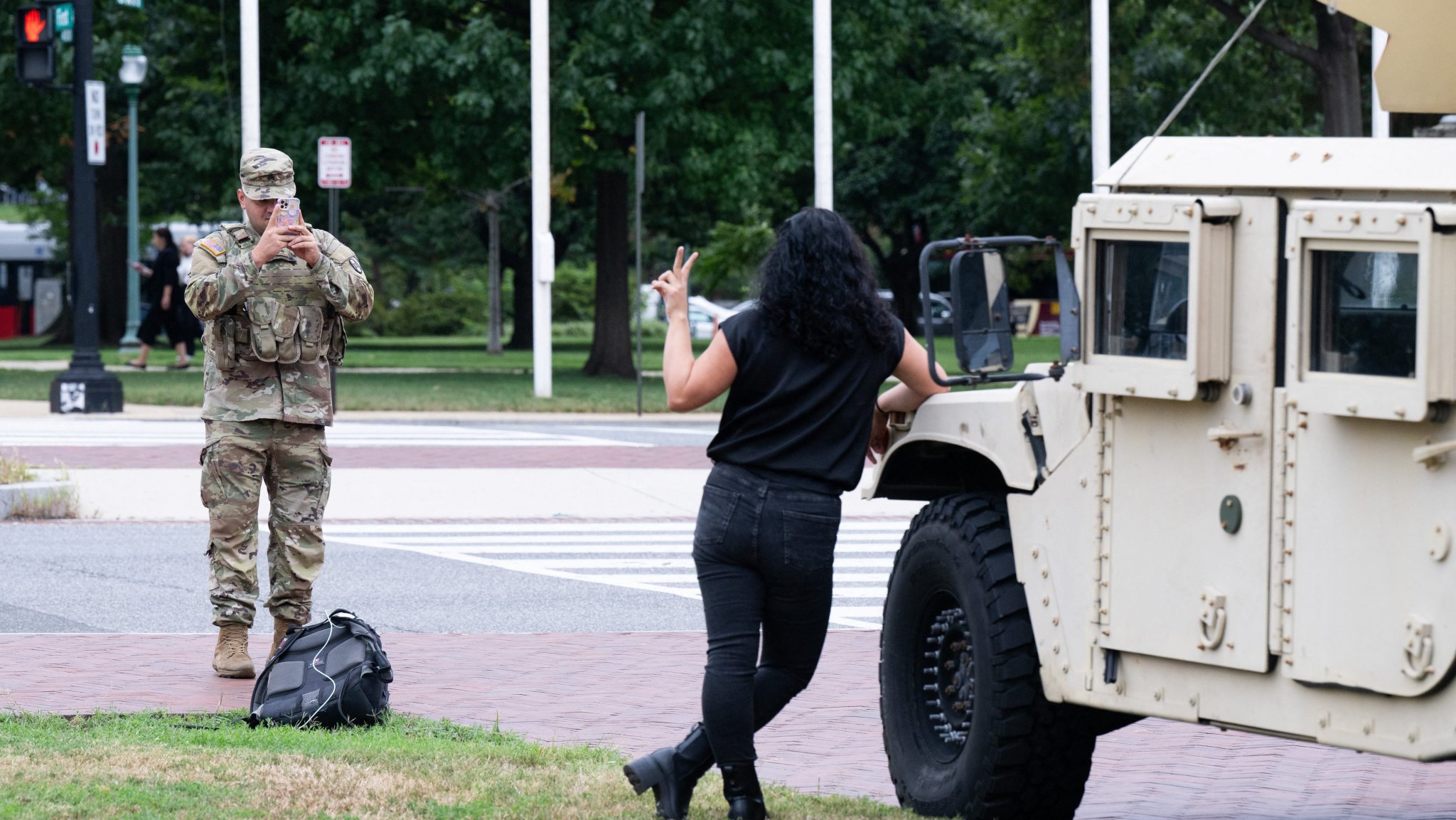
Troops have inadvertently stepped out on patrol to the foreboding cadence of the Imperial March from “Star Wars.” When not scrubbing city fixtures and raking leaves, they’ve posed for photos and have been asked to hold cameras as passersby lean on military vehicles and throw peace signs up.
It began in August, when President Donald Trump mobilized hundreds of Washington, D.C., National Guard troops to the nation’s capital via an executive order on public safety. In the weeks that followed, governors from seven other states announced they would send their own — bringing the total number of troops to more than 2,000.
Since their arrival last month, the commander of Joint Task Force D.C. has admitted that his troops have faced mixed reactions from local residents. In a city where masked agents and uniformed troops roam the streets during happy hour, an online generation has turned to social media — perhaps as a form of absurdist protest, or as a way to disassociate from the seriousness of it all. It’s D.C. humor at its finest. (This is the same city where residents hand out merch that celebrates an Air Force veteran who launched a sub at an immigration officer in protest.)
Some videos on social media are highly political off the bat, with one showing a Guardsman in the frame while a bystander shouts: “occupiers!” Others take a lighter approach. One TikToker captured Guardsmen inadvertently walking to the beat of the Imperial March from “Star Wars” — a song typically associated with Darth Vader and stormtroopers. In another ode to sci-fi nerds everywhere, as troops marched down 14th Street in northwest D.C. to the same tune, one soldier turned around and threatened to call D.C. Metropolitan Police. Reddit users shot back, noting: “Aren’t they there because the police couldn’t handle all the crime themselves?”
Another video making the rounds on Instagram had the voice of “Hanoi Hannah” play while troops picked up garbage at a park in D.C. The audio dates back to the 1960’s and 70’s when a Communist, North Vietnamese-run broadcaster targeted American troops in the South with a radio bulletin multiple times a day.
“GI why are you here? You should be at home with your honey, eating hamburgers and drinking milkshakes. The longer you are away, the more chance there will be that she will be with another boy,” the audio says. “Defect G.I. It is a very good idea to leave a sinking ship.”
Many of the videos appear to be filmed outside of Union Station in downtown D.C., where a group of Guardsmen are stationed daily.
One girl used their parked Humvee for her joke.
“For Margot?” she asked as if it were an Uber. “I swore they said a tan Toyota.”
@margotmurphyy My first week here has come with new surprises every day!
♬ original sound – Margot
Another influencer performed stand-up in a ski mask: “It’s good to be here in Iraq,” he said.
“I love the National Guard, or as I like to call them, the Washington Commanders,” the video continued, referring to the city’s football team. “The commanders have a little bit of a better record at the moment.”
He even weighed in on the highly contentious topic of facial hair in the U.S. military, asking why so many National Guard troops sport a very specific kind of mustache that was popular in adult films in the 1970s. A pornstache. That’s what he’s referring to, and yes, a curious number of Guard troops appear to be rocking them in D.C.
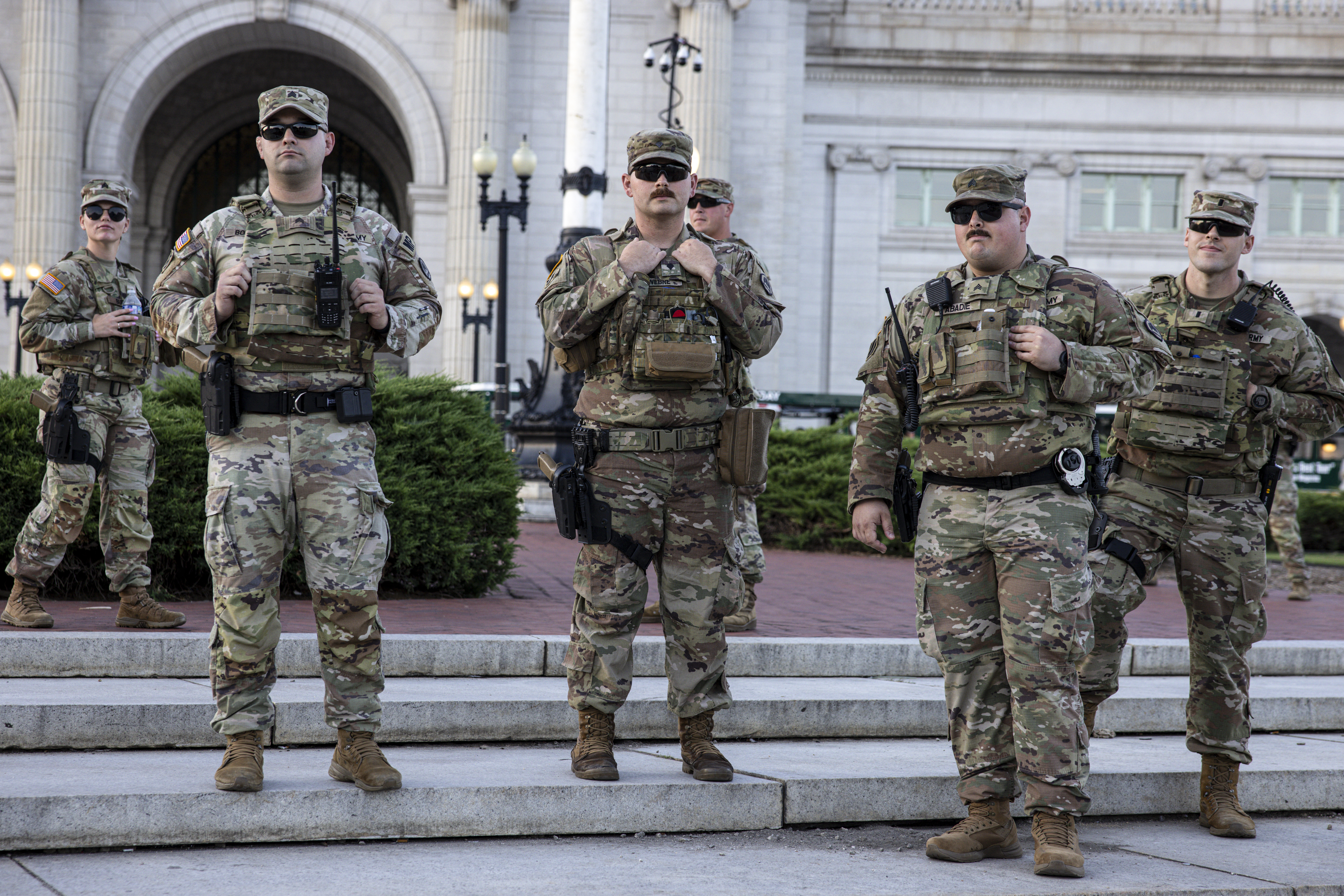
In response to all the TikToks, reels, jokes, gags, memes and other forms of trollfare, a JTF-DC spokesperson told Task & Purpose that National Guard troops are “encouraged to interact positively with the public” and “remain professional, protect privacy, and always maintain operational security.”
“They are also reminded not to share social media content that is political, advertises products, clashes with National Guard principles, or addresses internal concerns,” the official said, adding that the task force urges content creators to “prioritize the safety and welfare of our service members.”
The TikToks They Carried
It’s no surprise that the internet is playing a role in how D.C. residents respond to the deployment of the National Guard to their backyard. Beyond social media becoming a tool to fuel major protests like the Black Lives Matter movement and the Arab Spring, researchers have also investigated its use in civic political engagement, no matter how humorous.
These forms of political communication “take on the conventions of internet culture, which include wit, parody, sarcasm, co-optation, and playful memification,” researchers wrote in a 2018 study that analyzed Twitter content during the 2016 presidential election.
“I don’t know whether the people involved would say that it’s protest, but I certainly also think you shouldn’t downplay the potential persuasive impacts of humor,” said Eric Scheuch, a PhD candidate at Yale who studies environmental activism. “The research says that humor on social media can actually be a hugely effective way of getting engagement.”
Top Stories This Week
Scheuch referenced a 2020 experiment by University of Malta researchers on pro-environmental activism. Although the study covered a different political subject, Scheuch said there are broad parallels. The study found that including humor in online content “elicits a greater response than a factual message alone” and that the combination of humor and facts “creates the greatest difference.”
“We live in a really crowded information environment, maybe more crowded of an information environment than ever, and humor can be a tool for breaking through that,” Scheuch said. “If you go on Twitter and you scroll through 200 posts and 195 of them are just facts about what’s going on and then something’s funny, the funny thing is gonna stick in your brain.”