
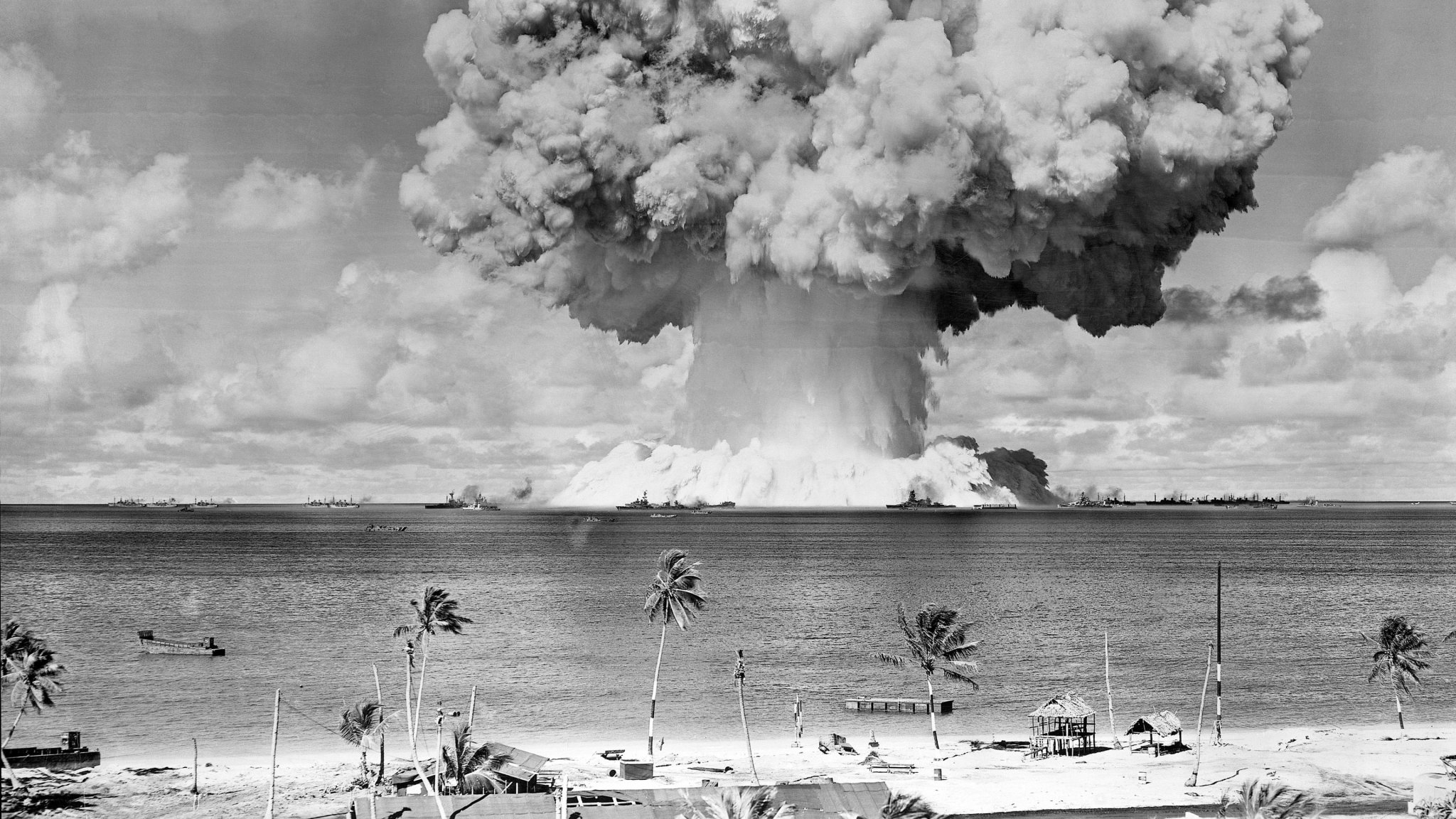
After World War II, the U.S. military had a new problem to figure out: Just what could a nuclear weapon do against a conventional force? To figure that out, the Army and Navy teamed up for the first post-war nuclear tests, assembling a massive fleet, tens of thousands of troops and several of its then-limited atomic arsenal for what would be dubbed Operation Crossroads.
What resulted was a pair of nuclear tests that sank several ships and rendered dozens inoperable, and heavily contaminated the Pacific islands the explosions took place in. 80 years ago this month the U.S. military detonated two atomic bombs at Bikini Atoll in the Marshall Islands, as part of an operation to see just what atomic weapons could do when dropped on a fleet.
These were the first nuclear tests since Trinity a year before, and the first nuclear detonation since the bombings of Hiroshima and Nagasaki. The Navy and Army knew the damage atomic weapons were capable of, but not when deployed like this. They assembled a fleet of aging, captured or decommissioned ships to weather the blasts. More than 90 ships were brought together, including two aircraft carriers and some captured Japanese and German vessels.
Crossroads was a massive endeavor. More than 42,000 personnel, including tens of thousands of troops, were brought into the mission. To track the damage, more than 150 other ships were brought in, while remote-controlled B-17 bombers (essentially a primitive drone) flew overhead with cameras and sensors to record the detonations and fallout. Meanwhile, the target fleet was staged with animals, as well as some ammunition and fuel to simulate a real combat force.
Top Stories This Week
A missed shot and a giant cloud
The operation’s first detonation was on July 1, with the “Able” shot. A B-29 dropped a Fat Man-type atomic bomb, aiming for the USS Nevada amid a cluster of ships. The Nevada had managed to survive the attack on Pearl Harbor and World War II, but was now set to be hit in an atmospheric result. However the Army Air Force missed. The Able shot was several hundred yards off course. The explosion was massive though, sinking five of the assembled ships.
The Bulletin of the Atomic Scientists later wrote that “a large ship, about a mile away from the explosion, would escape sinking, but the crew would be killed by the deadly burst of radiations from the bomb, and only a ghost ship would remain, floating unattended in the vast waters of the ocean.”
Three weeks later the joint Army-Navy task force tried again. The “Baker” shot detonated on July 25. This time the bomb was placed underwater, roughly 90 feet below the surface. That morning they detonated it, creating a giant expanding sphere of water, with harsh water pressure cutting across the bows of ships. Footage record showed a kind of detonation the military hadn’t seen before, without the blinding flash the military had seen in previous detonations. The Baker shot sank 10 ships in total, including one captured German cruiser that sank months later from damage.
Sailors meant to help decontaminate some of the ships did so without protection, but that was halted when an Army doctor overseeing some of the care stopped them out of concerns for radiation exposure.
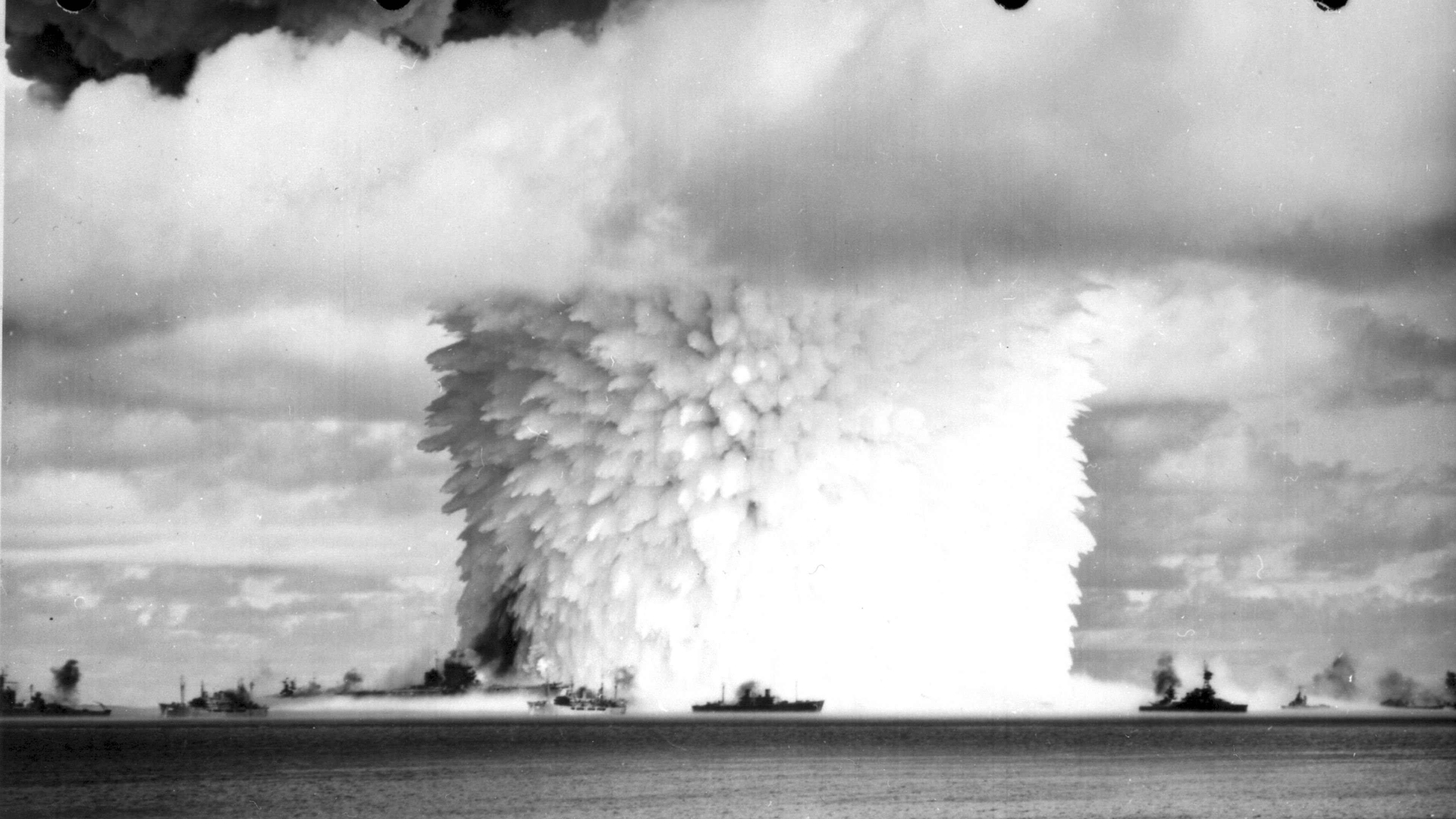
The damage
The images captured from both tests were striking. Footage from the Baker test became stock footage for nuclear explosions, including at the end of “Dr. Strangelove.” It was also used in two separate “Godzilla” films to depict that created the giant monster.
But in the Pacific the tests left very real damage. Before the tests, Bikini Atoll had been inhabited by 167 people, who were forcefully relocated off of the island, with little in supplies. Many islanders soon starved due to poor conditions before being transferred to other islands.
Bikini Atoll meanwhile would remain as a test site for American nuclear detonations through the 1950s, including Castle Bravo. That was the single largest atmosphere detonation the U.S. conducted, with the blast yield far exceeding predictions. The Marshall Islands were heavily polluted with radioactive fallout and suffering from radiation sickness.
The military had a third test planned, with the “Charlie” shot. This one was intended to be another underwater test, but from much deeper under the surface. However, the level of damage from radiation after Baker pushed the schedule back and the military eventually canceled it. As for the ships fired on, some were able to be saved but most were scuttled. Operation Crossroads proved that it wasn’t just the immediate explosion but the lingering damage of radiation that could take out a fleet.
But Operation Crossroads was the start of years of atomic tests in the Pacific, and the beginning of the military’s experiments with fielding conventional forces with atomic weapons. Those tests would yield strange results, including a short-lived Pentomic Army, or the time the Navy tried to turn off parts of the sky to disable enemy sensors and electronics.
Loading comments…
Comments couldn’t be loaded. Please refresh the page.