
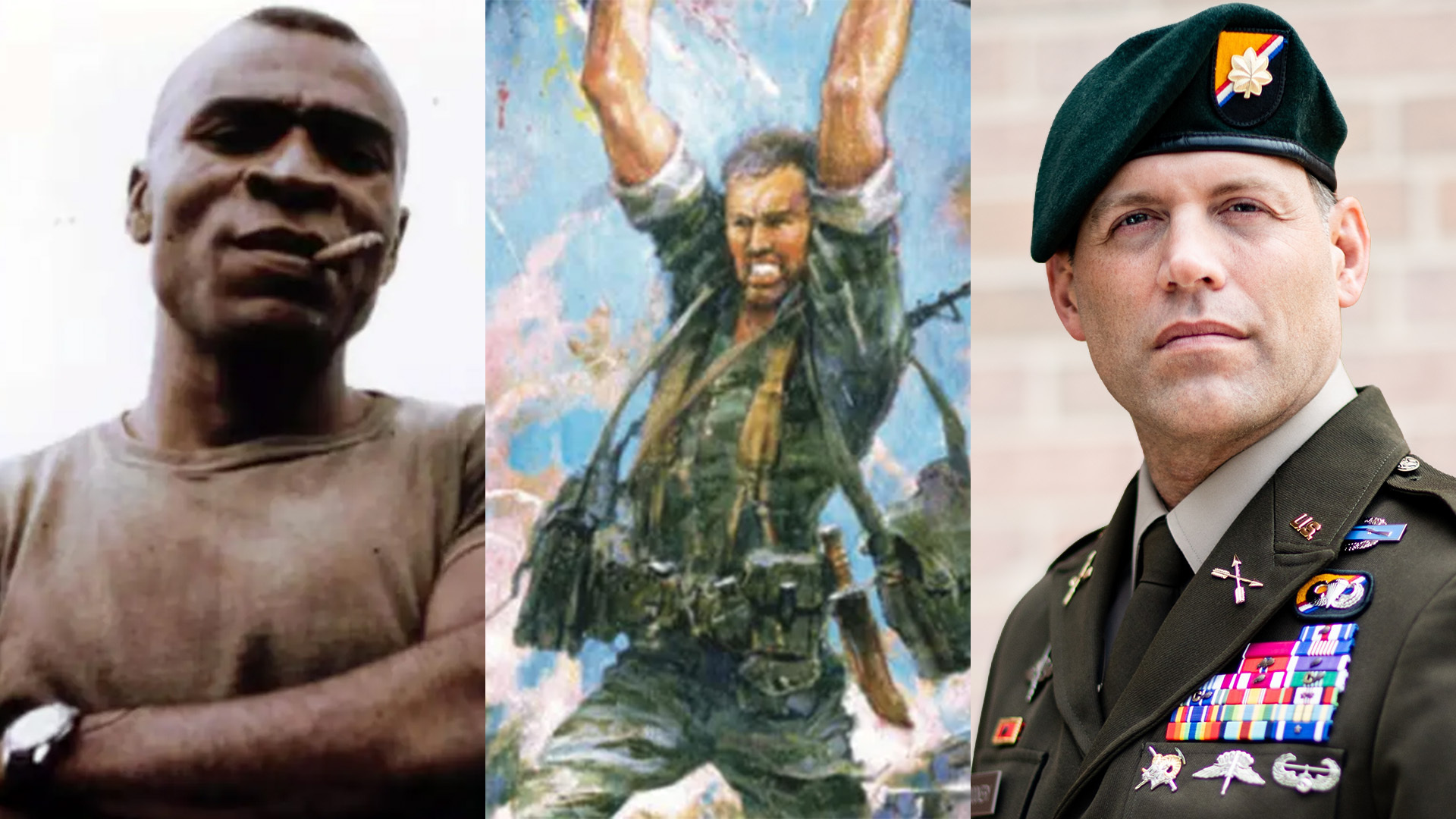
President Donald Trump presented the Medal of Honor on Thursday to three service members who fought in Vietnam and Afghanistan: Retired Marine Maj. James Capers Jr.; retired Army Maj. Nicholas Dockery; and retired Marine Col. John W. Ripley, who received the award posthumously.
Capers saved his reconnaissance team in South Vietnam following a bloody ambush in April 1967. Dockery’s bravery during a 2012 battle in Afghanistan included using his body to shield another soldier from a grenade blast and stopping the Taliban from capturing another soldier. A legend in the Marine Corps, Ripley spent hours swinging under a bridge in 1972 while under fire to plant explosives and ultimately stop a major North Vietnamese offensive.
Earlier this year, Congress passed laws that authorized Trump to upgrade awards that Capers, Dockery, and Ripley had previously received to the Medal of Honor by waiving a requirement that service members receive the award within five years of the date of the action.
The Medal of Honor ceremony for all three men took place on Thursday afternoon.
‘It was an attempt to save my troops’
Capers initially received a Bronze Star with a “V” device for valor following his actions in Vietnam. In 2010, that award was upgraded to a Silver Star.
As a second lieutenant, Capers was leading a nine-man team from 3rd Force Reconnaissance Company when the unit was ambushed in April 1967. Capers suffered bullet and shrapnel wounds and other serious injuries, but he was still able to order a mortar strike on his own position to prevent the enemy from overrunning the team.
Top Stories This Week
Despite losing a significant amount of blood and being administered morphine, Capers led his Marines to a helicopter landing zone, where he refused to board the aircraft unless the crew also took the body of the team’s military working dog.
When the helicopter initially struggled to take off, Capers tried to get out so that the others could escape.
“It was an attempt to save my troops,” Capers told Task & Purpose in a Monday interview. “It wasn’t heroism. It might have looked that way, but it wasn’t about Jim Capers. It was about the 10 men that I had and the dog’s body that I wanted to get home.”
‘Using his body to shield a soldier’
On Oct. 2, 2012, Dockery was a second lieutenant serving as an infantry platoon leader with the 4th Brigade Combat Team (Light), 4th Infantry Division when his platoon was ambushed by the Taliban. The enemy force outnumbered Dockery’s platoon and was armed with rifles, machine guns, and rocket-propelled grenades, according to the citation for one of the two Silver Stars he received for separate actions in Afghanistan.
During the battle, Dockery moved inside a courtyard to defend a small group of soldiers, the citation reads. After being surrounded by more fighters, Dockery assaulted into a room, killing one enemy combatant, and later leading a counterattack.
“Attempting to regain the momentum, Lieutenant Dockery led a counterattack to clear the courtyard, using his body to shield a soldier from an enemy grenade explosion,” his citation reads.
The enemy counterattacked with reinforcements, wounding every soldier in the unit and destroying their last covered position, according to the citation. Dockery then noticed that one of his noncommissioned officers was missing and found two enemy fighters dragging the unconscious soldier away. He killed them both and provided life-saving medical assistance to the soldier.
Dockery then braved enemy fire to get to the compound’s roof and used smoke grenades to mark his position so that friendly helicopters could attack the enemy.
‘Hold and die’
Ripley’s daring actions at the Dong Ha Bridge in April 1972 are widely revered by Marines. A diorama on display at the U.S. Naval Academy in Annapolis, Maryland, depicts Ripley hanging from the bridge’s steel I-beam girders to represent all graduates of the school who fought in Vietnam.
A captain at the time, Ripley was an advisor to South Vietnamese Marines that were directly in the path of North Vietnam’s Easter Offensive. Ordered to “Hold and die,” he climbed under the bridge and planted explosives while being shot at by enemy snipers, machine gunners, and a tank.
“The idea that I would be able to even finish the job before the enemy got me was ludicrous,” Ripley later told the U.S. Naval Institute in 2007. “When you know you’re not going to make it, a wonderful thing happens: You stop being cluttered by the feeling that you’re going to save your butt.”
For more than three hours, Ripley dangled under the bridge to plant more than 500 pounds of explosives while constantly reciting “Jesus, Mary, get me there; get me there” to himself in order to stave off exhaustion. Finally, the explosives were set and Ripley got off the bridge just a few minutes before they detonated. The blast was so big that it blew him through the air.
Ripley was later awarded the Navy Cross for “saving an untold number of lives” by destroying the bridge, which stopped the advance of 20,000 North Vietnamese troops and 200 enemy tanks.
Loading comments…
Comments couldn’t be loaded. Please refresh the page.