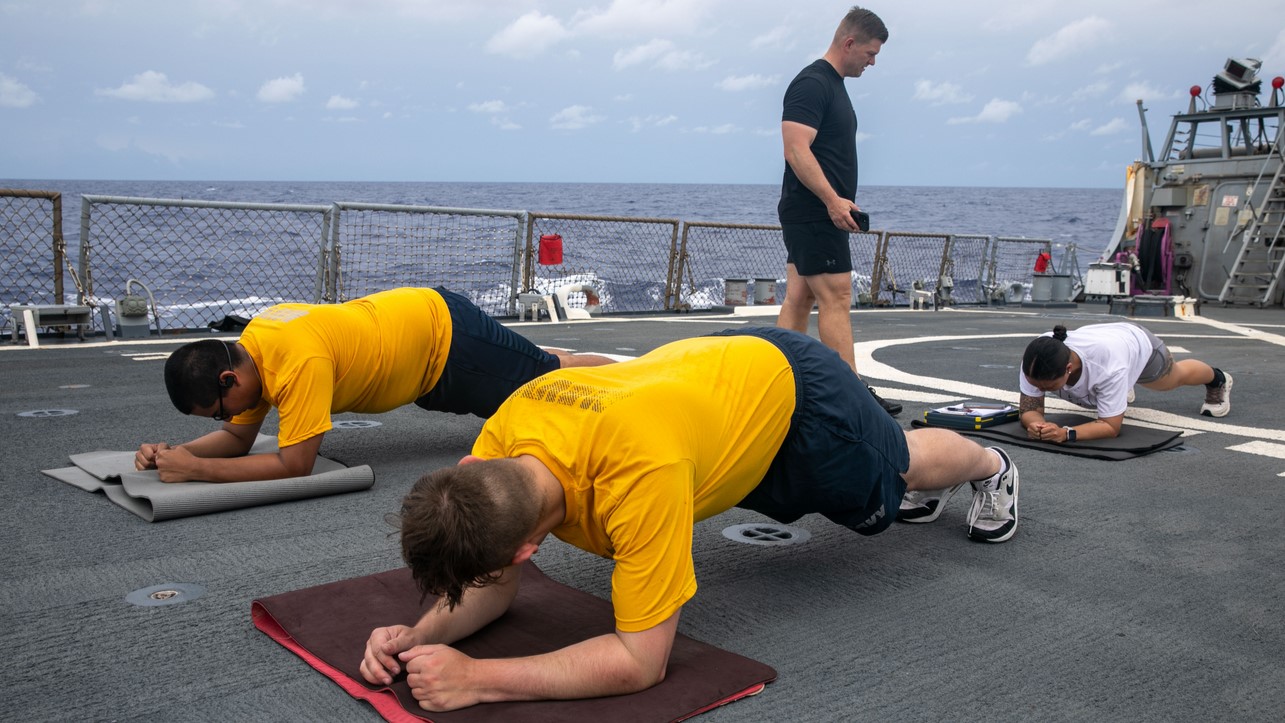
Sailors will once again be required to take two physical fitness tests per year, the Navy announced today. The changes to the Navy’s Physical Readiness Program say they will be implemented in January 2026.
The new guidance is outlined in a document available on MyNavyHR. Per the new policy, sailors will go through two fitness assessment cycles each year, one between the start of the year and the end of June and the second starting in July and running to the end of each year.
It’s a return to how the Navy previously ran its physical fitness tests prior to the COVID-19 pandemic. The Navy used to do two tests per year, but stopped in 2020 as the pandemic was in full effect. In 2021 the Navy switched its policy to just one test per year. The notice confirms some of the changes the Navy’s senior enlisted sailor announced this month.
Top Stories This Week
“For the majority of our sailors outside of our combat arms ratings, it will be the PT test we take now. It will just be given twice a year,” Master Chief Officer of the Navy John Perryman told Task & Purpose earlier in December.
Perryman announced the new policy during a wide-ranging interview with Task & Purpose. The changes come from a September directive from Secretary of Defense Pete Hegseth requiring that all branches of the military conduct two fitness tests per year.
Sailors in combat arms roles (such as Explosive Ordnance Disposal Technicians and Navy SEALs) will take both the Physical Fitness Assessment and Combat Fitness Assessment, while all other sailors will take the PFA twice a year. That includes sailors from the Reserves who are on active-duty orders of a year or more. The assessment includes a Body Composition Assessment and the Navy’s Physical Readiness Test. As per Perryman’s comments, the test is the same: A combination of push-ups, planks and a 1.5-mile run.
The new standards also note that the Navy revised its Body Composition Assessment to be sex neutral. It will now consist of two elements, a waist-to-height ratio and a body composition calculation. Additionally, sailors who are not within the standards of that assessment can pass the physical fitness assessment so long as they score “Outstanding-Low overall with an Excellent-Medium or higher” in all three of the physical readiness tests.
Any physical fitness assessment failures before 2026 are “reset to zero,” according to the Navy, in regard to reenlistment, promotion or other career advancements. However prior failures will be considered in other matters. Any sailor that fails three assessments within four years will be deemed ineligible for service and moved to be administratively separated, the Navy said.
According to the fact sheet, sailors who recently were pregnant are granted a grace period. Recently pregnant and postpartum sailors, once medically cleared, must take the fitness assessment where their year-long deferment period ends.
Update: 12/30/2025; This post was updated after the Navy clarified details regarding post-pregnant and postpartum sailors.