
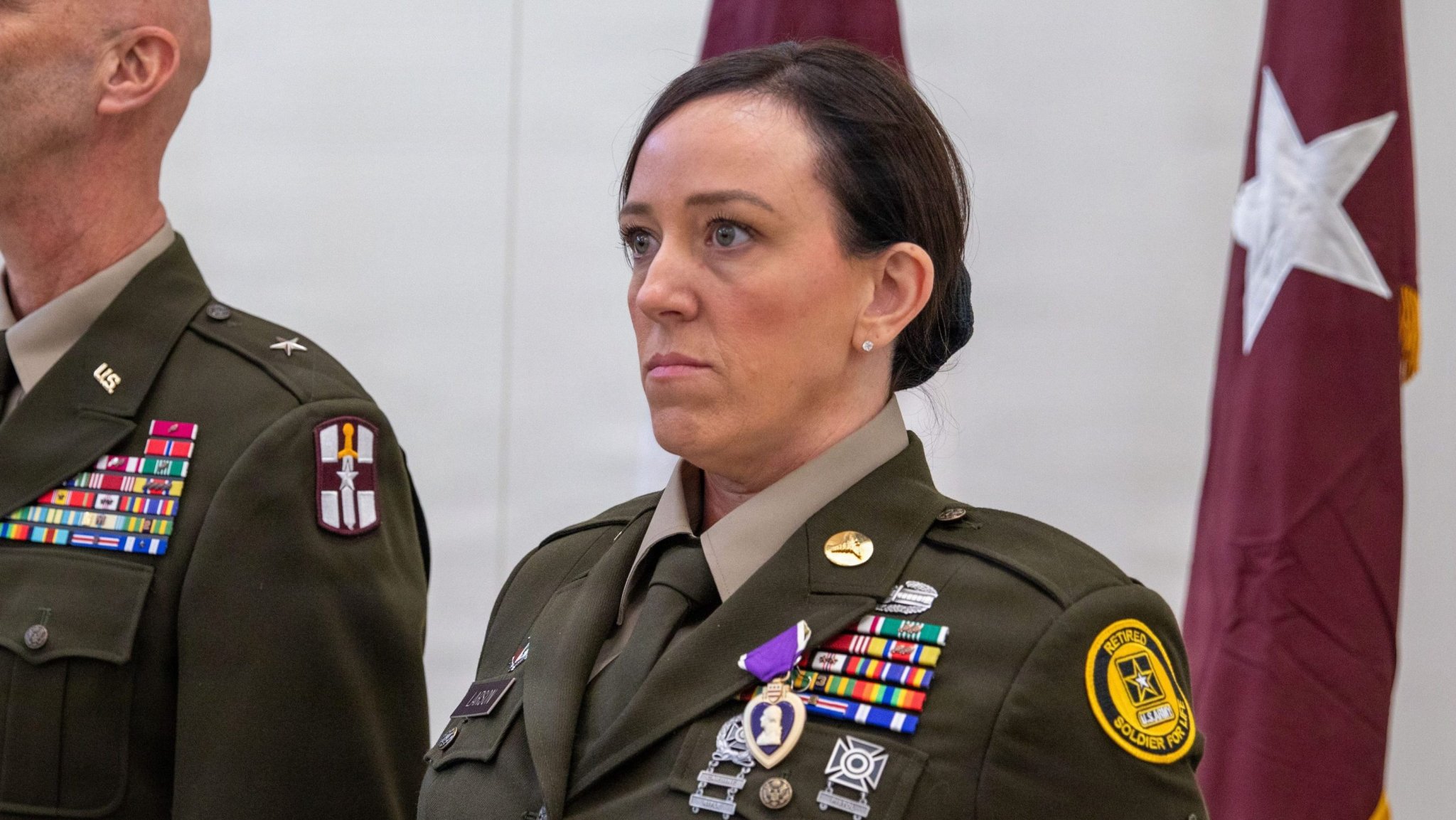
An Illinois soldier was awarded a Purple Heart on her very last day in the Army, receiving the award more than a decade after suffering injuries from a car bomb in Afghanistan.
Sgt. 1st Class Christina Larson was a combat medic with the 911th Forward Surgical Team in 2015 at Kabul’s main airport, then known as Hamid Karzai International. A car bomb attack against the base that January leveled buildings and blew in the windows to Larson’s barracks room, where she was in bed when the explosion went off.
“I remember thinking, ‘Am I dead? Am I alive? Am I going to die? Where’s my tourniquet? Do I have my arms? What is going on right now?’ I was very disoriented,” Larson told Task & Purpose.
Within minutes, she gathered herself, grabbed her rifle, and ran to help other injured soldiers. What she didn’t realize was that she had suffered a traumatic brain injury, or TBI, in the blast that would leave her with a host of medical issues.
Larson retired from the Army on Feb. 20, in a ceremony at Fort Sheridan, Illinois, surrounded by family, friends, fellow soldiers, and mentors. Larson served on active duty and in both part-time and full-time reserve roles during 15 years of service before ongoing medical issues from the Kabul blast forced her retirement.
As part of the ceremony, she was finally awarded a Purple Heart from the attack, presented by Brig. Gen. Todd Traver, the deputy commanding general of the 807th Theater Medical Command. In 2015, Traver was the commander of a medical battalion at Bagram, Afghanistan that oversaw Larson’s team, the Army said in a release.
Larson told Task & Purpose she had come to view her injuries as many veterans wounded in combat often do, that they weren’t ‘bad’ enough for a Purple Heart.
“But I know when it was brought to me that I should have one, I remember initially thinking, ‘I don’t deserve a Purple Heart,’” Larson said. “What do I get a Purple Heart for? I have all my limbs. I’m not in a wheelchair.”
During the process of medically retiring, a civilian in her unit suggested Larson was eligible for a Purple Heart. The idea sent her down the rabbit hole of finding paperwork to prove she was present for the attack and documenting her injuries.
Top Stories This Week
Larson said that, looking back, she thinks the award’s long delay was due to a mix of issues, including the military’s evolving culture around TBIs and early mistakes by her unit in Afghanistan that overlooked her eligibility.
Lt. Col. Kristin Porter, a spokesperson for the 807th Theater Medical Command, said the Army Reserve “cannot speculate as to why the chain of command in theater did not submit an award for the soldier while deployed.”
In the post-9/11 wars, overlooked or delayed Purple Hearts for injuries with slow-developing symptoms like TBI have been widespread. More than 50 Purple Hearts were eventually awarded to troops after a January 2020 missile attack in Syria, most for TBI-like injuries, despite initial reports from Pentagon officials that the attack produced few injuries.
As Army officials reviewed Larson’s records for the Purple Heart, they also realized she was eligible for a Combat Action Badge.
“The Purple Heart was ultimately awarded based on a comprehensive review of official records and more than a decade of consistent medical documentation, reflecting the Army’s commitment to ensuring soldiers receive appropriate recognition, even when delays occur,” Porter said.
The attack
On the morning of the attack, Larson was supposed to go for a run with her commander, but he sent an early-morning text to tell her he was sleeping in. While Larson said she wasn’t the type to go back to bed, she decided to lay down.
“Last time I looked at my clock, it was like 5:46 in the morning,” she said. “I just closed my eyes, and then all of a sudden, all I remember is the sound of glass shattering.”
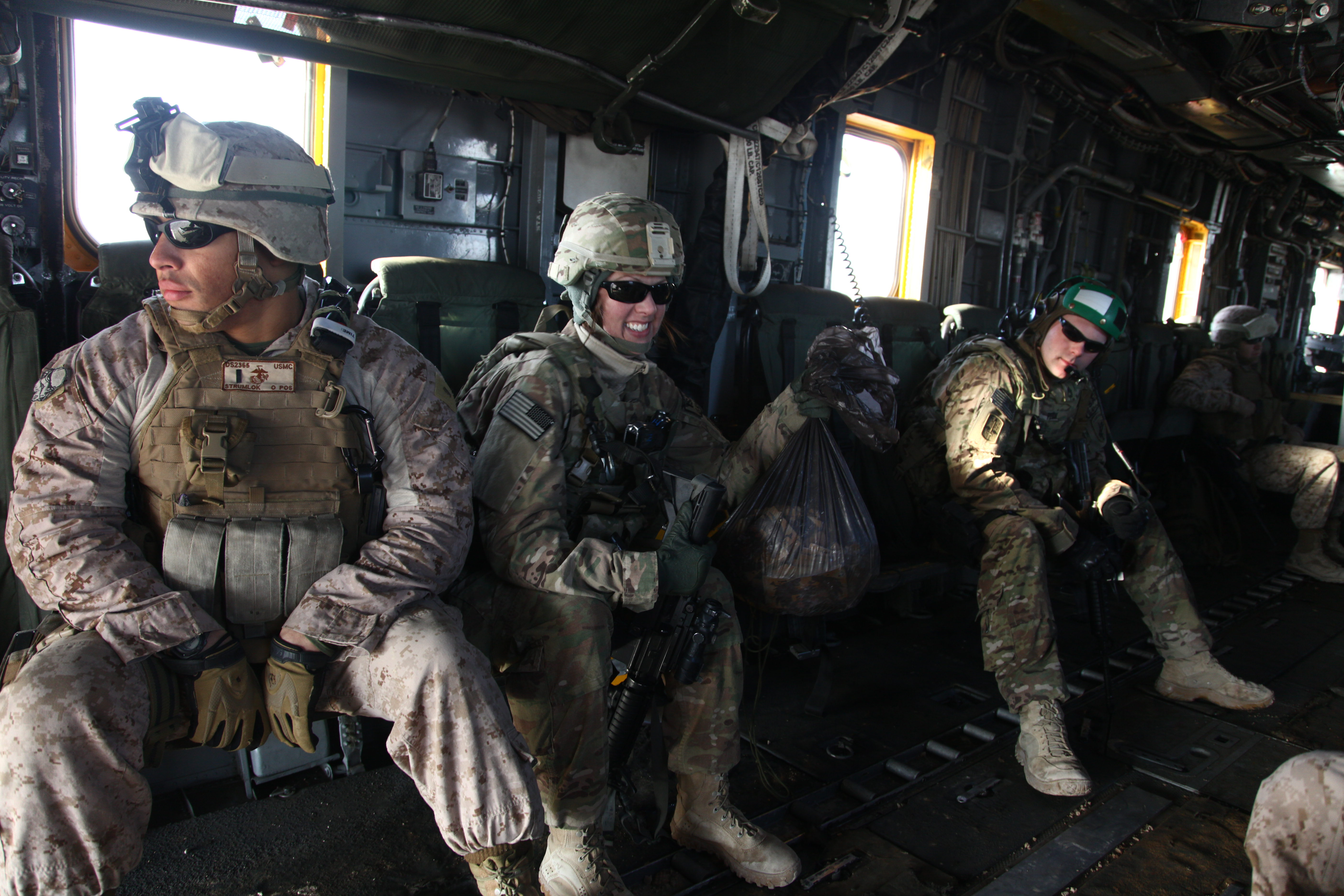
At Larson’s retirement ceremony, Traver described the IED blast as “catastrophic,” leaving “not a single building” near the airport without damage.
“Hardened structures were shifted on their foundations. Fire doors were blown off their hinges. Windows were shattered across the base,” he said. “Shrapnel from the explosion was later found on the airport runway, more than 1,000 meters from the point of detonation. After the attack, the largest identifiable piece of the truck that could be found was smaller than a basketball.”
After the explosion, Larson remembered her ears ringing and her head pounding. Her barracks building was completely blown out — the window blown open, shelves collapsed, and “I had landed on top of all of it,” she recalled.
Despite being in a daze, Larson gathered her medical equipment and M-16 and went to check on NATO civilians on base, helping one injured woman as she limped to the hospital.
“In the immediate aftermath of the blast, amid confusion, alarms, and uncertainty, her first instinct was not self-preservation. It was duty,” Traver said. “She did exactly what we ask our medical soldiers to do: she ran toward the mission.”
Later, as she walked across the tattered compound, she saw the area where she and her commander would have been running. The area lay in ruins with a lawnmower blade sticking out of the side of a shipping container.
“It could have easily killed or decapitated one of us,” she said.
A ‘loosely managed’ TBI
Coming out of her deployment, Larson said she was diagnosed with migraines, post-traumatic stress disorder, and, later, a TBI. While the military’s TBI diagnostic tools have improved in the last decade, symptoms can take weeks to develop.
“At the time, they had just diagnosed me with a bad headache, basically suggesting [mild] TBI, but they didn’t have the diagnostic capabilities there to be able to say ‘yes, you have a brain injury,’” she said. “They put me on a brain injury protocol so for two days, I basically lay in my room. No screen, no stimulation, trying to rest.”
Larson said for the next few years, her symptoms “were loosely managed” with migraine medication. Later, she turned to Botox for treatment because she wanted to avoid side effects like drowsiness while taking care of her newborn daughter.
She was medically retired with conditions that include global amnesia, medication-resistant migraines, and peripheral nerve damage, according to the Army release.
According to the National Purple Heart Honor Mission, among the 2 million Americans who have received a Purple Heart, Larson is one of fewer than 500 women, most in post-9/11 combat operations, according to the Army release.
“We all look at the Purple Heart as the award nobody wants, and it’s true,” she said. “But I think some of the more politically minded leaders see it as a mark of being ‘damaged goods.’ I may be wrong, and I hope I am, but there are many who should have received one and haven’t.
