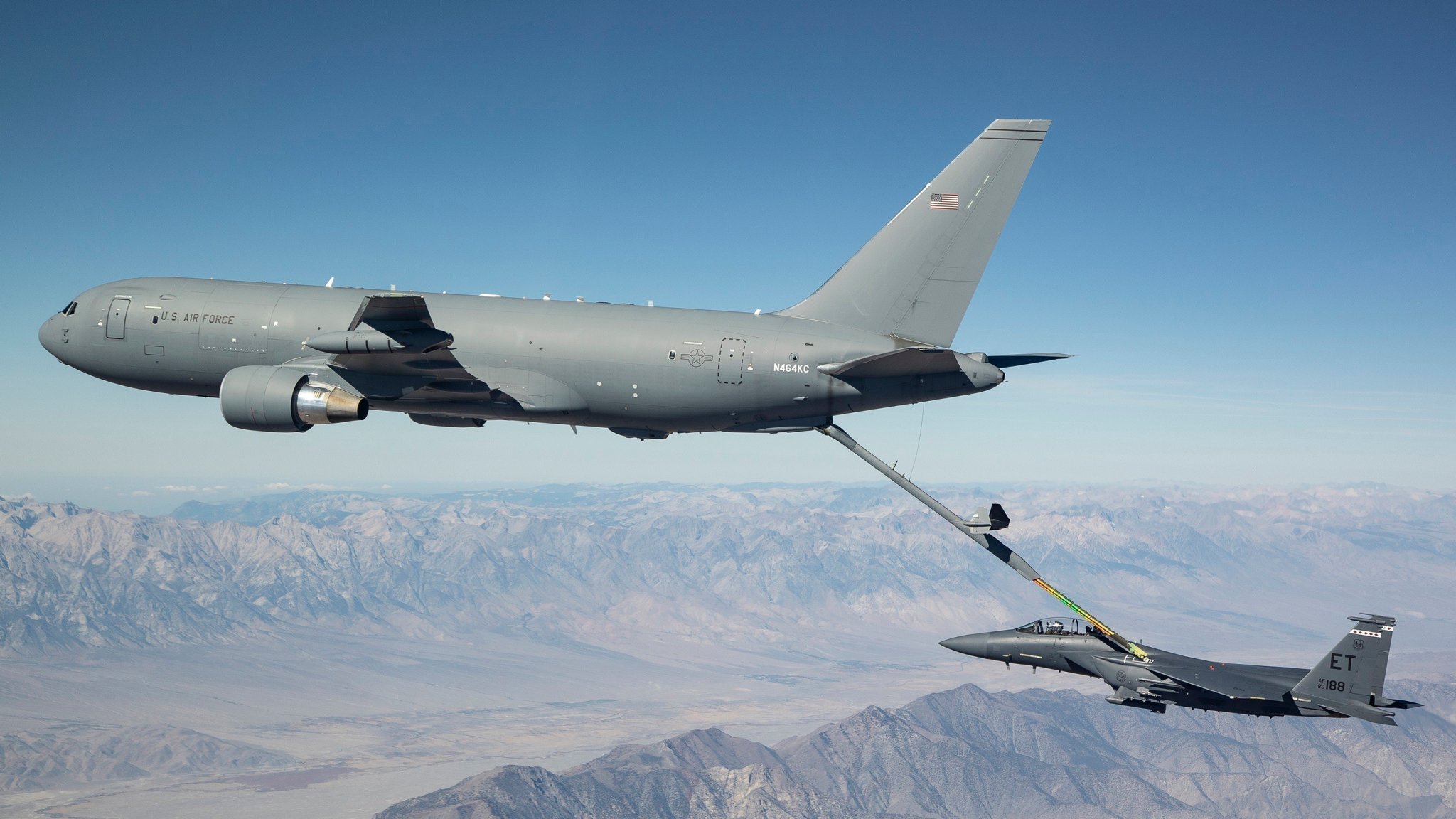
Three of the Air Force’s newest and most advanced refueling tankers sustained a combined $22 million in damage in similar airborne accidents when refueling probes became stuck in fighter jets during refueling.
One of the accidents in 2024 was so violent that the plane’s refueling boom broke off the jumbo jet and fell into a remote California forest.
All three mishaps occurred on KC-46 Pegasus refuelers — the Air Force’s newest tanker — and all three were caused, investigation boards found, by similiar mistakes: each of the planes’s three boom operators made errors as they connected up to a trailing fighter plane, mistakes that were compounded by flying errors made by the pilots on the mission and weaknesses in the design of the controls that operators use to fly the boom.
The Air Force released investigation reports for the three mishaps last week. Two of the accidents occurred in 2022, while the most recent was in 2024.
A fourth KC-46 refueling mishap occurred two months ago and remains under investigation.
Only one of the three laid any blame on the KC-46’s problem-prone Remote Vision System, or RVS, the camera system boom operators use to “fly the boom.” Using the system, the boom operators on KC-46s sit in the front of the plane, rather than in rear-facing window seats in the back to directly observe refueling. Both KC-135s and KC-10s fly with boom operators in the tail.
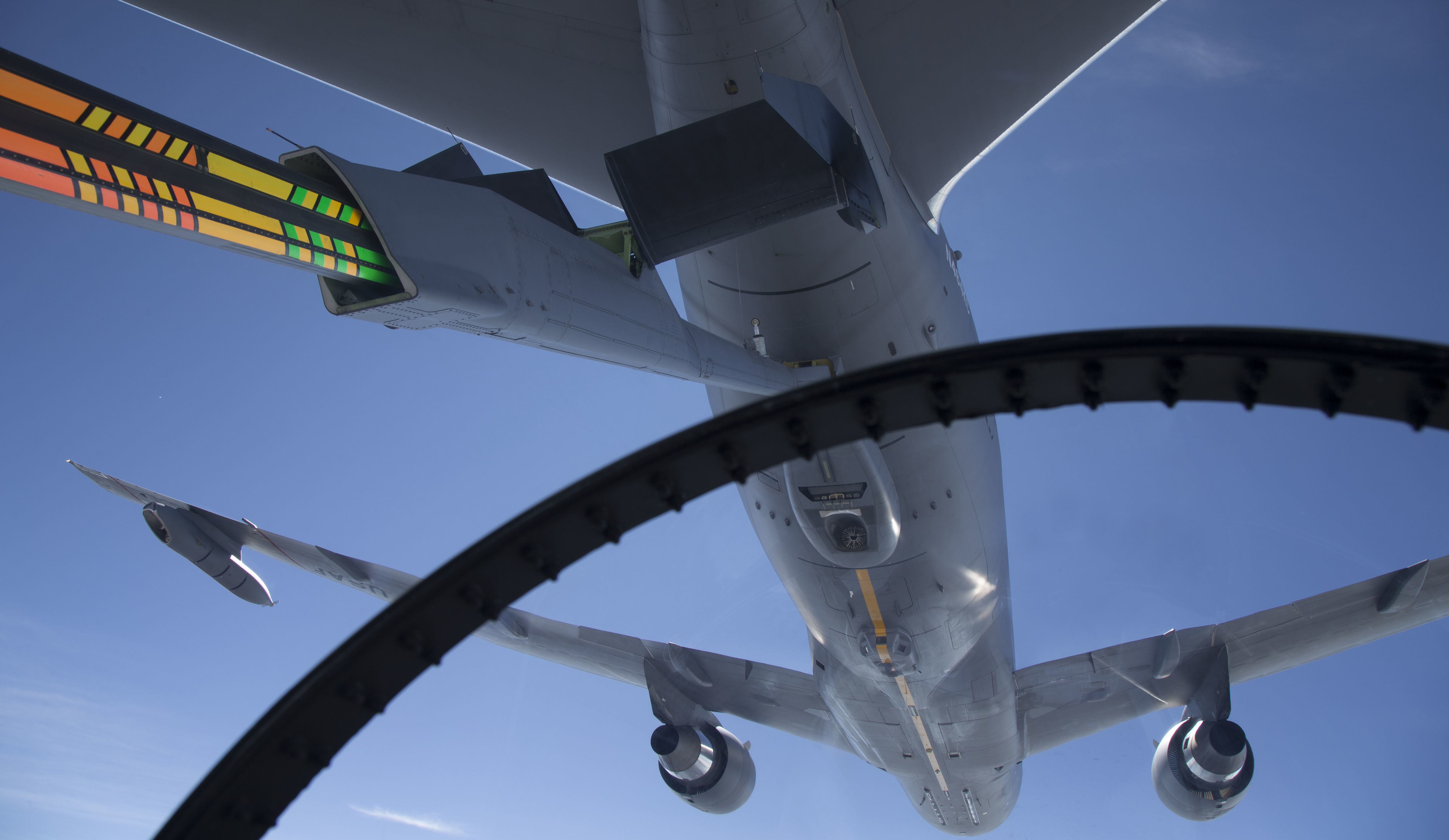
The system has been under scrutiny since its introduction, and the Air Force expects to upgrade it in 2027.
In an unusual disclosure, the Air Force released accident reports for all three mishaps together, with a single press release.
“The KC-46 tanker fleet will sustain our air refueling mission capabilities for decades to come,” said Lt. Gen. Rebecca Sonkiss, AMC deputy commander in the release. “Challenges with adding a new aircraft to the fleet are not uncommon, but we do not take these incidents lightly.”
A ‘fly-up’ and broken boom in 2024
The worst of the three accidents occurred in 2024, between a KC-46 from McConnell Air Force Base, Kansas and an F-15E from Mountain Home Air Force Base, Idaho. Both planes were participating in Operation Noble Eagle, the name for flights in support of NORAD’s defense mission of U.S. airspace.
After an early morning take-off from Travis Air Force Base, California, on Aug. 21, 2024, the Kansas-based KC-46 met with two F-15Es for a routine mid-air refueling. One of the jets tried four times to hook up to the plane’s refueling boom, but the fighter’s pilot had trouble maintaining constant contact. His wingman connected for a full gas-up.
On a final attempt, as the boom connected to the F-15E’s fuel port, the fighter continued to fly towards the tanker, compressing the boom to 3.75 feet, more than two feet shorter than its normal operation. Then, as the two jets tried to separate, the boom momentarily caught in the F-15E’s fuel port. As the F-15 eased back, it pulled on the stuck probe with 7,404 pounds of force, extending the boom 17 feet.
Top Stories This Week
In the few seconds the jet was stuck, the boom operator tried to fly the boom upwards. When the probe finally released from the F-15, the upward push from the boom operator caused the boom to spring violently upwards, smashing into the bottom of the KC-46’s tail section.
“The boom reached a peak fly-up rate of 114 degrees per second,” the report found, before smashing into the underside of the tanker.
The F-15 pilot told investigators the boom began to “sway and oscillate back and forth in an obviously uncontrolled manner” after it smashed the plane, before breaking off and falling into a remote area of Los Padres National Forest, about 20 miles north of Vandenberg Air Force Base.
The damage, officials said, totaled $14,381,303.
Two 2022 nozzle binding mishaps
The Air Force also released details on two other KC-46 nozzle binding mishaps in 2022. The more expensive of the two was also with an F-15E, while a similar run-in with an F-22 left relatively little damage.
On Oct. 15, 2022, a KC-46 from Joint Base McGuire-Dix-Lakehurst flew a routine training mission to refuel a flight of F-15Es from Seymour Johnson Air Force Base, North Carolina.
Similar to the 2024 accident, the boom’s nozzle became stuck in the F-15 after a mistake by the boom operator and the failure of the F-15E pilot to recognize the condition. Also, like the 2024 accident, when the boom finally released, the operator’s actions caused the boom to spring upwards forcefully and strike the underside of the KC-46, causing over $8 million in damage.
In that 2022 flight, an accident board found, the boom operator “inadvertently placed a radial force on the ARB that caused the nozzle to become bound in the receiver’s receptacle. As a result, the bound forces exceeded the structural limitations” of the boom and “caused a rapid upward movement” that struck the plane.
But unlike the 2024 mishap, the accident board found the operator’s mistakes were neither intentional nor preventable, but were due to a poorly designed flight control system, or FCS.
“A pattern begins to emerge which leads me to conclude that this FCS input by [the boom operator] was inadvertent and due to a limitation of the KC-46 [boom] control system,” investigation board President Col. Chad Cisewski wrote. “It is not a reasonable conclusion that [the boom operator] could have recognized his inadvertent input and corrected the situation with the current [boom] control deficiencies.”
The second mishap in 2022 came between a KC-46 and an F-22, and though investigators traced the cause to a mistake by the boom operator, the final report also found a “lack of image detail” on RSV cameras contributed to the accident.
Using just the cameras, the report said, the boom operator could not see if the boom’s nozzle was still in the F-22.
“Lack of image detail,” the report said, “substantially contributed to MBO1’s ability to correctly respond to the situation which he was presented. The reduced quality of the [system] display, to include a reduction in depth perception due to the grayscale of the presented image, made it impossible for MBO1 to adequately verify that the [boom] nozzle was clear of the receiver receptacle.”
Unlike the two mishaps that ended in the boom doing millions of dollars in damage as it struck the underside of the tanker, the F-22 accident damaged only the KC-46’s fuel probe, with a price tag of $103,295.