
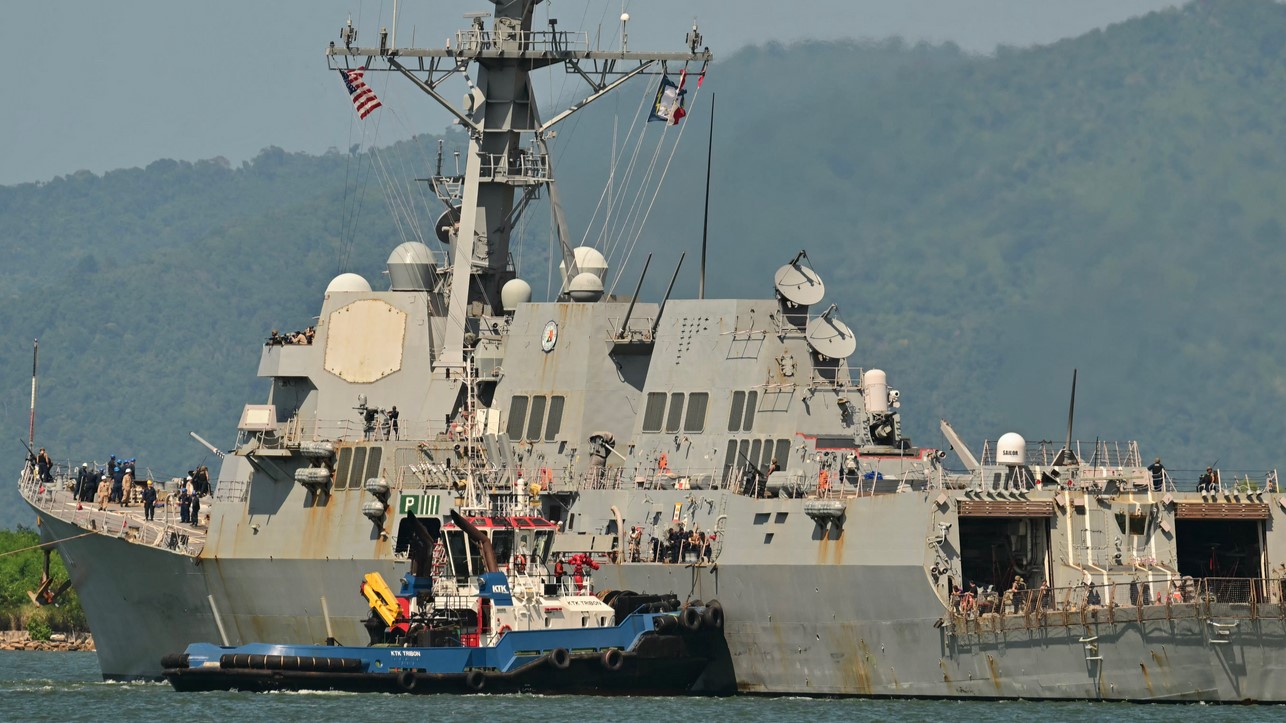
A little more than 60% of Americans support using military force against suspected drug traffickers, according to new polling data, as the Department of Defense continues to carry out airstrikes on vessels in the waters around Latin America.
That’s according to this year’s Reagan National Defense Survey, an annual polling of roughly 2,500 Americans on issues tied to national security, the military and geopolitical events. Of the respondents, 7% identified as veterans.
The results, released today, found that 62% of respondents strongly or somewhat approve of using the military to take on possible drug traffickers in Latin America and the Caribbean. It was one of several findings in this year’s survey, which noted deep partisan divides on many topics but also a growing support this year for NATO and the defense of Taiwan and Ukraine.
The survey, conducted between Oct. 23 and Nov. 3, looked at what Americans thought of topics ranging from support for deploying the National Guard into American cities to confidence in institutions like the Supreme Court or the U.S. military.
Top Stories This Week
The use of force against suspected drug traffickers was a new question in this year’s survey. The question specifically mentioned the use of force, compared to the types of interdictions the Coast Guard and Navy have regularly done against suspected or proven drug boats for years. The survey is notable as it happened during a time when the use of force in those waters was escalating. By the time the survey began, the United States had carried out nine strikes, and 15 by the end of it. Since Nov. 3, six more strikes have happened, bringing the death toll to 83. The United States currently has a large naval armada in the Caribbean, with approximately 15,000 troops deployed to the region.
The survey asked roughly 2,500 people to rank their confidence in various public institutions, with responses of “a great deal” of confidence, “some” confidence, “a little” or “not much at all.” The military got the highest scores of any institution, with 82% at “some” confidence or higher. The effort to rename the Department of Defense into the Department of War (the unofficial title the Trump administration is using) had less support, with 59% of respondents disapproving it and only 36% in favor.
This year’s survey asked about ongoing issues tied to national security and American involvement abroad, but other questions touched on recent domestic developments. On the topic of deploying the National Guard to cities during “major civil disturbances and to address violent crime” — the reasons given for sending troops to cities such as Los Angeles and Washington, D.C., since this summer — 62% of responders were in favor.
On topics tied to diversity and civil rights in the military, respondents were pretty evenly split: 47% favored eliminating diversity, equity and inclusion programs in the Pentagon, and 48% were against ending them. Half of survey takers were in favor of reinstating restrictions on transgender military service, with 45% opposed.
Overall trust in the military held steady, at 49% of Americans reporting high confidence in it. That is still far down from 2018, where it was 70%, but it is consistent with the last few years. This year also saw an increase in support for recommending friends or family to join the military, with 59% of respondents saying they would encourage military service, compared to just 51% in 2023.
In terms of foreign policy, support for arming Ukraine was up to 64% this year, up from 55%. Support for defending Taiwan was also up, and favorability for NATO and its collective defense agreement was also up.
