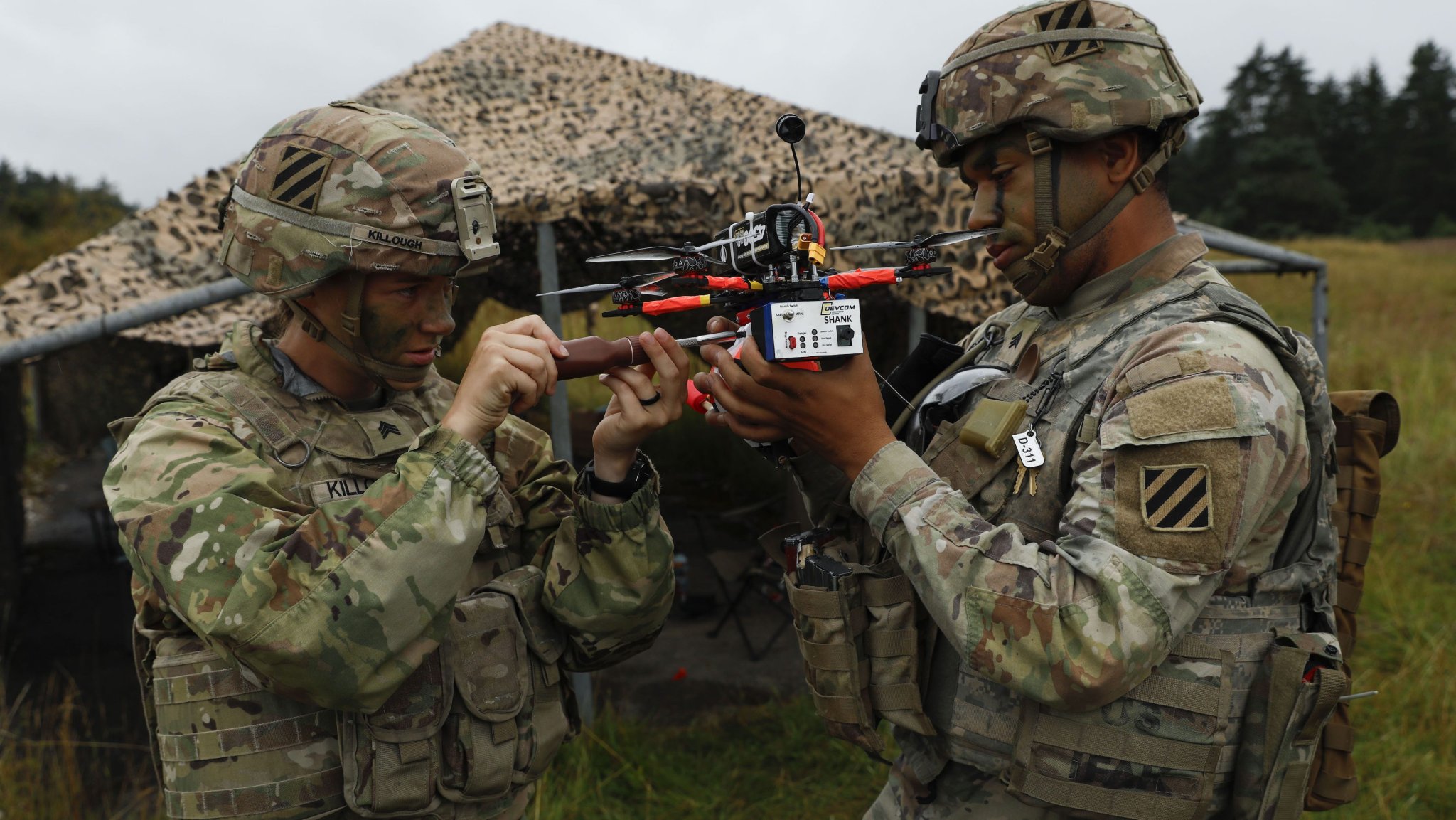
A recent Army exercise in Europe revealed a generational gap with drones. Soldiers in the field are picking up new frontline tech within hours, while leaders at higher headquarters are still figuring out what their future battlefields will look like.
“This younger generation of soldiers and leaders, they have a lot of these skill sets already just from coming from their STEM-focused schools throughout their education,” Col. Donald Neal Jr., commander of the Grafenwoehr, Germany-based 2nd Cavalry Regiment, said on a call with reporters Wednesday. “We may have a rifleman that pulled the trigger, but they may have a hidden talent of building drones or may have a data science degree.”
Those lessons, Neal said, emerged during Project Flytrap, an ongoing series of exercises the Army began hosting in June at Hohenfels Training Area, Germany, and in Poland. The exercises pair troops with a wide range of drones and the civilian engineers developing them.
Neal said the exercise is also teaching Army leaders to find “hidden talents” within their own ranks, and to recognize that younger soldiers may be better prepared for the arrival of drones as an everyday weapon.
In most cases, the Project Flytrap teams took less than eight hours of training to get soldiers comfortable using the systems, according to Command Sgt. Maj. Eric Bol for the 3rd Squadron, 2nd Cavalry Regiment. Bol, however, said that he doesn’t see it as a generational difference, but just a talent that some people are more attuned to.
“Flying drones we found is definitely a skill set that some people have and some people don’t and we kind of assess that in simulators before we go through the training process. Some people just have an aptitude for it,” Bol said.
Top Stories This Week
The exercise was designed to help the Army decide which counter-drone systems the service should buy and bring into its formations faster — part of an effort by Chief of Staff Gen. Randy George called Transform in Contact, TiC 2.0. So far, the initiative has led to the creation of units focused on specific types of electronic warfare and drone threats and smaller, more mobile combat unit formations.
“Think of a soldier operating a piece of equipment with the person from industry next to him,” Neal said. “The soldier gives feedback on what would make it work smoother. They make that change. They test it out.”
Neal said drone defense runs from front-line squads to above-battalion level headquarters, but begins with soldiers on the ground taking the initiative to decide how to take down drones, fast.
“Once you acquire whatever is in the air, whether it’s friend or foe, you can distinguish between it. The next thing you need is the ability to decide what to do about it,” Neal said, adding that it includes the “most junior soldier” up to the “multi-star level headquarters.”
But at those battalion and command levels, one training gap that the Army is foreseeing is among higher-level officers processing fast-moving threats like drones.
“Once you start talking O-5 level command and above, there probably is a need for folks that understand how to manage data and how to manipulate software. Because the culture of adaptation, it is gonna require skill sets that maybe we don’t have throughout our force,” Neal said. “We owe that to the Army. We don’t know what that looks like yet, but that’s part of what we’re finding out in this exercise.”
Countering drones
During Project Flytrap, soldiers tested a variety of emerging counter-drone tech ranging from soft kills, like rerouting the drone’s path by jamming its radio frequency, to hard kills, such as shooting drones down with a projectile.
“There is no silver bullet single solution, and the layering options that we have out here are very revealing to show what kind of equipment you need across a range of technologies to enable the formation appropriately,” said Lt. Col. Jeremy Medaris, commander of the 3rd Squadron, 2nd Cavalry Regiment.
In order to effectively counter these threats, the Army wants soldiers to build up defensive “layering.”
A first layer might be soldiers with anti-drone tech compact enough to wear as part of their standard kit, like the My Defence Pitbull, a lightweight jammer that resembles a portable charging pack. The system detects the radio frequencies that drones operate on.
“An effect that that jam could have is it could stall that drone in the air. Maybe it knocks it out of the sky. Maybe it’s not powerful enough. Maybe it sends it back to base,” Medaris said. “Or maybe it just stalls it there. If it stalls there, a different layer might be another soldier next to that individual who has a specialized optic on his M4 that gives him a better ability to engage and shoot the enemy drone.”
If that doesn’t work, the next ‘layer’ would be larger systems carried in an infantry squad vehicle, which have greater power output and for radio frequency jamming “at a broader scale, over a greater piece of terrain, or maybe it also has an infrared sensor or an active radar,” Medaris said.
“The fundamentals of maneuver warfare still matter. Things like dispersion, protection, fortification, selecting the correct routes, and planning to an objective, things like that, they remain essential,” Medaris said. “The essential nature of warfare, maybe some components are changing, but those fundamental pieces are still there and that is just as applicable to the counter-UAS fight.”