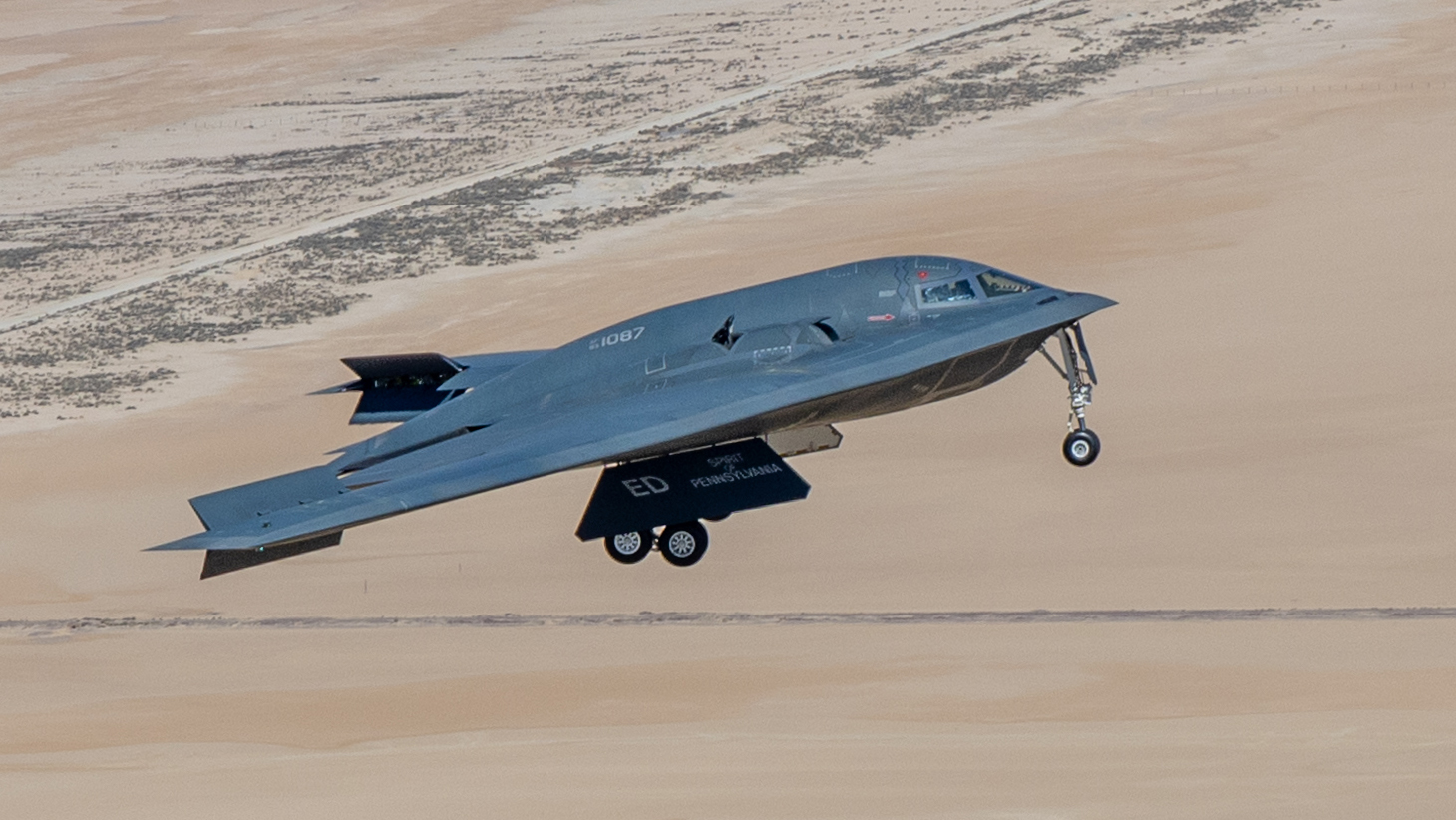
As a B-2 stealth bomber skidded down a Missouri runway, its left landing gear collapsed, and fuel pouring from a punctured gas tank, the pilot at the plane’s controls stomped on the pedal of the remaining brakes with as much force as he could muster.
According to an accident report on the 2022 crash, the pilot “st[ood] up out of [the] seat to give it everything [he] had on the right brake” as the stealth plane skidded helplessly on its left wing for over a mile.
Air Force Global Strike Command released the final report this week of an Accident Investigation Board that reviewed the Dec. 1010, 2022, crash. Investigators found that a series of failures in the plane’s hydraulic system prevented the left landing gear from locking in place beneath it as the aircraft prepared to land. When the plane touched down, the gear collapsed, sending the B-2 skidding on its left wing, causing a fire and subsequent explosions that consumed most of the aircraft’s left side.
The crash caused $300 million worth of damage to the bomber, the report said, and $27,500 in damage to the runway.
After the bomber made a textbook touchdown on a set of stripes on the runway known as the “captain’s bars,” the report found, the left landing gear collapsed about 1,000 feet farther down the runway, and began skidding for over a mile.
Top Stories This Week
“The B-2A came to a stop 9,062 ft down the runway, with the left wingtip on fire in the infield,” the report found. “The fire, fed from the left surge fuel tank, caused the left surge fuel tank to explode, then spread to the left outboard fuel tank, which exploded shortly afterwards.”
Both of the jet’s pilots were unhurt in the crash. Investigation board president, Air Force Col. Jesse W. Lamarand, wrote that both pilots reacted properly to warnings of hydraulic failures in the flight’s final minutes, but an underlying design flaw in the system led to the gear failing to lock in place.
The report also found no fault with maintenance crews at Whiteman Air Force Base, Missouri, or with leaders on the base who approve and oversee all B-2 flights. Whiteman is the only base where B-2s are flown in the Air Force.
The crash occurred as the B-2 returned from an uneventful two-ship training flight with a second B-2. The two planes departed Whiteman early that morning for a long day of flying that included upgrade training for a pilot on the second B-2, and ended with one of the stealth bombers flying to Joint Base Pearl Harbor-Hickam, Hawaii.
Both bombers flew west until they reached a pre-arranged decision point, when one continued to Hawaii while the second turned back to Missouri.
The report also cited an error by the base’s firefighters who responded to the crash. Firefighters waited more than three minutes to spray the burning aircraft with Aqueous Film Forming Foam, or AFFF, a substance designed to fight fires caused by jet fuel, according to the report. The fire chief, investigators found, hesitated in ordering the use of AFFF because he believed it was meant as a “last resort” in such fires. That misunderstanding, the board found, was an example of “allowing unwritten policies to become standard,” a factor Air Force investigators often cite in mishap investigations.
However, the board concluded that early use of AFFF on the fire would not have substantially reduced the damage suffered by the plane.