In 2023, the Navy hired a Los Angeles video firm to make four short films about a string of deadly accidents and the human errors, including lack of sleep, that led to them. The films would be training videos for future officers and chiefs and chronicle the crew fatigue and poor training that led to the grounding of the USS Antietam, and the deadly collisions at sea involving the USS Fitzgerald and USS John S. McCain, all in 2017.
The Navy paid the studio $200,000 for a series entitled “Out of Harm’s Way,” and then the same amount for a second series in 2024.
And then, they disappeared.
Dale Russell, a human performance engineer hired to work for Naval Surface Forces Pacific after the 2017 incidents, hoped they’d be a wake-up call for sailors preparing to deploy.

“It was supposed to make people leave a classroom and go, ‘I need to have a different mindset,'” Russell told Task and Purpose. “If we look good, we risk mistaking appearance for reality and end up in a positive feedback loop of hollow validation, as opposed to going, ‘Hey, guys, we kind of suck. We need to own this and move past this.'”
But in July 2024, the filmmaker got an email from the Navy asking them to take the videos offline.
“We will let you know when and if we would like the videos publicly available again,” the email said.
Two collisions, one grounding in a year
The films are a confessional and soul-searching look at the three deadly mishaps, which together caused an upheaval in Navy leadership, training, and safety rules.
In one, a photograph of a Navy destroyer with a giant hole punched into the side slides across the screen, colliding with an upbeat soundtrack. Memorial photographs of young sailors rise out of a bouquet of red roses on a table.
The voice of Rep. Jackie Speier, a Democratic California congresswoman well known as a gadfly for military accountability, intones: “The last thing we want to convey is that our ships aren’t safe, but … we have some egregious examples.”
Officials at Naval Surface Forces Pacific acknowledged receipt of queries about the films and sustainment of Navy efforts to fight fatigue and address human factors, but did not provide any responses.
The move, which appears to the filmmaker and the former Navy officials behind it to be a face-saving effort by the service, is one example of ways that safety proponents in the surface force see the Navy slow-rolling or backing off efforts to shore up health and resilience. They worry that unwillingness to engage with root causes, or, perhaps more likely, distraction from this work amid other demands, could pave the way for another preventable disaster at sea.
The impetus for the videos — as with many initiatives affecting Navy ship crews over the last decade — stems from a trio of catastrophic mishaps that resulted in 17 sailors’ deaths and a forced reckoning for the entire fleet. In April 2017, the cruiser Antietam ran aground in Tokyo Bay due to poor seamanship. In June and August, two Navy destroyers — the Fitzgerald and John S. McCain — collided with commercial vessels in separate deadly incidents in the Pacific.
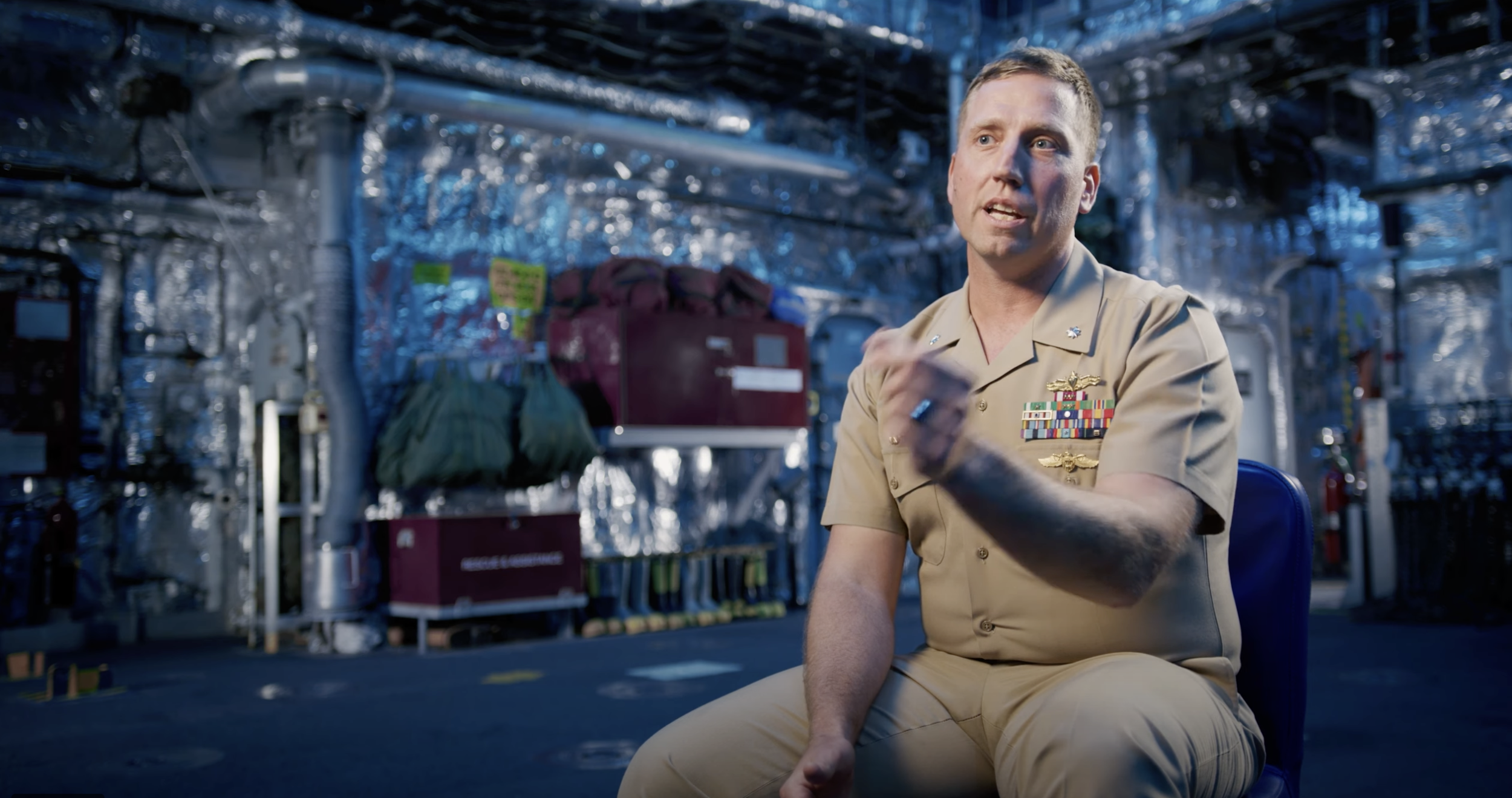
Screenshot from “Out of Harm’s Way.”
Within months, the Navy had published a comprehensive review of all the surface forces, overseen by a four-star admiral, with some 60 recommendations for action targeting common themes behind the mishaps. “Fatigue” is mentioned 46 times in the 177-page report; the phrase “human factors” is cited 20 times. For a while, the Navy seemed to be investing heavily in aggressive efforts to confront the trend of under-rested sailors and a can-do mentality that was creating conditions for big mistakes.
Russell was one of those investments. As part of the Comprehensive Review directive that followed the investigations, he was hired as a human factors engineer at Naval Surface Forces Pacific.
Len Dickter, the co-owner of the production company A Very Good Agency, came across the solicitation for ship training videos in 2023 and saw an opportunity to bring the company’s experience making documentaries and filming onboard ships to bear. When he inquired about the project, he learned that Russell and his departing boss, Vice Adm. Roy Kitchener, commander of Naval Surface Force Pacific Fleet, hoped to create a resonant message that would survive after they’d moved on.
“They wanted something that could sort of reach those upper-echelon people, but could still motivate and inspire. Any officer, any crew member would sort of find insight in this, because it’s also a question of your personal responsibility too, ” Dickter said.
Top Stories This Week
The result was “Out of Harm’s Way,” a series of four roughly 25-minute films probing the causes of the 2017 incidents. But in July 2024, after the videos had been delivered to the Navy and Dickter’s company had begun work on a second film project focused on human performance, he received an email from a Navy public affairs officer.
“I am writing from a client of yours, the Naval Surface Force. Respectfully requesting if you could unlist/remove the video series ‘Out of Harm’s Way,'” the officer wrote, according to an email reviewed by Task and Purpose. “We will let you know when and if we would like the videos publicly available again.”
Dickter learned then that his project had rubbed some leaders the wrong way.
Some Navy leaders, he was told, found the films “demoralizing” and believed “we can’t point the finger at ourselves,” and so “it sort of became a bit controversial,” Dickter said. “We never took [the films] off our Vimeo channel.”
It’s not clear what exactly in the content triggered warning bells, or from what level the order came down to deep-six the films. Multiple sources suggested they got pushed aside amid new leaders at Naval Surface Forces and an all-consuming new crisis: combat operations in the Red Sea following the Oct. 7, 2023, Hamas attacks on Israel.
But while the sailors and experts interviewed in the films don’t villainize anyone or demean the Navy, they do reflect remarkable vulnerability.
“We have to be reminded sometimes,” Capt. Edison Rush, then commanding officer of the littoral combat ship Montgomery, said, “that fatigue will make cowards of us all.”
Locked into a second film project for the Navy, Dickter said he was cautioned to avoid controversy by “new superiors” who inherited the project after the 2023 and 2024 departures of the leaders who set it in motion. The second four-video series tackled Navy fitness and health programs, arguing for changes similar to the Army’s much-praised Holistic Health and Fitness, or H2F, initiative. Featuring interviews from academic and military fitness experts, it did contain a few subversive notes: “Six-thirty [a.m.] PT. Is that really necessary?” one expert asks. “We don’t think so.”
That series, completed a few months ago, has been delivered to the Navy, Dickter said. He doesn’t know how, or if, the service will ever use it. Russell said that before those videos were even done, officials in his former command had decided to kill the project and move on from the idea of a human performance program.
Tackling fatigue and ‘human factors
The years since the collisions have seen some change. Fatigue management is now briefed to sailors ahead of shipboard evolutions and included in training for commanders. The Navy established a circadian-based watchbill intended to help sailors get predictable rest between watch shifts. A human factors oversight council established at Naval Surface Forces Pacific developed “six common traits of a mishap ship,” including poor log-keeping, poor risk management, and — surprisingly — generally above-average performance scores.
A recent ALNAV message called for the prioritization of “restorative sleep” as a way to preserve mental health.
Other efforts are in progress, but in need of resources. Navy initiatives to monitor rest and fatigue aboard ships using wearable devices are slowly moving forward, but are still funded incrementally by research dollars, limiting speed and size of distribution.

Still, several recent accidents across the fleet came between 11 p.m. and 7 a.m., when sailors are most vulnerable to fatigue-fueled errors. In February, the carrier USS Harry S. Truman collided with a Panama-flagged merchant vessel near the Suez Canal. In May 2024, two landing craft air-cushion (LCAC) vessels collided off Jacksonville, Florida. In August, a fire aboard the Amphibious Transport Dock New Orleans burned for about 11 hours off the coast of Okinawa.
Capt. Kevin “Bud” Couch, who served as the Navy’s director of Safety, Human Factors Engineering and Analytics until his May 2023 retirement, and appears in the safety videos, told Task and Purpose that the surface Navy still had two major obstacles to real change: No true consequences for leaders who did not follow instructions on preventing fatigue, and a resistance to prioritizing some tasks over others to keep exhaustion at bay.
“There’s a deep cultural belief that surface warriors work harder than anybody … [we] kind of slide into this idea that every day, everything you do is important, and if we arrive exhausted tomorrow, it’s OK; we’ll just do it again,” Couch said. “It’s sort of an embedded cultural idea that you can do more if you don’t sleep. Which is, you know, physiologically untrue.”