More than a year before the Dec. 7, 1941, Pearl Harbor attack, Britain’s Royal Navy gave the world a preview of the future of warfare when carrier-based torpedo-bombers launched a surprise attack on the Italian navy, damaging and destroying several vessels.
Now, Ukraine and Israel have both shown that small drones launched from behind enemy lines have the potential to devastate an adversary’s most valuable weapons systems.
The Pentagon recently announced a series of new initiatives that are meant to catapult the U.S. military into the forefront of small drone warfare. But the Defense Department, to put it mildly, has a very long way to go.
Currently, the U.S. military is nowhere near Ukraine’s ability to mass produce and use small drones, but the comparison is a bit unfair, a former defense official told Task & Purpose.
Both Ukraine and Israel face an existential threat, the official said, adding that “Nothing focuses the mind like the prospect of being killed. You pick any tool that is handy, and you use it. And if it doesn’t work, you throw it away and don’t worry about how much it cost.”
Recent changes announced by Defense Secretary Pete Hegseth about how the U.S. military acquires and fields small drones could be a step forward in how the American defense industry produces drones at the scale that Ukraine is.
Top Stories This Week
In a July 10 memo, Hegseth called for every squad to have “low-cost, expendable drones” by the end of 2026, with priority going to equipping combat units in the Indo-Pacific region. In a major change, Hegseh wrote that small drones “resemble munitions more than high-end airplanes,” so they should be categorized as consumables.
In other words, troops can treat small drones as munitions instead of aircraft, and that will allow the U.S. military to buy many more of them, said Caitlin Lee, of the RAND Corporation.
“I think this move to treat small drones like munitions is a recognition of the fact that we don’t need four FAA flight restrictions on these small drones,” Lee said. “We don’t need triple redundancy on their software or hardware. They’re unmanned, so let’s not get wrapped around the axle with the regulation. The line between a drone, a loitering munition, and a missile is just getting blurrier and blurrier, and I think this is a recognition of that.”https://www.dvidshub.net/image/9132867/drone-grenade-drop-gta
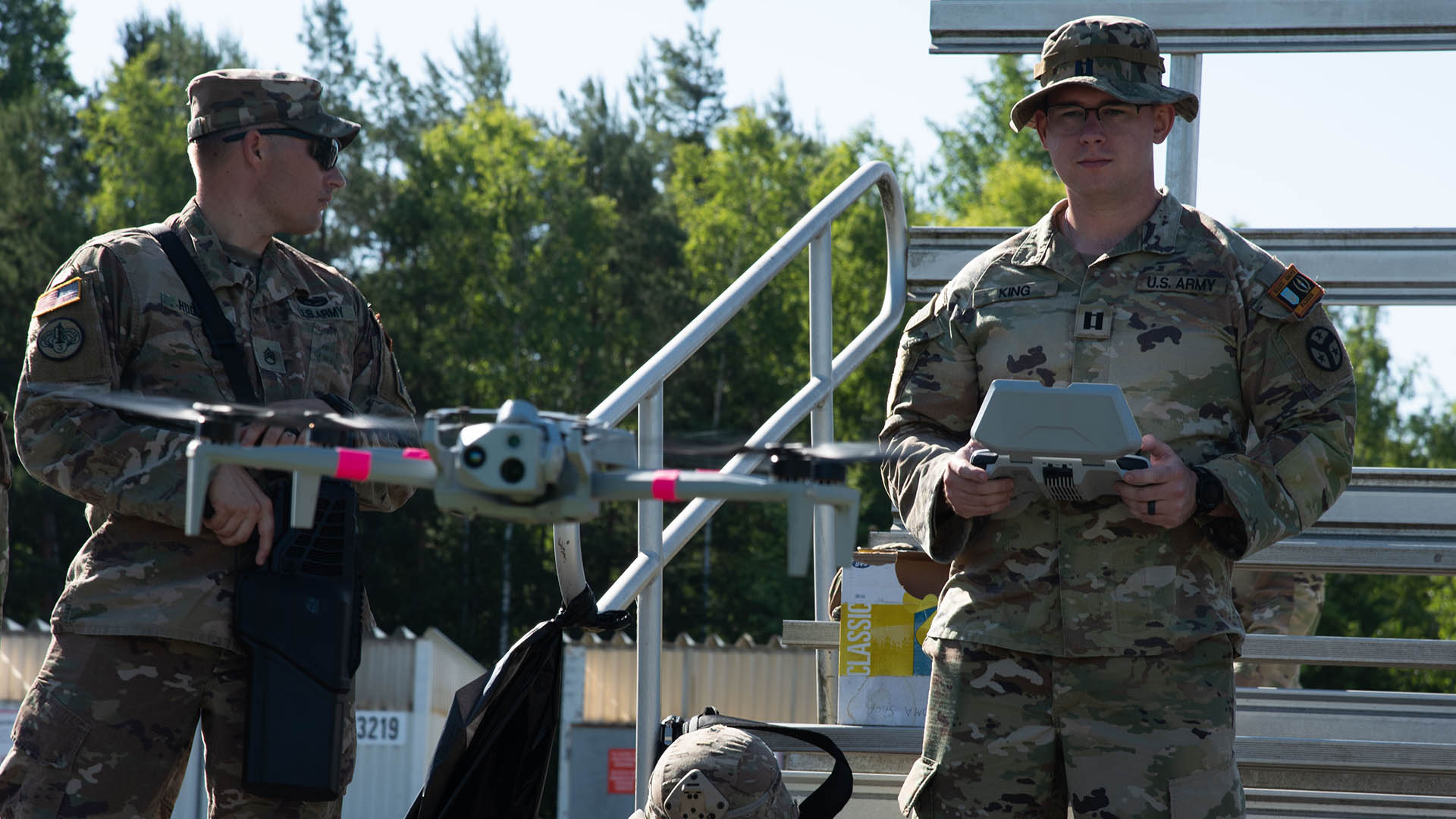
In a future war, small drones would give the U.S. allies and partners to “blunt an invasion,” buying time for the American military to bring its more advanced weapons systems to bear, Lee explained.
The Army has already been implementing some battlefield lessons about small drones at its training centers in recent years, said retired Lt. Gen. Ben Hodges, former commander of U.S. Army Europe. The training center at Hohenfels, Germany, for example, has pitted soldiers against an opposing force equipped with drones since 2016, based on lessons from Russia’s initial invasion of Ukraine two years earlier, he said.
“When you really want to make change happen in the Army, you do it at the training center, because everybody wants to beat the hated OPFOR,” Hodges said. “And so, if the OPFOR has drones — and they do — then you have to get good at countering that and using drones on your own.”
The question now is whether the U.S. military can produce and field small drones quickly enough to adapt to new battlefield realities, or whether it will be unprepared by an enemy that is much further ahead in realizing the potential of small drone attacks. Task & Purpose’s video producer, Kyle Gunn, discusses this issue in depth on our YouTube channel. You can watch that video here.