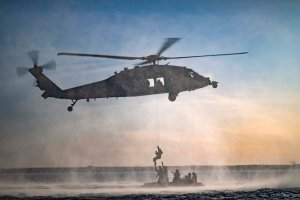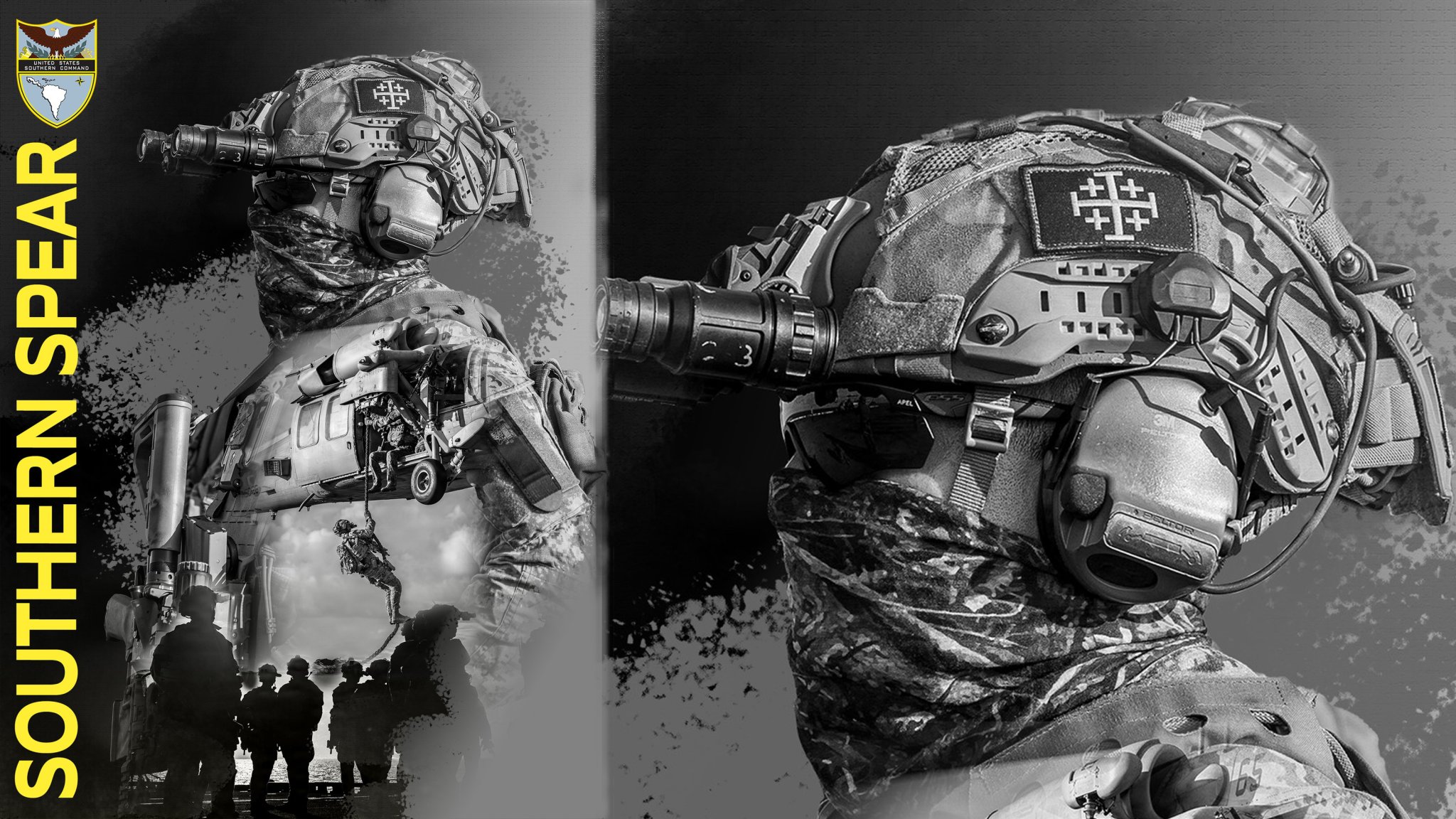
Officials at U.S. Southern Command posted a photo collage Tuesday, illustrating Marines fast roping from a helicopter and a masked infantryman wearing his helmet, NVGs, a plate carrier, and armed with his rifle.
But the Marine, some noted, was out of uniform.
The black and white collage features a Marine with the Jerusalem Cross patch fixed prominently on their helmet. The Marines appear to have been assigned to the 22nd Marine Expeditionary Unit, which is currently deployed to the Caribbean as part of Operation Southern Spear, the Pentagon’s stated mission to dismantle drug cartels.
The photo was removed from the Defense Visual Information Distribution Service, or DVIDS, but was still on the command’s official Instagram, Facebook and X pages Tuesday afternoon.
The photo was “removed from DVIDS because the service member shown was not in standing with uniform regulations,” Steven Mcloud, a spokesperson for U.S. Southern Command, told Task & Purpose.
According to Marine Corps uniform regulation, religious apparel can be worn if it is “not visible or apparent when worn with the uniform,” when “attending or conducting divine services or while in a chapel or other house of worship,” or when given explicit command approval.
The 22nd MEU did not respond to requests for comment and SOUTHCOM did not elaborate on why the image remained on its other social media accounts despite the command’s decision to remove it from DVIDS.
The photo drew attention online with users pointing to the religious nature of the Jerusalem Cross, which dates back to the Crusades.
“The graphic that’s on social media is an illustration of service members in a ready posture during Operation SOUTHERN SPEAR. There is no other communication intent for this image,” Mcloud said.
Top Stories This Week
Mikey Weinstein, a former Air Force judge advocate and president of the Military Religious Freedom Foundation, argued that the patch, and the social media posts showcasing it, violate uniform regulations and constitutional norms.
“This is the most egregious example of a church-state violation in the military,” Weinstein said. “That Jerusalem cross and that graphic, it sticks out to the same extent that a tarantula does on a wedding cake and it sends the exact wrong message. It sends an encyclopedia of wrong messages on every possible level, because what it stands for is Christian nationalism.”
Matthew Gabriele, a medieval studies professor and chair of Virginia Tech’s religion department, said the Jerusalem cross is not a symbol used in contemporary Christianity and has been appropriated by modern far-right movements, spotted in imagery used by protestors in Charlottesville, Virginia, and at the U.S. Capitol on Jan. 6, 2021.
“It is really attached to a far right understanding of kind of this nostalgia for a medieval Christendom and that’s really kind of the only way that you kind of see it being used in the 21st century,” he said.
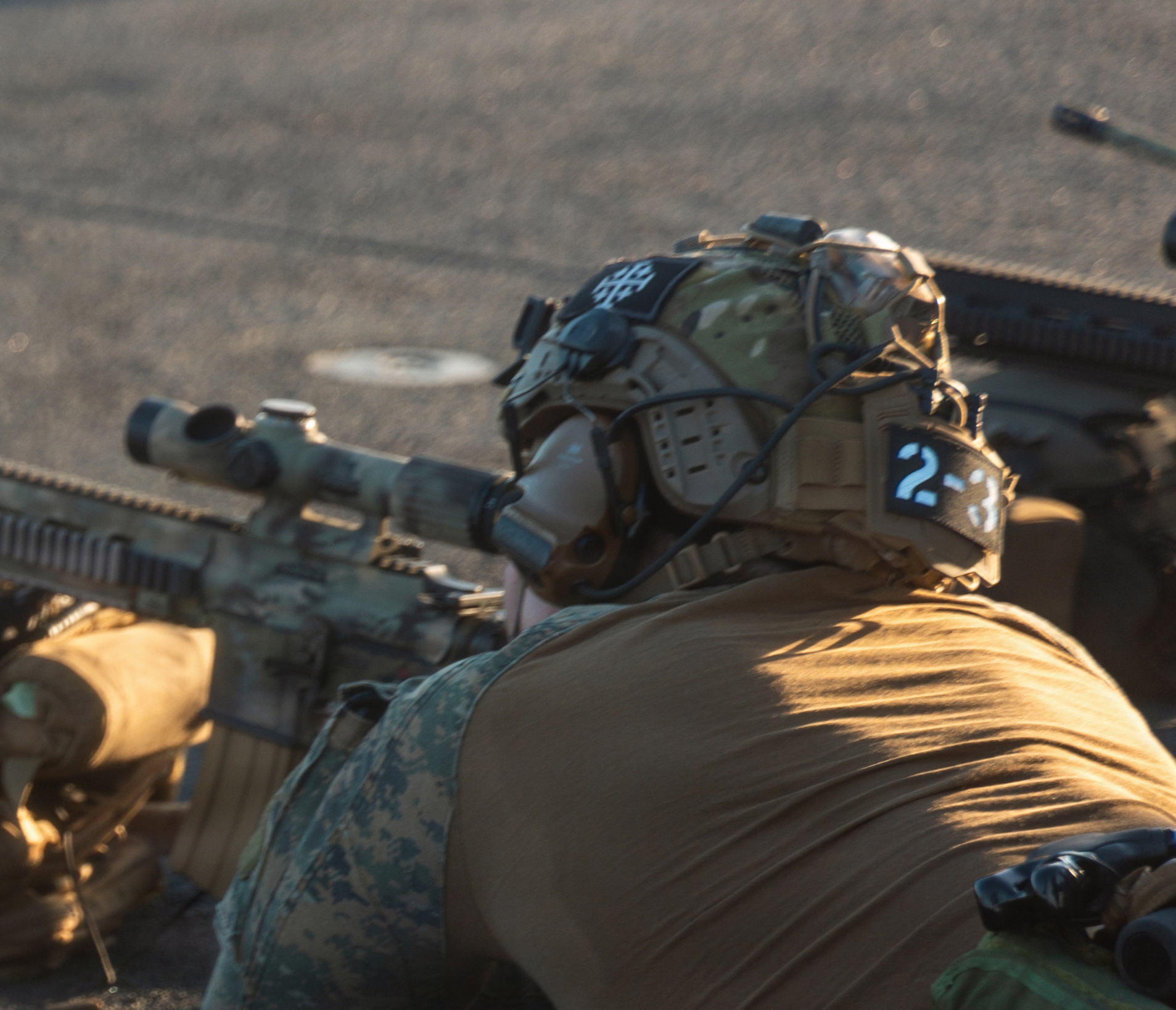
Another photo taken in November from a different angle appears to show the Marine aboard the USS Iwo Jima. The patch can be seen on the left side of his helmet in the second shot.
Crusader symbolism, in particular, has come under fire in the Marine Corps before. In 2012, a Marine attack squadron named the “Crusaders” with a cross and shield insignia changed its name to the “Werewolves” after the Military Religious Freedom Foundation blasted the use of the name and logo.
During his confirmation hearing last year, Defense Secretary Pete Hegseth, who has a tattoo of the cross, was questioned about the symbolism.
Gabriele noted that the symbol became popularized among troops after 9/11 when former President George W. Bush said the U.S. would “rid the world of evil-doers,” referring to “this crusade, this war on terrorism.”
“There was an outcry about that. They kind of walked it back,” Gabriele said. “Not a lot, I would say, but certainly a noticeable number of military [personnel] were spotted wearing crusader cross tattoos.”
It’s not the first time that morale patches garnered controversy. In November 2024, while deployed to the Red Sea, a Navy helicopter squadron member donned a “Houthi Hunting Club Red Sea 2023-2024,” patch with an image of the Tusken Raiders from “Star Wars,” otherwise known as “sand people.” The patch was featured in an official Navy photo and then removed from DVIDS. Troops regularly wear morale patches on their uniforms that feature unofficial imagery ranging from cultural references to inside jokes within a unit. Some patches have featured more controversial imagery and led to condemnation by the services, like a Special Forces patch resembling a Nazi skull and crossbones that was banned by the Army. In some cases, they’ve led to formal reviews, such as in January 2021, when the Air Force directed commanders to review their official and unofficial unit emblems, morale patches, mottos, and other unit imagery “to ensure an inclusive and professional environment.”