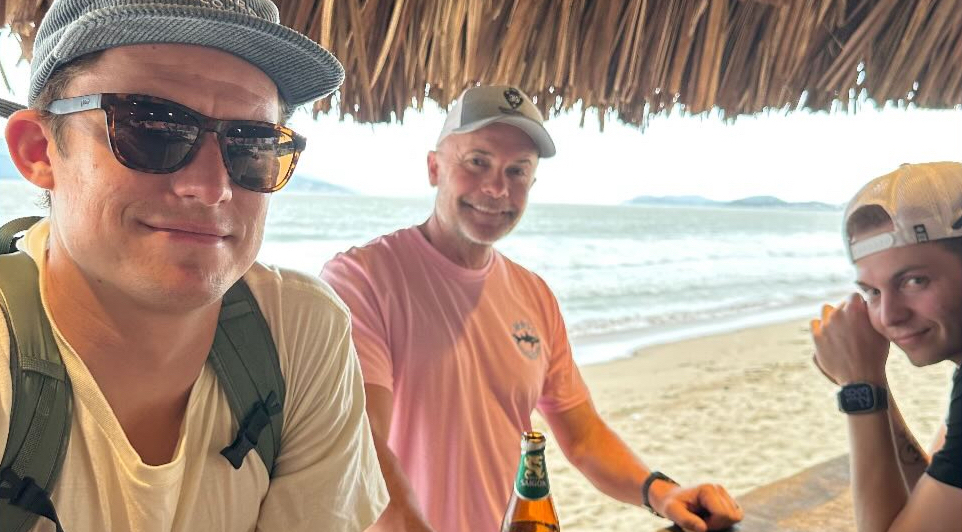
Sitting at a beachside bar, Jeff Evans looked out into the waters of the South China Sea and wondered if his dad and uncle had ever shared a beer at the same bar.
“The rumor mill in the family was that they had got together once or twice,” Evans said. “And I would only like to hope that they’re like me, and I love the beach.”
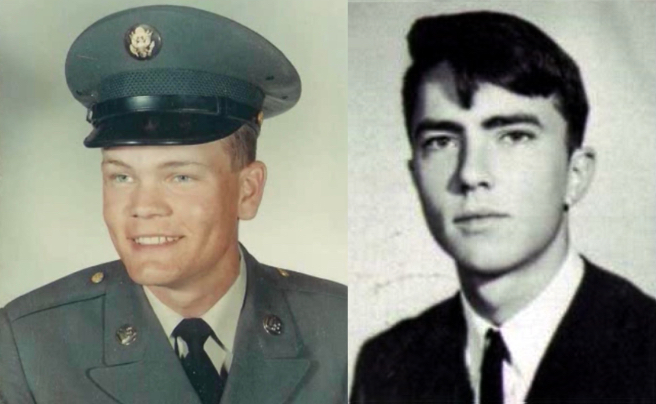
Perhaps, he thought, his uncle David Lynn Evans had taken leave from his base outside Ho Chi Minh City and traveled to Nha Trang, where his brother, Norman Francis Evans — Jeff’s father — was stationed. It would have been early 1968, during both men’s first tour in Vietnam.
Perhaps the brothers from Oregon had shared a beer at one of the city’s oceanside bars — maybe this bar.
It was a nice idea, even if only based on a family rumor. But Jeff Evans had not come to Vietnam to chase rumors.
Instead, after nearly two years of planning, he’d come with his own family to visit the exact sites where his uncle David and his father had died more than five decades before.
“I was watching a 60 Minutes story on Vietnam veterans going back to where they fought,” Evans said. “I thought, ‘Why can’t a Gold Star kid go back?’”
Jeff spent over a year collecting old files and reports on their deaths before traveling to Vietnam in late 2024 (a Task & Purpose story in early 2024 chronicled the three members of the Evans family killed in wartime service).
“I’m not getting coordinates, but I’m getting the maps, trying to go from there,” Jeff said.
Top Stories This Week
A Vietnam vet put him in touch with a friend at the National Archives, who helped track down old personnel files and some maps. But he soon found that names of villages and towns had changed, rivers had shifted, and new roads and canals added confusion.
“Trying to match those maps up to present-day Google Maps was very difficult,” he said. “You travel 8,000 miles, crossing your fingers that you’re in the right spot.”
A hidden memorial
At just 19, David Evans was a gunner with the 117th Assault Helicopter Company in the Long An province. When his helicopter was shot down, Evans stayed on his gun, holding off advancing Vietnamese as the other survivors ran for a nearby treeline. In the years since, Jeff says, he’s met several men who were on the helicopter.
“They said they made it to the jungle only because David stayed on that gun,” Jeff said.
With a plan to find David Evans crash site on the first day in Vietnam, the group — Jeff, his wife, Dena, and sons Jake and Austin — took a two-hour van ride from Ho Chi Minh City, stopping at a remote farmhouse. After walking for 30 minutes through jungle paths, Jeff suddenly recognized an arrangement of canals and rice paddies.
“I had stared at satellite maps so long I actually recognized the area from the ground,” he said. “As we’re standing there, we could be the first Americans that have been there since 1968 for all we know.”
An older woman approached the group, who said she was born and raised on the property, and had been a teenager in 1968.

Uncle Dave’s location of death in Vietnam
“I said, ‘ask her if she remembers a helicopter crash in a gunfight.’ And as soon as he says this, she points right to it,” Jeff said. When the guide introduced Jeff as the nephew of an American killed on board, the woman pointed to a nearby courtyard: had he seen the memorial?
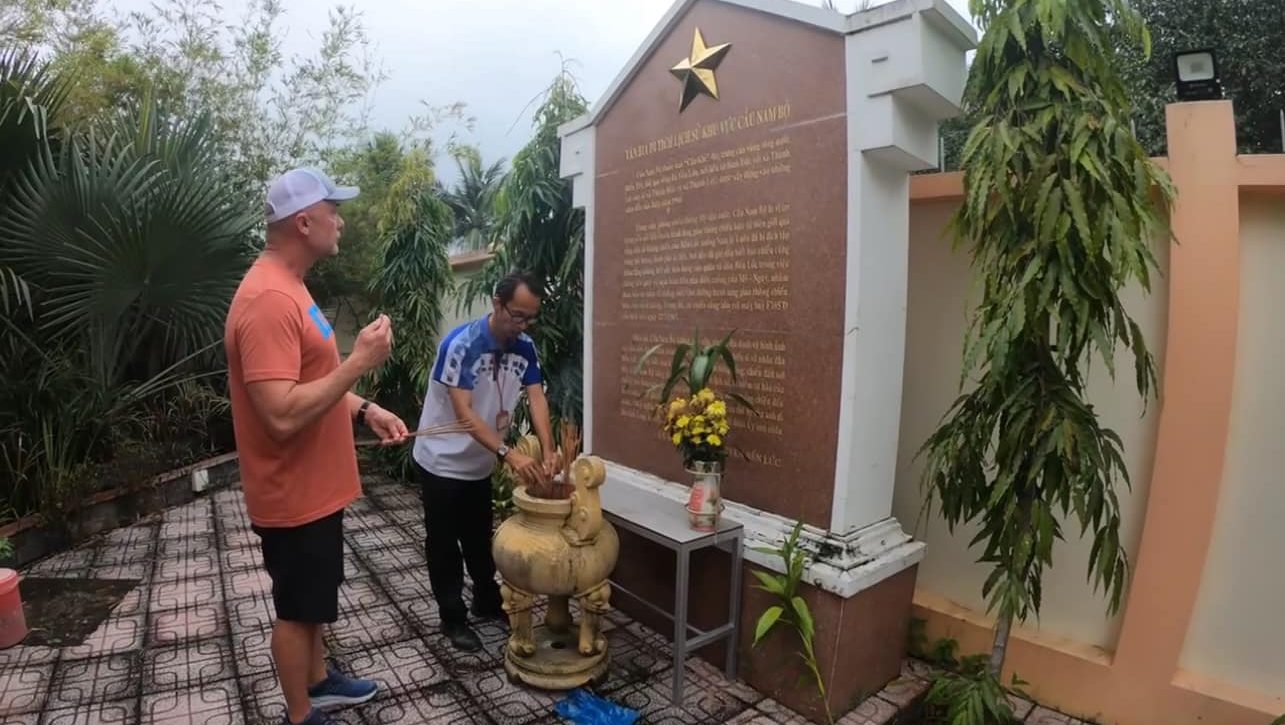
Marked by a Vietnamese flag, a small walled compound nearby hid a plaque memorializing a firefight and helicopter crash. The listed year was wrong, 1967 rather than 1968, but the details matched: 12 dead Vietnamese soldiers and one American.
“So we go around the corner, and she says, ‘The memorial was built for the South Vietnamese soldiers that died, and one of yours, one American,’” Jeff said.
As Jeff took video of the moment, he held back sobs.
“This is the craziest thing in the world to come all this way and find this,” he said.
Still exhausted from the three days of travel to reach Vietnam, Jeff said, the entire episode felt almost dream-like.
“We have 13 more days,” he remembers thinking. “I’m not sure I can make it 13 more days with all this emotion.”
A father’s crash site
Days later, the Evans visited Can Tho, where Jeff’s father, Norman, was stationed in 1970 as a 23-year-old SP6 — the equivalent of a staff sergeant today — assigned to the 156th Aviation Company of the secretive Army Security Agency. The ASA operated hidden listening posts and slow-moving RU-6 spy planes, combing the air for enemy radio signals.
Returning from a mission in November, Norman Evans’ plane collided with a helicopter, killing all four Americans on the plane and 12 Vietnamese Marines.
The crash had been in a river. Though the bodies of the men on board had been recovered, the engine of the plane had sunk too deep in the mud. But the crash had been close to the city of Can Tho, and proved easier to reach than his uncle’s crash.
“According to my guide, we got to about 10 feet of where my dad was at,” he said. “So I stood where my uncle died. I stood where my dad died, I shared the dirt. You know, people, you know, ask me if I had closure, yeah? And I think it was more of a connection that I had with my dad, you know, sharing the same dirt that he died on.”
The trip ended at the bar on the beach, drinking a beer with Austin and Jake.
“I’m sitting there with my boys drinking a beer on the beach, wondering if my dad, my uncle, drank beer on the same beach,” he said.