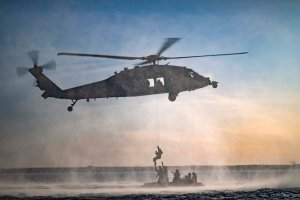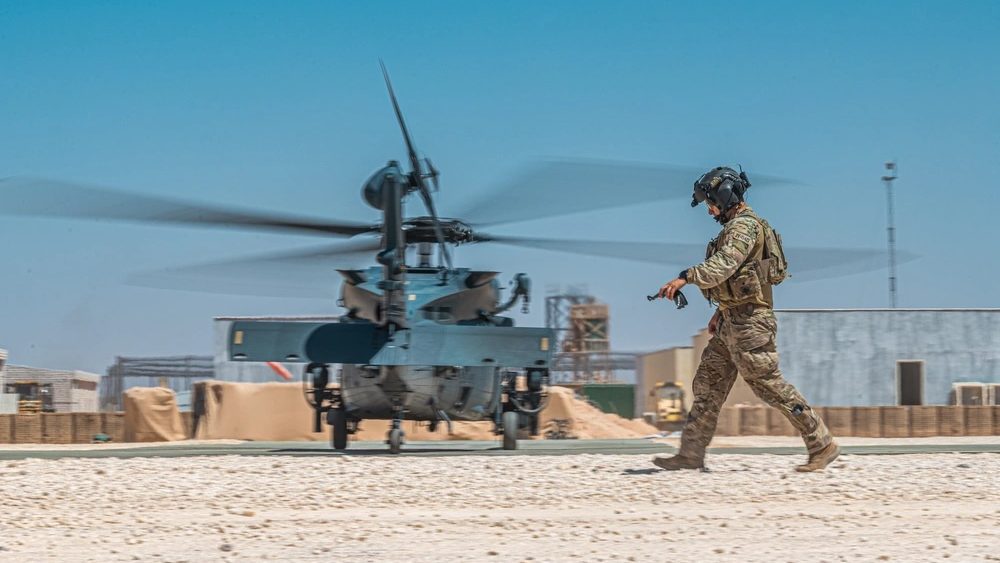
Combat search and rescue is the promise the Air Force makes to American and allied pilots and aircrew: “if you punch out over enemy territory, we’ll come get you.”
The problem is that the rescue force isn’t growing, right as the Pentagon is preparing for a possible conflict with China, where aircraft losses are likely, and the vast waters of the Pacific Ocean make walking home impossible.
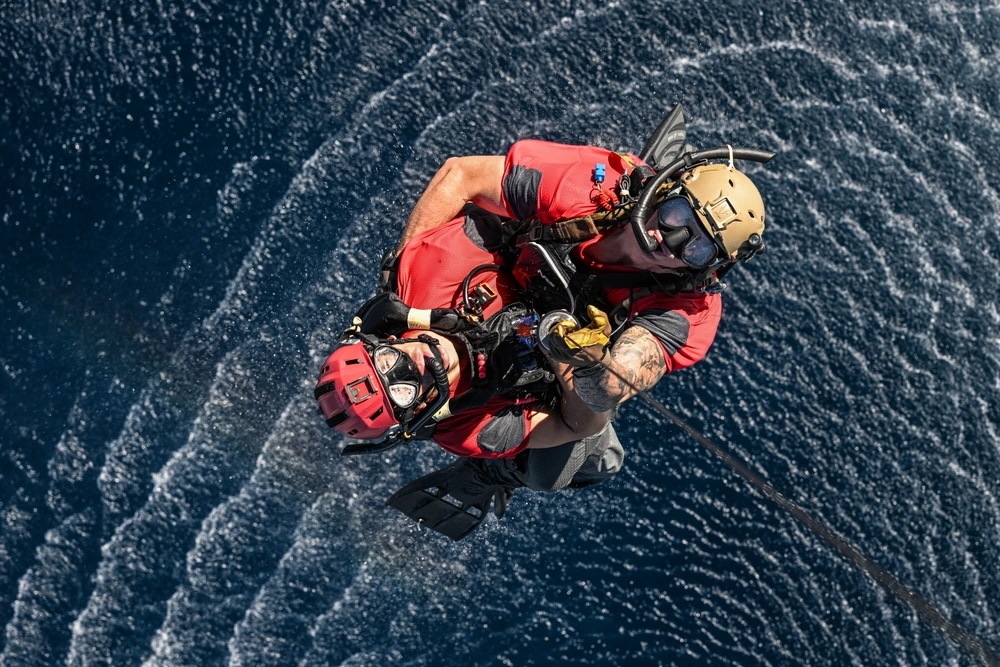
For context, the full-time Air Force combat search and rescue, or CSAR, corps has three key components: helicopters that pick up wounded or isolated troops; the C-130 cargo aircraft that command the rescue operation and refuel the helicopters en route; and the pararescuemen (better known as PJs) and combat rescue officers who actually get on the ground or in the water to make the pick-up.
This triad earned a reputation for bravery in the Vietnam War, where rescue helicopter crews often made easy targets of themselves under heavy enemy fire while lowering PJs into the jungle to grab downed aircrew.
The rescue crews couldn’t save everyone, but earned a reputation for fierce determination to try. Of the roughly 3,000 Air Force aviators shot down over Southeast Asia, about 49% were killed or declared missing, while about 10% were captured. But over the course of the war, Air Force rescue crews brought home close to 1,200 Air Force pilots — 41% of those shot down — and over 600 Navy fliers. Put another way, combat pilots could fly missions knowing that if they ended up on the ground alive, they had a four-out-of-five chance of being rescued, which has a morale effect that is difficult to quantify.
Capt. Ronald Bliss, a fighter pilot in Vietnam, said after the war: “When I showed up at Takhli in ‘66, an F-105 pilot had a 100% chance of being shot down and a 50% chance of being rescued. We never failed to fly a mission.”
Air Force CSAR upheld its reputation while picking up injured ground troops under fire during the Global War on Terror. But by the 2010s, the aging HH-60G helicopter fleet needed urgent replacement. The new HH-60W holds a lot more gas, which lets it fly further than the 60G. The ‘Whiskey’ also has better avionics, defensive countermeasures, and communications gear, which will help crews better understand the battlefield, work more closely with friendlies, and stay alive in a dangerous airspace.
But Air Force rescue crews may not get as many of them as they say they need. The Air Force was originally slated to receive 112 60Ws, enough to replace all the 60Gs. But after several rounds of back and forth between Air Force officials and Congress, that number shrank to 75 in 2022.
Now, Air Force officials and Congress seem to have arrived at a peculiar compromise. The plan is for the Air Force to buy close to 100 of the new helicopters, but use about two dozen of them for ferrying officials around Washington, D.C. Demodifying those 60Ws, which were designed specifically for long-range combat rescue, will cost millions of dollars.

How ‘force packaging’ works on a modern battlefield
Part of the reason why the Air Force wanted to shrink its 60W buy was the theory that a slow helicopter would not survive on a battlefield crawling with modern radar systems, surface-to-air missiles, and fighter jets, all of which are in China’s military inventory.
At first glance, heavy helicopter losses on both sides of the war in Ukraine would seem to validate that theory. But even the most sophisticated anti-air weapons have blind spots that can be exploited with the right tactics and countermeasures.
Retired Air Force Lt Col. Brandon Losacker provided an insider’s view of the problem. Losacker spent his career flying the HH-60G and Marine UH-1Y and is a graduate of the Air Force Weapons School. In his view, no modern aircraft will be invulnerable on future battlefields, whether it’s a slow-moving helicopter or an F-35 with the latest stealth technology. That’s part of why, even with F-35s, the U.S. military constantly drills “force packaging,” where pilots and planners use a mix of systems and weapons to cover each other’s weaknesses and knock a hole in enemy defenses.
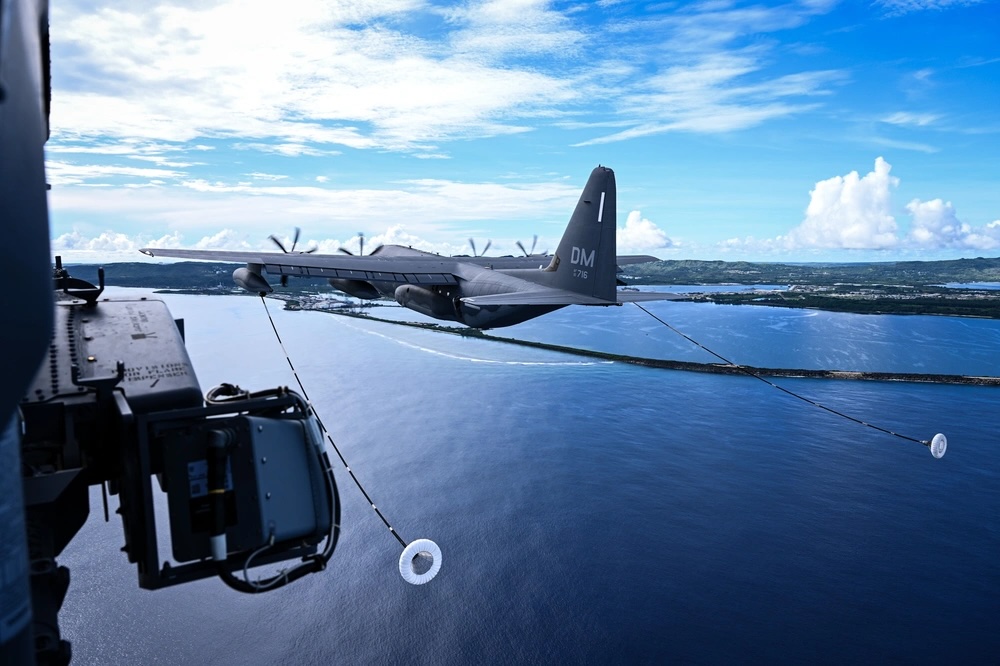
So as rescue crews dash towards a pick-up, they’re covered by a mix of other assets that might include air-launched decoys to confuse enemy radars; electronic warfare aircraft such as the EA-18G Growler to jam communications; F-16 or F-35 fighters to suppress surface-to-air missiles, with F-22s watching out for enemy aircraft overhead. Losacker said the rescue community constantly trains to integrate with other forces, and new technology makes CSAR teams even more formidable.
In September, an HC-130J was spotted with an Angry Kitten electronic warfare pod (yes, it’s actually called Angry Kitten). The pod can project hostile radar signals back at the receivers to create false or confusing tracks.
With a few technicians in the back of an Angry Kitten-equipped HC-130J, they can tailor bogus signals on the fly or launch drones out the back emitting decoy signals to confuse enemy air defenses. Meanwhile, HH-60W crews have developed successful tactics while training with larger force packages against America’s best radars and other threats, including the F-15 fighter jet.
New tech to boost performance
Still, the HH-60W has a glaring weakness. Even with air refueling, helicopters fly relatively slowly, and their combat range is partially limited by how far into dangerous airspace their tankers can fly. But with Pentagon officials wary of a fight with China in the next five to ten years, the Air Force does not have the time or budget to go about inventing, testing, and buying a new aircraft for long-distance rescue.
So how do we work with what we’ve got? One idea is to make the slow-flying helicopter more like a faster-moving plane. That’s basically the goal of a design called the vectored thrust ducted propeller, or VTDP for short. VTDP puts a propeller on the back, wings on the sides, and has other features that would make the 60W fly a lot faster and at a longer range. Engineers actually flew a prototype Seahawk kitted out like this (and dubbed the SpeedHawk) back in 2007, but the military ended up passing on the project.
Finding aviators lost at sea
A conflict in the Pacific would likely take place at least in part across the region’s vast oceans, which require different skills and equipment than CSAR over land. Losacker suggested modernizing an idea that dates to World War II, when modified B-17 and B-29 bombers dropped motorized lifeboats to downed aviators. Dropping inflatable boats remains a central skill for both Air Force and Coast Guard crews today, but the next version of that might be dropping lifeboats carried by autonomous gliders. Those systems could be dropped out of an HC-130J from outside the enemy’s weapons range, then fly to the downed aviator, a tactic the Air Force is already exploring for cargo delivery.
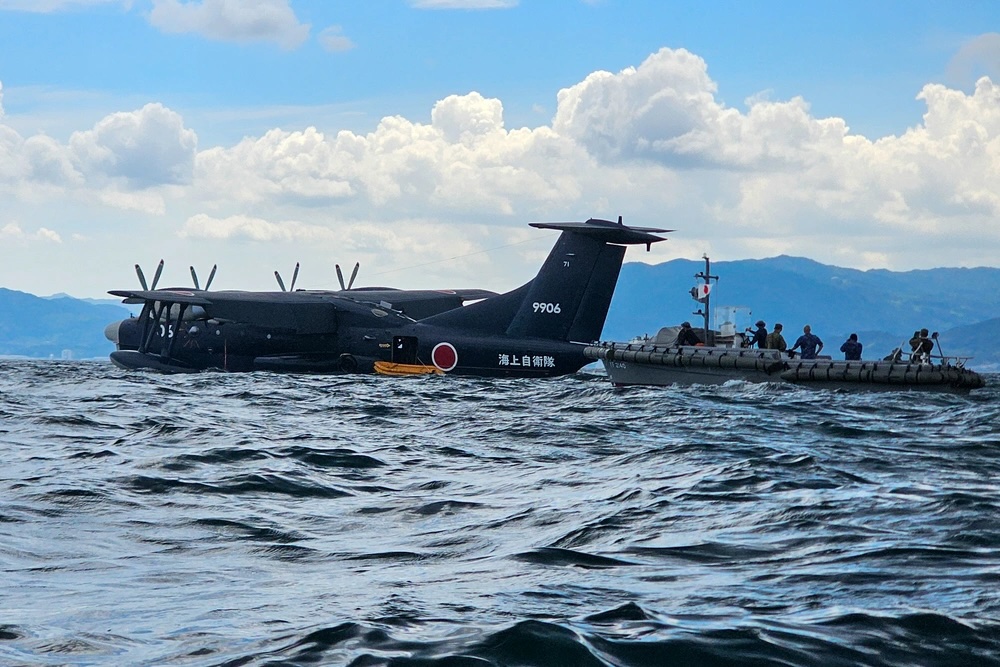
Of course, the simplest way to grab a pilot floating in the ocean is to land a plane next to them. A pilot program in this year’s defense funding bill lets Indo-Pacific Command hire contractors who fly amphibious aircraft, which are built to land on open water. It’s not clear what kind of aircraft would be involved or for what purpose, but the military has hired contractors for casualty evacuation before. The U.S. military currently has zero amphibious aircraft.
Other ways to augment the military’s rescue force could include drafting tiltrotor V-22 Ospreys for rescue use, along with the Navy’s fleet of more than 450 helicopters, which can take off from boats as small as littoral combat ships. But while the Osprey has longer legs and faster speeds than an HH-60W, it is more expensive and needs more resources to keep running. Also, the Ospreys already in use by the Air Force are a mainstay of special operations forces.
Navy helicopters excel at picking up downed aviators close to the fleet. But unlike Air Force rescue forces, the Navy flies helicopters that can’t refuel mid-air, which limits their range. Losacker pointed out that they are also Navy assets, so in a major conflict, they will likely be busy performing Navy missions such as anti-submarine warfare and fleet defense. Ultimately, the Pentagon assigns the mission of global personnel recovery to the Air Force, not the Navy.
CSAR ‘muscle memory’
But the biggest advantage of Air Force rescue squadrons is that, after a generation of combat in the Middle East, they have the best-toned muscle memory for CSAR. They just might not have enough aircraft to meet the potential demand.
In a sweeping 2017 research paper, Losacker analyzed the number of rescue aircraft the U.S. had in Southeast Asia and during Desert Storm and calculated based on that precedent that the U.S. would need about 200 rescue aircraft to provide similar coverage for a two-theater major conflict today. Short of that, Losacker said the 75 dedicated rescue helicopters the Air Force is due to receive may not be enough to cover multiple simultaneous crises, such as a major war with China, an emergency in the Middle East, and natural disasters.
It is unlikely the Air Force will buy more rescue aircraft in the near future, as the service is stretched thin trying to modernize its fighter, bomber, tanker, trainer, and nuclear missile fleets all at once.
In the short-term, the Air Force can modify its current helicopter fleet to move faster, farther, and bring more punch to the fight. Long-range air-launched lifeboats and contracted amphibious aircraft could also open up new possibilities.
In the long-term, this is not an easy problem to solve, Losacker said, but the U.S. military has a moral and operational responsibility to solve it. In the meantime, find out more about the Air Force’s CSAR problem by watching our YouTube coverage here.