
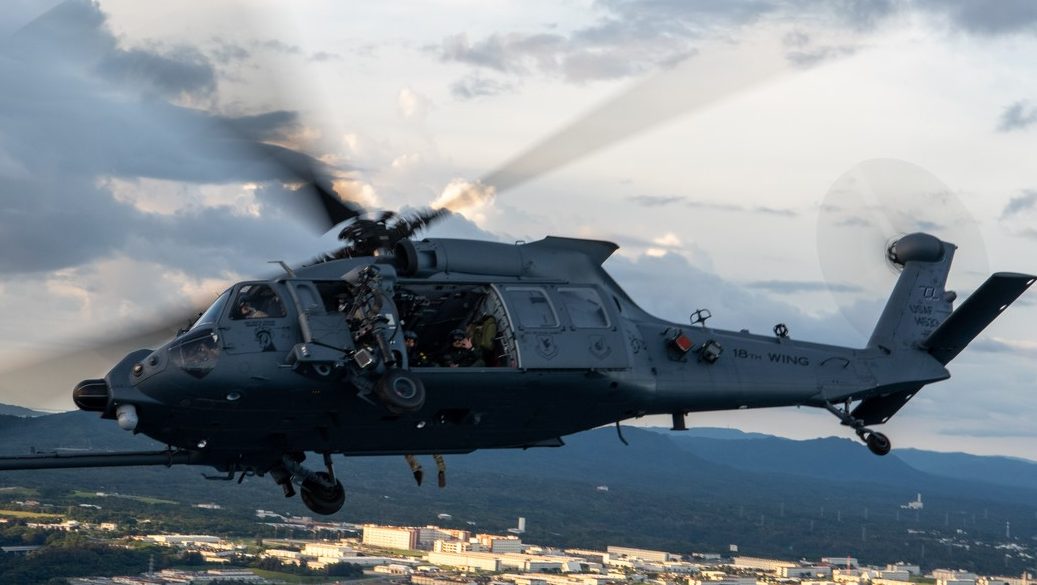
A 60-year-old elementary school teacher died from severe head injuries after rotor wash from an Air Force helicopter slammed her to the ground during an ill-fated demonstration flight last April outside the school in which taught.
The woman was among a group of children and teachers that Air Force officials allowed to stand less than 100 feet from the planned final line of flight and landing spot of an HH-60W rescue helicopter at Kadena Air Force Base, Japan, according to an accident investigation report released last week. That decision — based on a flawed review of regulations governing helicopter landings and air shows — put the children and their teachers 500 feet closer to the helicopter than they should have been at the family-focused event.
The woman’s death, the report found, came amid poor planning and a “false confidence of safety” among personnel at the 33rd Rescue Squadron at Kadena. Those mistakes arose, investigators found, despite a heavy focus on safety for the flight among the pilots, crew, and leaders at the 33rd.
“Aircrew members stated that when they planned and flew the aerial demonstration, they believed they were doing so safely, attested to by the fact that many aircrew members had family members physically present in the spectator areas,” according to the report.
But while at least two children were knocked over by the rotor wash, the teacher’s injuries were made “much more severe,” investigators found, by an umbrella hooked to her arm. When hit by a 40-miles-per-hour “blast” of air from the helicopter, the umbrella inflated and slammed the woman, a Japanese civilian, onto a concrete sidewalk, far harder than a typical fall would have.
Medical personnel quickly reached the woman, finding her in an altered mental state and beginning to vomit — both signs of a severe head injury. She soon lost consciousness, the report said. Responders took the woman to an on-base hospital and then a local Japanese hospital, where she died.
‘False confidence of safety’
Investigators found that the root of the mishap lay in the decision to allow spectators to stand far too close to the HH-60W’s planned landing zone. That decision, the report said, came at the end of a cascade of incorrect planning decisions and procedures. Approvals for the flight were mishandled by officials in the 33rd and at the 18th Wing at Kadena, investigators found, and senior planners who should have spotted errors did not.
But behind paperwork errors, the report found, was “an operational mindset” that pilots and crews of the 33rd brought to the flight, approaching the family-focused event at an elementary school with a mindset little different from one that served the crews well in training and even active combat missions.
Air Force Rescue pilots, the report said, regularly train and operate on missions in which they land their helicopters “within 25 feet of trained military aircrew and often as close as one foot away.” That expertise, however, led the pilots and planners of the mission to overlook the Air Force regulation for all public-focused demonstration flights, DAFI 11-209, Participation in Aerial Events.
That regulation applies to events aimed at civilians, like static displays, air shows, and demonstration flights. Instead, the report found, the planners relied on regulations that govern normal operational flights at military landing and drop zones, along with their own judgment.
Top Stories This Week
“In considering safe distances for spectators, assessments by the [two flight planners] also were informed by their experience in normal HH60W helicopter operations,” the report said. One of the planners said he believed a safe spectator distance would be one “rotor disc” or about 50 feet.
In fact, the Aerial Event regulation requires spectators to be 500 feet from an HH-60W’s landing zone. An approved plan for the Kadena event, which followed those rules, specified a wider 600-foot buffer at the school. But on the day of the flight, dozens of school children from two adjacent schools and their teachers were allowed to stand in three areas within 150 feet of the landing zone.
“That operational mindset appears to have contributed to a planning approach that did not intentionally disregard distance requirements” from the air show rules, the report said. “It simply did not consider those requirements.”
Month of the Military Child event
The flight occurred on April 22, 2025, as part of a “Month of the Military Child” celebration at Kadena. The HH-60W — the Air Force’s newest and most powerful rescue helicopter — would land at Kadena Elementary School as teachers and students watched.
The landing was one of four that helicopters from the 33rd Rescue Squadron were set to do on the base, showing certain movements before landing and letting students talk to crews. Similar landings had been executed in the two previous years, and planning for the event began two months prior to the April event.
But the 2025 plan, investigators found, was little more than a copy of the 2024 plan. One of two ground controllers for the event — who would have been responsible for assuring that the landing zone was prepared for the helicopter’s arrival, including the location of spectators — was assigned just the night before the flight and had little understanding of the event, the report said.
“The mishap at KES — with the tragic loss of a longtime DoDEA teacher and deeply respected community member — regrettably makes clear that their well-meaning confidence was misplaced,” the report said.
Loading comments…
Comments couldn’t be loaded. Please refresh the page.