
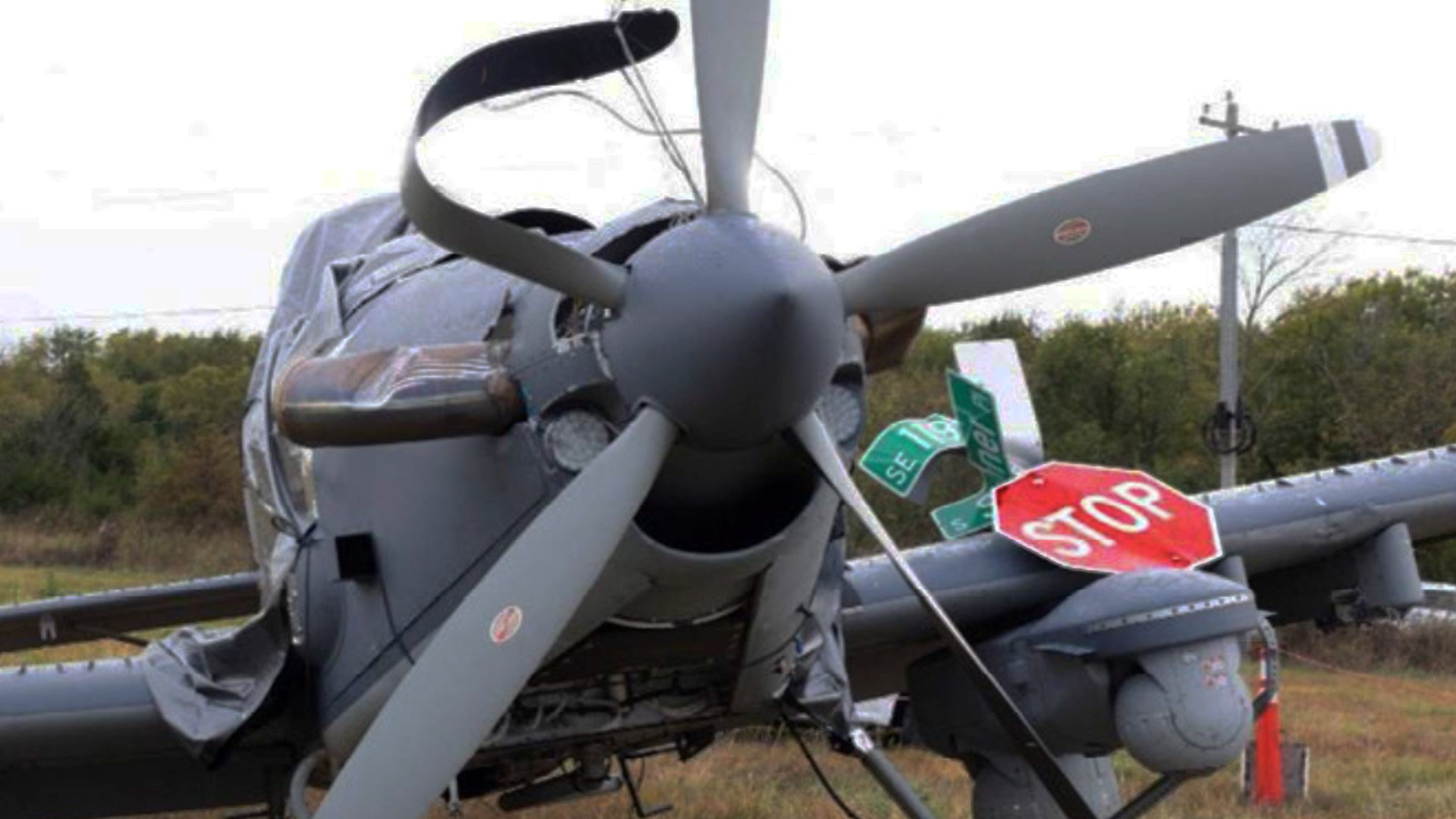
An Air Force special operations plane made an emergency landing last October on a rural Oklahoma road after a student pilot mistakenly switched off the fuel supply to the plane’s engine while 2,300 feet in the air. When the plane skidded to a halt in an empty nearby field, a stop sign from the road was lodged in its wing.
Neither the student nor the instructor pilot on board, who took over the plane’s controls as the engine sputtered and the plane began to fall from the sky, were hurt in the October 2025 mishap outside Oklahoma City. But the Skyraider II, which belonged to the 17th Special Operations Squadron at Will Rogers Air National Guard Base, was a total loss, which investigators valued at $17 million. The squadron trains Skyraider II pilots for Air Force Special Operations Command, or AFSOC.
In a final report released Friday, an Air Force accident investigation board blamed the pilot’s unintended mistake for the crash.
The pilot, the board found, was instructed to test the plane’s fuel system, but “inadvertently turned the fuel shutoff valve handle clockwise pulling the fuselage fuel tank valve backward, resulting in engine fuel starvation and subsequent power loss.”
Although the student pilot was “unqualified” in the Skyraider with just 19 flights and 37 hours in the tiny plane, he was an experienced AFSOC pilot with 2,300 flight hours in the secretive U-28 reconnaissance plane, including several hundred as an instructor.
The flight was a familiarization flight for the pilot, with a civilian Skyraider instructor pilot sitting in the plane’s rear cockpit.
A ‘crop duster’ for special ops
Though the size of a civilian-style “crop duster” or “puddle jumper,” Air Force officials have described the new single-engine turboprop OA-1K Skyraider II as “a Swiss Army Knife of airborne capability” for AFSOC. The plane, officials say, can fly armed reconnaissance, close air support, and precision strike missions. The Skyraider can even carry Advanced Precision Kill Weapon System, or APKWS, laser-guided rockets, with plans to add the Red Wolf cruise missile. The plane has rails and pylons on its wings so it can be equipped with more advanced weapons and sensors in the future.
AFSOC officials said in May the command had taken delivery of 18 Skyraider IIs, whose pilots learn to fly the plane at the Oklahoma base.
Under the callsign Zorro 75, the flight took off from Will Rogers just after 2:30 p.m., according to the report, with no mechanical or weather issues. Climbing to the east away from the city, the pilot leveled the plane out at 2,300 feet, during which a pilot would typically adjust the plane’s controls to cruise under less power than required for climbing after take-off. But as he struggled to adjust the plane’s intercom volume levels for his helmet, the board found, the pilot mistakenly shifted a lever for the plane’s fuel supply to off.
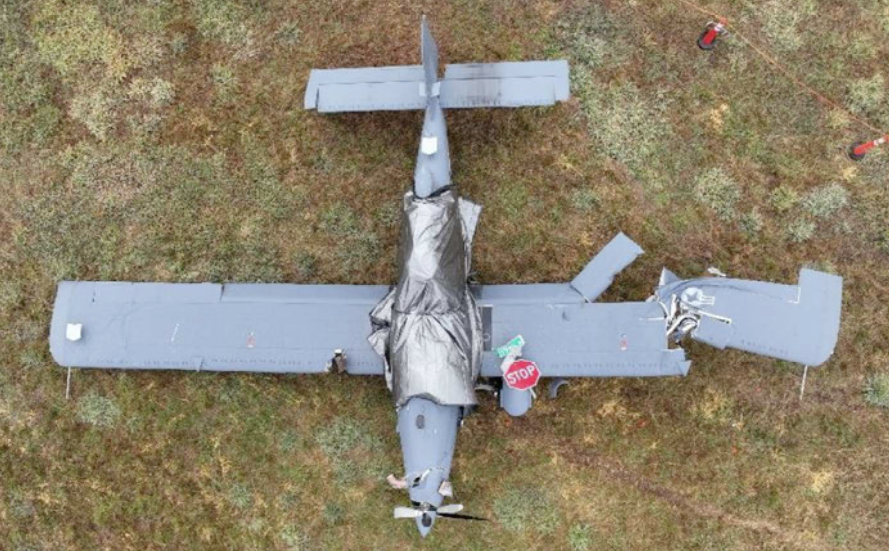
“The unintended activation of the fuel shutoff valve caused the mishap, which isolated the fuel supply from the aircraft firewall, starving the engine of fuel in flight,” Col. Joshua W. Petry wrote the board’s president.
Petry also cited three other contributing factors: the student pilot was distracted by “task saturation” in the cockpit when he cut off the fuel; poor communication between the student and instructor prevented the instructor pilot — who quickly took control of the plane as it fell — from learning that the student quickly corrected the fuel switch; once in control, the instructor pilot bypassed emergency procedures that might have kept the plane flying to instead immediately make an emergency landing, a decision Petry called “ineffective task prioritization.”
Loading comments…
Comments couldn’t be loaded. Please refresh the page.