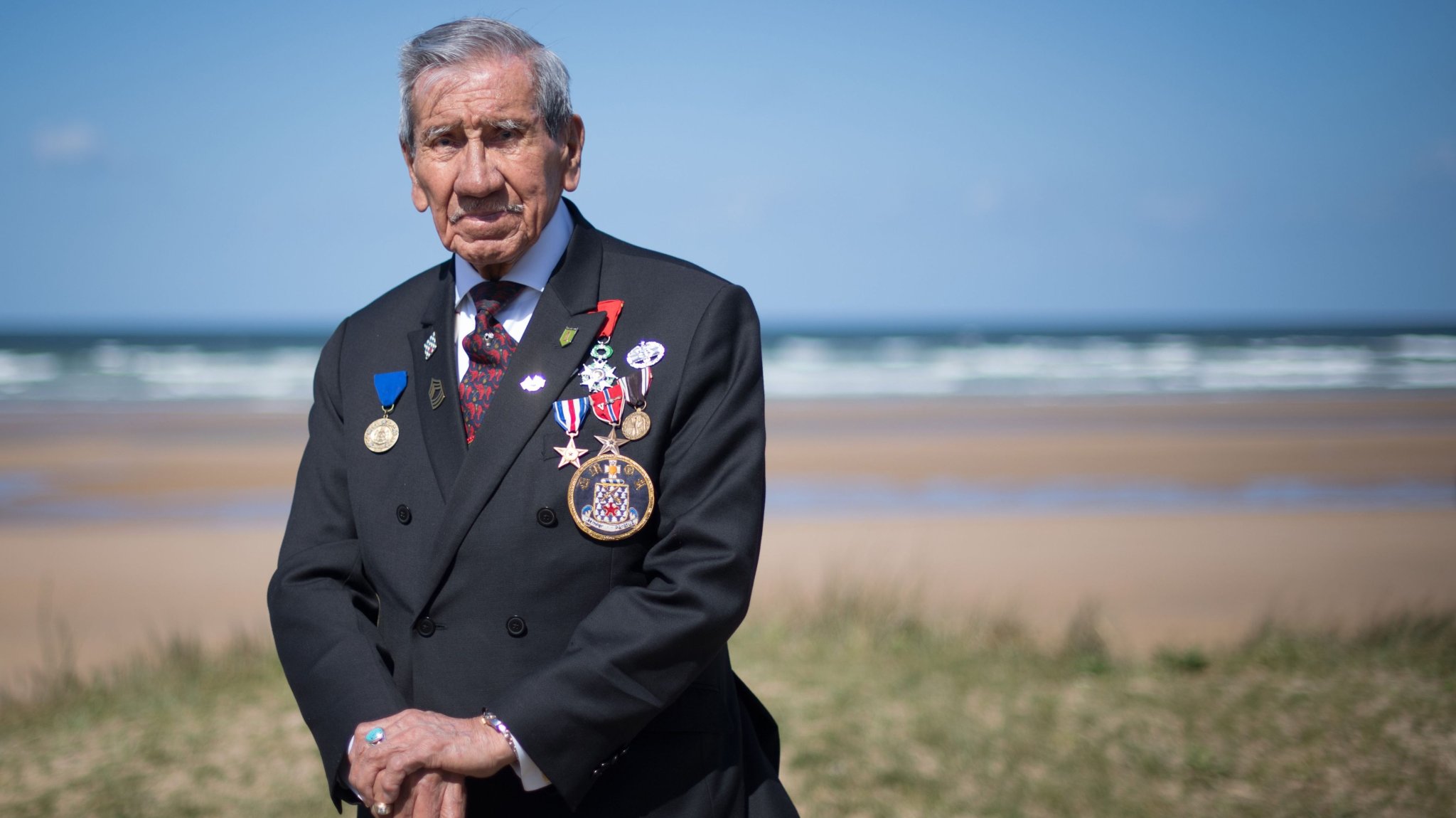
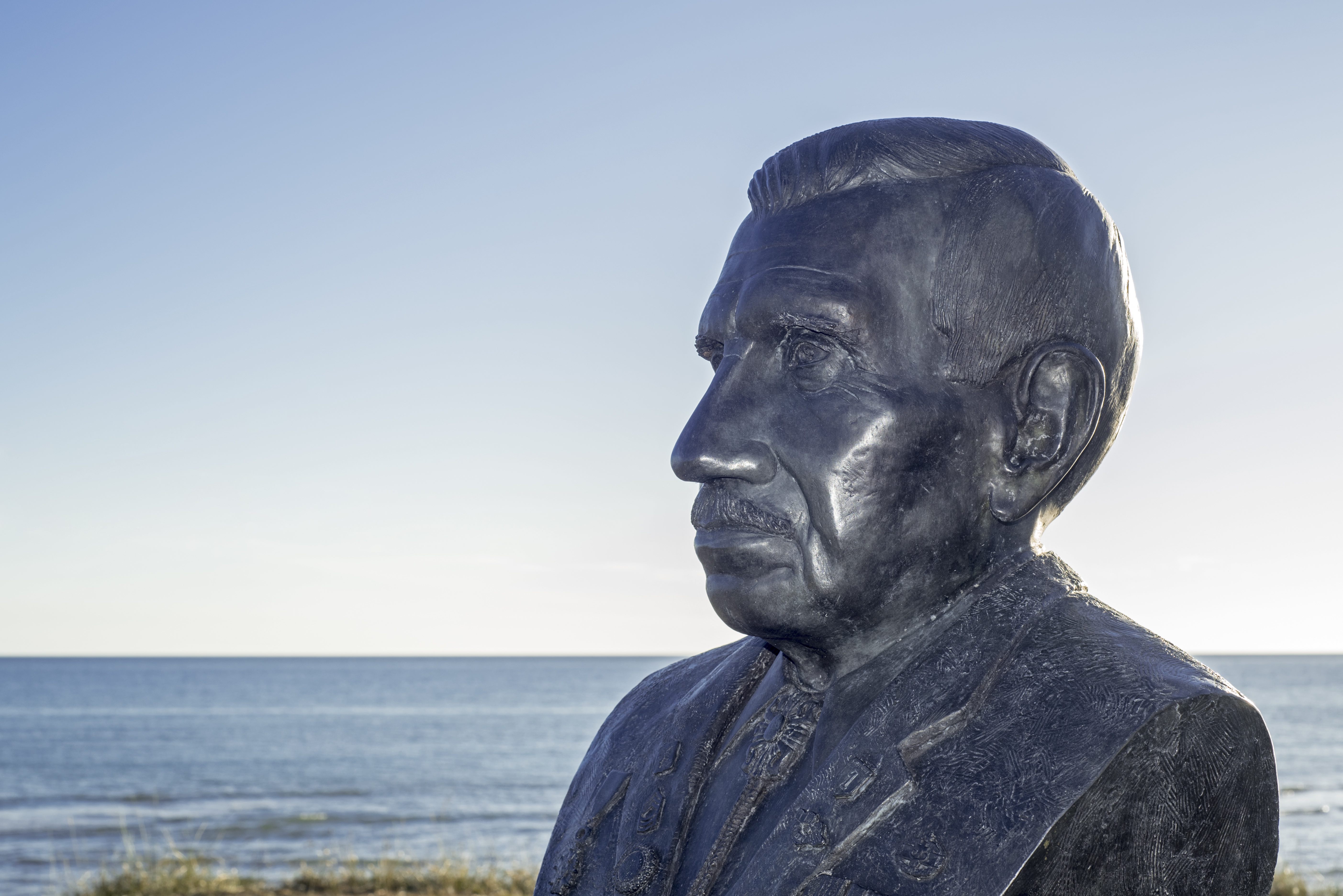
As a teenager from the Penobscot Indian Nation in Maine, Charles Norman Shay pulled drowning troops to shore on Omaha Beach, earning a Silver Star as a medic on one of World War II’s defining days. In his final decade of life, he lived in a small Normandy town just miles from that shoreline, sharing his story with tourists and American troops who visited the hallowed beach. A statue of Shay now stands above the sands, part of a memorial to Native American soldiers who fought in the landings.
Shay, 101, died Wednesday in his home in Thue et Mue, France, just outside of Caen, about 30 miles from Omaha Beach. He was believed to be the last of roughly 500 Native American soldiers who came ashore in the June 6, 1944 landings, including as many as 175 on Omaha Beach, according to some Native American researchers. His company landed far from their assigned zone, directly in front of two German machine gun positions.
“My concern was to get to the beach. I was thinking about survival. I began treating the men on the beach who had made it,” he told a Library of Congress interviewer in 2017.
Naval gunfire and an assault by fellow soldiers took out the machine guns, Shay said, as he tended to wounded soldiers. As the tide began to come in, he looked back and saw troops struggling in the water.
“I saw there was many men in the water who were floundering, and I knew if no one went to help them they would die,” Shay said. “I proceeded back in the water to get as many out as I could by turning them over on their backs and grabbing them by their shoulders. I don’t know where my strength came from. But once the adrenaline starts flowing in your body, you can do unbelievable feats of strength. I guess that’s what happened to me.”
Separated from his company as the day wore on, he found a fellow medic dying of a stomach wound. He told the Library of Congress that he gave the man morphine as the two said goodbye.
Shay was awarded the Silver Star for his actions on D-Day. He later earned three Bronze Stars with V devices for combat in Korea and eventually retired after more than 20 years in uniform.
Penobscot Nation to D-Day
Born in 1924 in Bristol, Connecticut, Shay was one of nine children and his family moved to the Penobscot Nation reservation in Maine when he was five, according to a biography on the tribe’s website.
“As the only Indian boy in a class of 40 students, he crossed the river by ferry or canoe, or walked across the ice in the winter,” the site says. Drafted after high school, he was assigned to the 1st Infantry Division, known as the Big Red One. On June 6, 1944, he was on the first wave of assaulters on Omaha Beach.
He remained on the frontlines for almost a year, including combat in the Battle of the Bulge, until he was captured and spent nearly a month in a German prison camp, before being liberated in the war’s final days, he told the 2017 interviewer.
When he arrived home on the Penobscot Nation, he knocked on his parents’ door, which was answered by his mother — whose only word on her son’s fate to that moment had been a letter from the Army months earlier that he was “missing in action.”
He was later assigned as a military policeman in Vienna, Austria, where he met his wife, Lilli. The two remained married until her death in 2003, according to an obituary in the New York Times.
Eventually promoted to master sergeant, Shay fought in Korea, then joined the Air Force in 1952, based at Tinker Air Force Base, Oklahoma. He was later assigned to units in the Marshall Islands involved in live nuclear tests and left the Air Force in 1964.
Top Stories This Week
After the Air Force, Shay and his family lived in Lilli’s hometown of Vienna for almost four decades, then moved to the Penobscot reservation in Maine.
Only after his wife died did Shay return to Omaha Beach for the first time.
He told Portland Magazine in 2017, “When I returned to Omaha Beach, it was difficult for me to believe that 63 years earlier, I had landed in the first wave of the invading troops. So many had to die or were wounded, and I remained unscathed. I thought I must have had a guiding angel. When I looked across the beaches all those years later, I could still hear the screams and cries of the wounded and dying begging for help. I did what I could to relieve their pain and misery.”
Shay moved to France in 2017, the same year a memorial bust was dedicated to Shay above the beach.