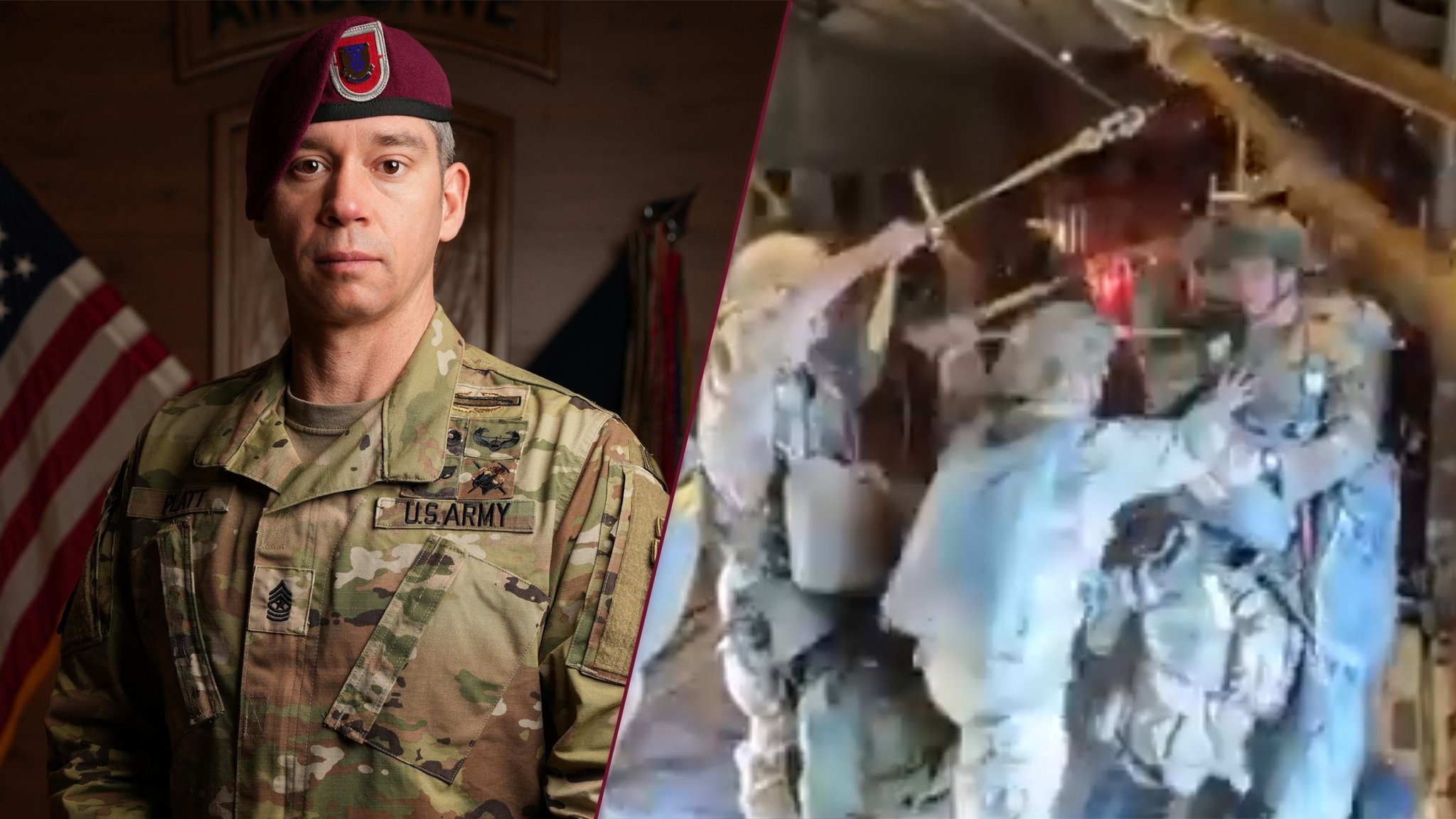
Sgt. Maj. Keith Platt was closely watching as a stream of Army paratroopers hustled out the door of a C-130. As one of the mission’s jumpmasters, Platt stood in the final safety position, closely scanning each of the soldiers for any potential problems in the last moments before they jumped.
After four jumpers safely passed Platt, he saw that the fifth soldier in line had something very wrong: the paratrooper’s static line was cutting across his neck.
Platt knew instinctively that if the paratrooper jumped with the cord over his neck, he could suffer a “catastrophic injury” – an Army term that encompasses loss of limbs and death.
“As the jumper leaves the aircraft, the static line gets tight,” Platt explained to Task & Purpose. “That process of falling away from the aircraft is, ultimately, where the injury would happen. Anything between that static line and the aircraft is soft. Something’s going to happen.”
Video taken from a unit GoPro camera inside the plane captured Platt’s instant reaction: leaping forward from his position and physically stopping the soldier before he could jump, yelling “Stop, stop, stop!”
Since the jump last month, video of the incident has been shared on social media, and Platt has been widely hailed for his quick actions that may have saved the paratrooper’s life.
An inherently dangerous mission
Military parachuting is inherently dangerous, particularly the missions that paratroopers call “mass tacs,” or mass tactical jumps in which dozens of jumpers parachute at once. Inside tightly-packed planes, jumps are overseen by teams of jumpmasters, each a senior soldier trained in every skill and piece of equipment of the flight and jump. As paratroopers prepare to jump, jumpmasters take up specific positions in the plane’s interior, each with a specific role.
Platt’s position on the jump was vital, the final safety jumpmaster positioned at the door as a last-second set of eyes for each jumper.
In an interview with Task & Purpose, Platt said he was just doing his job.
“The incident does not reflect heroics,” Platt said. “It reflects competent and trained professionals placing themselves at risk areas and then demonstrating an action to ensure the safe exiting of paratroopers.”
Platt is the operations sergeant major for the 1st Battalion, 503rd Infantry Regiment, 173rd Airborne Brigade in Vicenza, Italy. He is also a senior jumpmaster with 56 jumps and previously served as a jumpmaster at 5th Ranger Training Battalion in Georgia.
On Nov. 17, Platt was one of several jumpmasters aboard a C-130 as paratroopers readied themselves to jump on the Juliet Drop Zone in Aviano, Italy.
As the plane made a pass over the drop zone, the paratroopers filed rapidly towards the C-130’s open rear troop doors, each holding tight to their static line, the yellow cord attached inside the plane that activates their parachute. Just before leaping out, their last job was to hand the line to Platt, who would control it to ensure it presented no danger to the jumpers.
But as the jumpers filed past him, Platt saw that the fifth paratrooper was not holding the static line in his hand.
“So, he does not have control of his static line like he should,” Platt said. “The process of him walking towards the door routes the static line across the neck as it’s attached to the anchor line cable above him.”
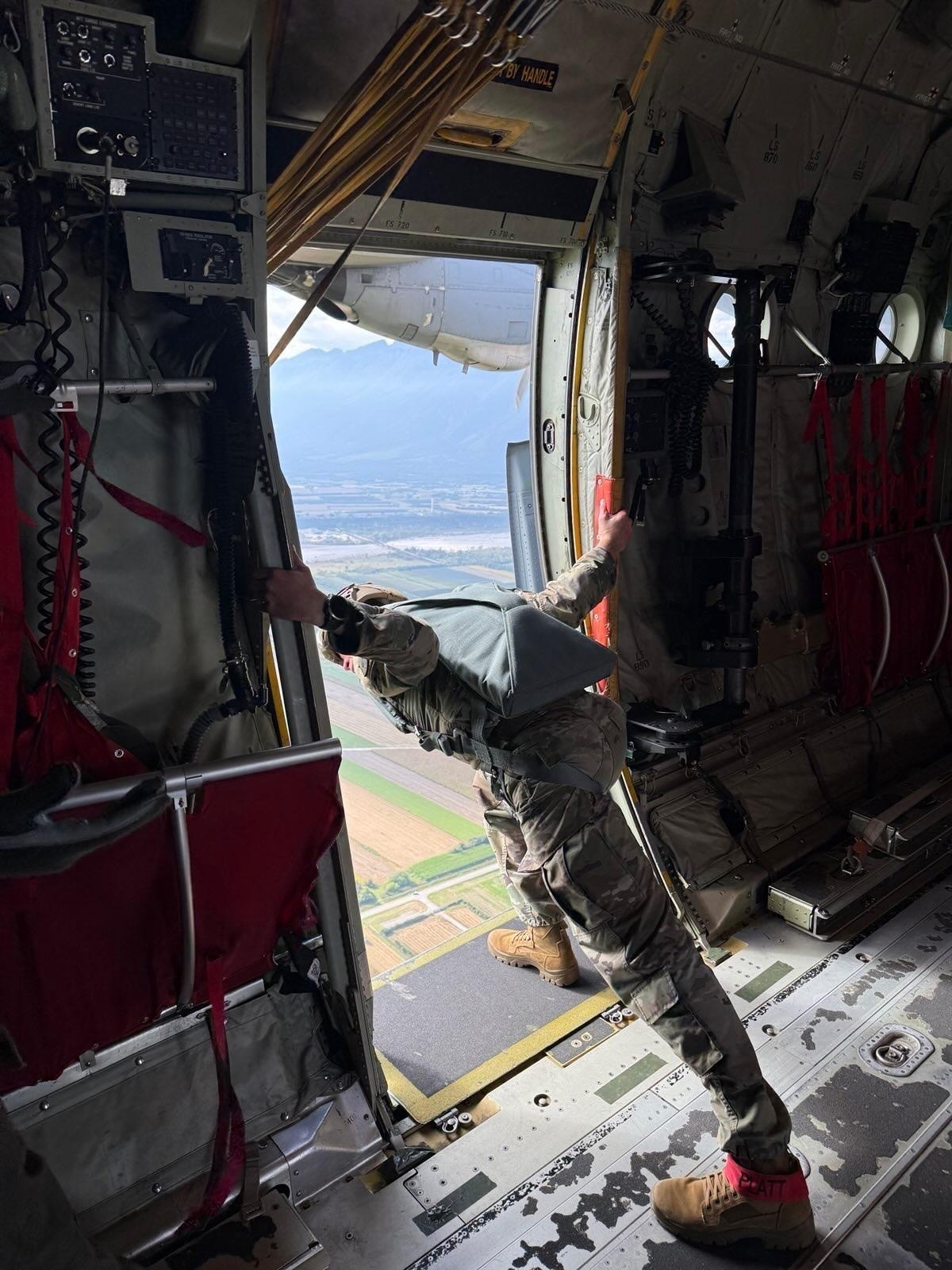
The static line was not wrapped entirely around the paratrooper’s neck, as it may appear in the video of the incident, Platt said.
Paratroopers were jumping out of both the right and left doors of the C-130 in intervals one second apart. That meant Platt had about 2 seconds to recognize the danger the paratrooper was in and respond.
“I stepped in front of the jumper and placed my hand on his right shoulder and giving him the command of ‘stop, stop, stop,’” Platt said. “At the same time, I start pushing him back away from the door, so that way we can address the safety situation.”
The video shows Platt untangling the static line from the paratrooper’s neck as he moved the soldier away from the door. Everything happened so quickly that the soldier initially didn’t realize what the problem was.
“So, in that moment, you know, he was like, what is going on?” Platt said. “There wasn’t a, ‘Hey, you were wrong,’ or anything. There were no fingers pointed.”
Ultimately, the C-130 made a third pass over the drop zone, and the paratrooper successfully jumped, Platt said.
Platt said that one lesson that all airborne soldiers should take away from the close call is, “If something isn’t right, say something.”
The incident also shows the importance of constantly training for and rehearsing drops because airborne operations are inherently dangerous.
“Every time that there’s an operation put together, it’s not just a. ‘Hey, you’re going to jump to earn $200 for your airborne hazardous duty incentive pay.’ It’s a training event to prepare for if we have to do this for real.”