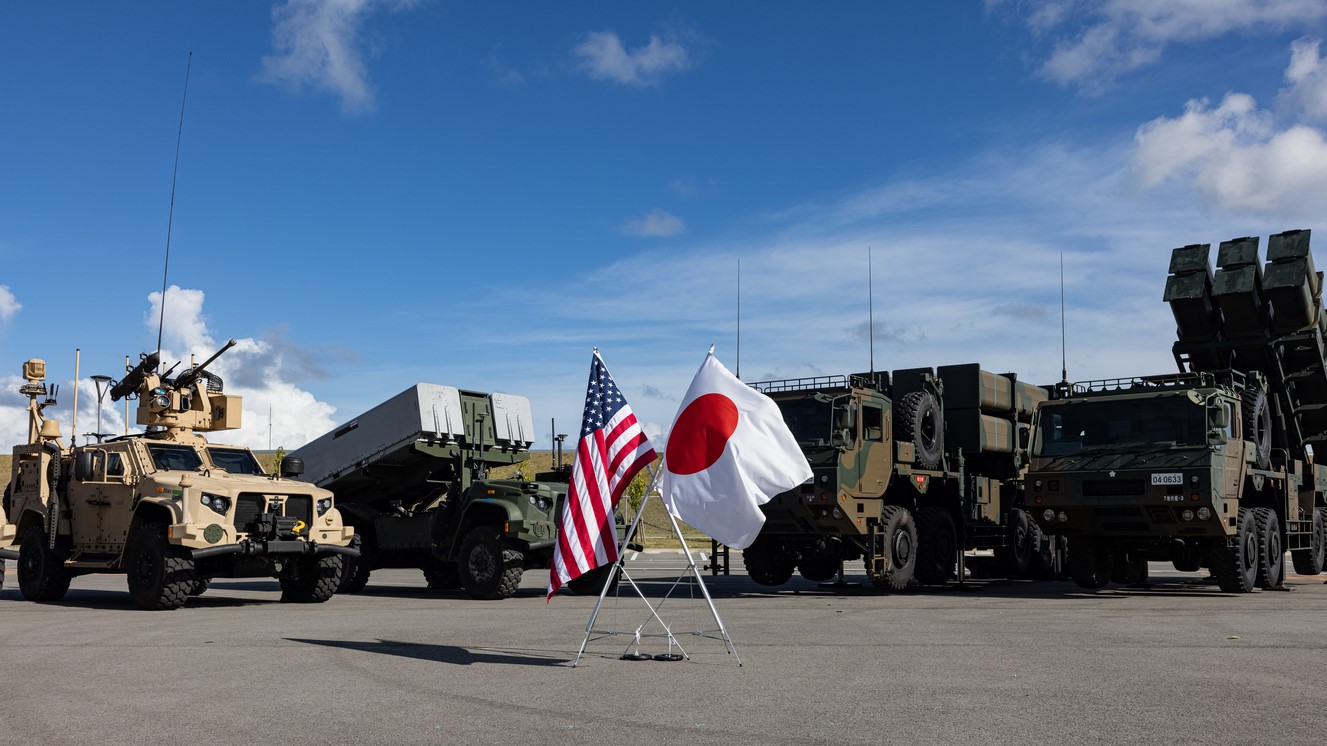
The Marine Corps is rapidly fielding its newest anti-ship weapons platforms in Japan. The Navy-Marine Expeditionary Ship Interdiction System, better known as the NMESIS, is being forward deployed to the islands around Okinawa as part of a bilateral training exercise focused on island defense.
Speaking at a press conference on Saturday, Col. Richard Neikirk, the 12th Marine Littoral Regiment commander, said that training with the NMESIS is ongoing. According to Kyodo News, Neikirk said that the Marines and the Japanese Self-Defense Force are coordinating how to rapidly field the NMESIS. The training is focused on deploying it to islands in the Okinawa Prefecture, where it is providing defense against potential maritime threats. Anti-ship missiles have largely been the focus of the Navy and Air Force, but both the Marine Corps and U.S. Army have been developing and testing their own anti-ship batteries and are currently fielding both in Japan.
The NMESIS uses Naval Strike Missiles, mounted on remote-controlled uncrewed Joint Light Tactical Vehicles. In practice, each system allows Marines to provide critical defense from remote islands while themselves out of danger if the NMESIS is targeted. Each missile has a roughly 115-mile range, allowing them to hit targets well out at sea.
The United States and Japan are currently in the middle of the Resolute Dragon 25 exercise, a two-week series of drills which are set to end on Sept. 25. The Marine Corps also tested its and the Marine Air Defense Integrated System, or MADIS, platform, while the Japanese Self-Defense Force showcased its Type 12 surface-to-ship missiles. As part of the exercise, the two armed forces are working on rapidly deploying these weapons systems. Earlier this month a Japanese Air Self-Defense Force C-130 airlifted one NMESIS from Okinawa to Ishigaki Island, per Kyodo News.
“So whether that’s the U.S. transporting Japanese equipment, or Japanese transporting U.S. equipment, the ability for both of us to do that is very relevant for combat situations,” Neikirk said, according to Kyodo News. “All the capabilities that the U.S. has, along with the Japanese Self-Defense Forces, are complementary.”
Top Stories This Week
The Marines Corps has been testing the system throughout the last two years. Late last year the 3d Marine Littoral Regiment in Hawaii took custody of one of the NMESIS batteries, becoming the first unit to field it. The first NMESIS arrived in Japan in July and is set to remain there until at least the end of Resolute Dragon 25.
Alongside the NMESIS training, the U.S. military also fielded another of its major anti-ship weapons systems in Japan during Resolute Dragon. The U.S. Army brought its Typhon platform, also known as the Strategic Mid-Range Fires program. A ground-based weapons system, it fires two Navy missiles capable of striking long-range targets. The move drew criticism from China and Russia. Chinese military drills are also happening in nearby waters as Resolute Dragon is underway.