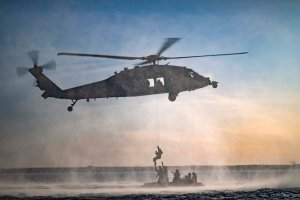
For most of its 250-year history, the Marine Corps has been defined by its ability to project power from the sea. That meant beach landings, first at Nassau in 1776, then on a massive scale during World War II. But today, the concept of storming a beach has evolved into something far more complex and far less visible.
The Marines’ first amphibious landing happened in March 1776, just a few short months after Capt. Samuel Nichols recruited the first two battalions of Marines at Tun Tavern in Philadelphia, Pennsylvania, in late 1775. The Continental Army needed gunpowder badly, having just 728 pounds in December 1775. So, the Marines raided New Providence in the Bahamas, seizing two British forts and 200 barrels of gunpowder.
Top Stories This Week
Following the disastrous landings at Gallipoli by the Allies in 1915, where 250,000 men became casualties, large-scale beach assaults were thought to be a thing of the past due to the advent of machine guns and rapid-fire artillery. As many know, Marines don’t really listen to anybody, and in 1934, they published the first modern manual on amphibious assaults. Fun fact: In 1921, another Marine published a manual that would eventually become the Corps’ doctrine for the Pacific theater of World War II.
By World War II, amphibious operations had become a cornerstone of U.S. strategy in the Pacific. Entire divisions hit the beach under cover of naval gunfire and carrier air strikes, often suffering staggering casualties to seize tiny islands that gave the U.S. leverage over Japanese supply lines and forward bases to launch bombing campaigns on mainland Japan.
By the 1950s, as seen at the Battle of Inchon during the Korean War, amphibious assault was still possible, but only under the right conditions. Army Gen. Douglas MacArthur’s landing at Inchon succeeded in part because the terrain was so risky that North Korea didn’t expect an attack there.
In Vietnam, the threat of an amphibious landing was often more important than the act itself. U.S. Navy and Marine Corps forces would posture offshore, forcing the enemy to spread their defenses. In Desert Storm, a massive amphibious force in the Persian Gulf helped tie down Iraqi divisions without a single major landing.
The modern amphibious toolkit
Today’s Marine landings look nothing like the storm-the-beach assaults of past wars. The modern Marine Expeditionary Unit (MEU), a 2,200-strong force built around a reinforced infantry battalion, air assets, and logistics elements, is designed for rapid insertion, not mass invasion.
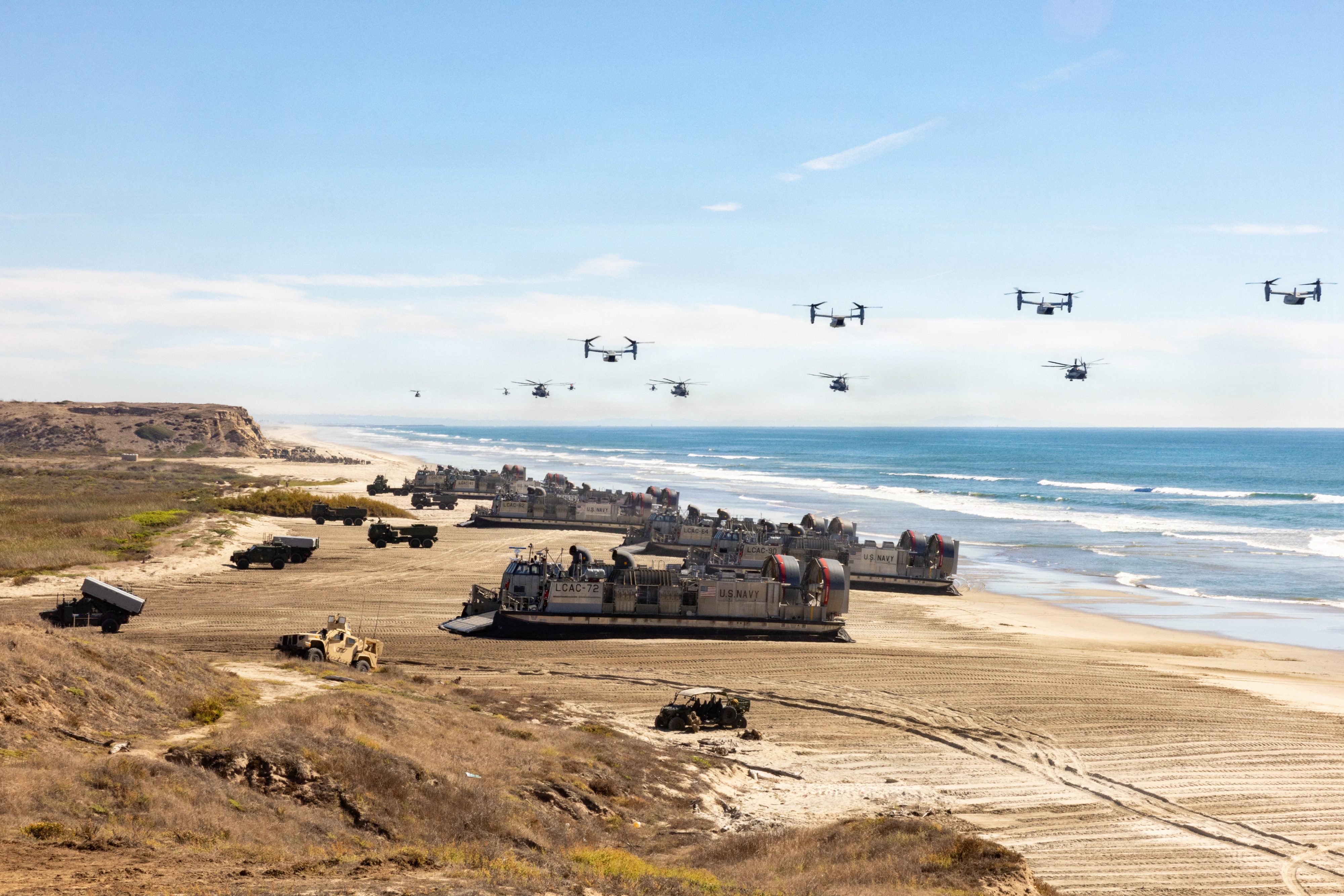
Under the concept of “ship-to-objective maneuver,” Marines launch from amphibious ships offshore using MV-22 Ospreys, CH-53 helicopters, amphibious combat vehicles (ACVs), and Landing Craft Air-Cushions (LCACs). These get Marines through the beach, fast, and onto inland objectives.
Force Design 2030: The new amphibious warfare
In 2020, the Marine Corps formally committed to a new approach to amphibious operations under Force Design 2030. The plan called for divesting heavy gear like tanks and reconfiguring forces for distributed operations across the Indo-Pacific, particularly for scenarios involving a fight with China.
One major concept is Expeditionary Advanced Base Operations (EABO). Instead of storming a beach, small Marine teams insert onto islands and coastlines using aircraft, boats, or unmanned systems. Their job? Set up missile launchers, sensor nodes, or logistics hubs, then disappear before the enemy can react.
The Marine Littoral Regiment (MLR), first activated in 2022, was built for this purpose. It combines infantry, logistics, and air defense into a unit that can operate inside contested areas with minimal support.
What a modern landing looks like
A contemporary amphibious operation might begin with satellite surveillance and drones scanning the objective. Cyber teams and electronic warfare aircraft suppress enemy communications and radar. Then, loitering munitions and precision fires hit known defenses. Recon teams insert quietly to confirm the landing zone.
Only then do small elements of Marines arrive, some by air, some by sea. A missile team lands, sets up a Navy-Marine Expeditionary Ship Interdiction System (NMESIS), and starts feeding targeting data back to the fleet. Logistics teams offload generators, fuel bladders, and spare parts. Drone detachments deploy loitering munitions or sensors.
Within a few hours, the position is live, but temporary. Once the mission is complete, Marines exfil or move on to the next position. The entire operation is built for speed, survivability, and precision.
Of course, there is a lot more to it, and we break it down in much more detail on our YouTube channel, which you can watch here.