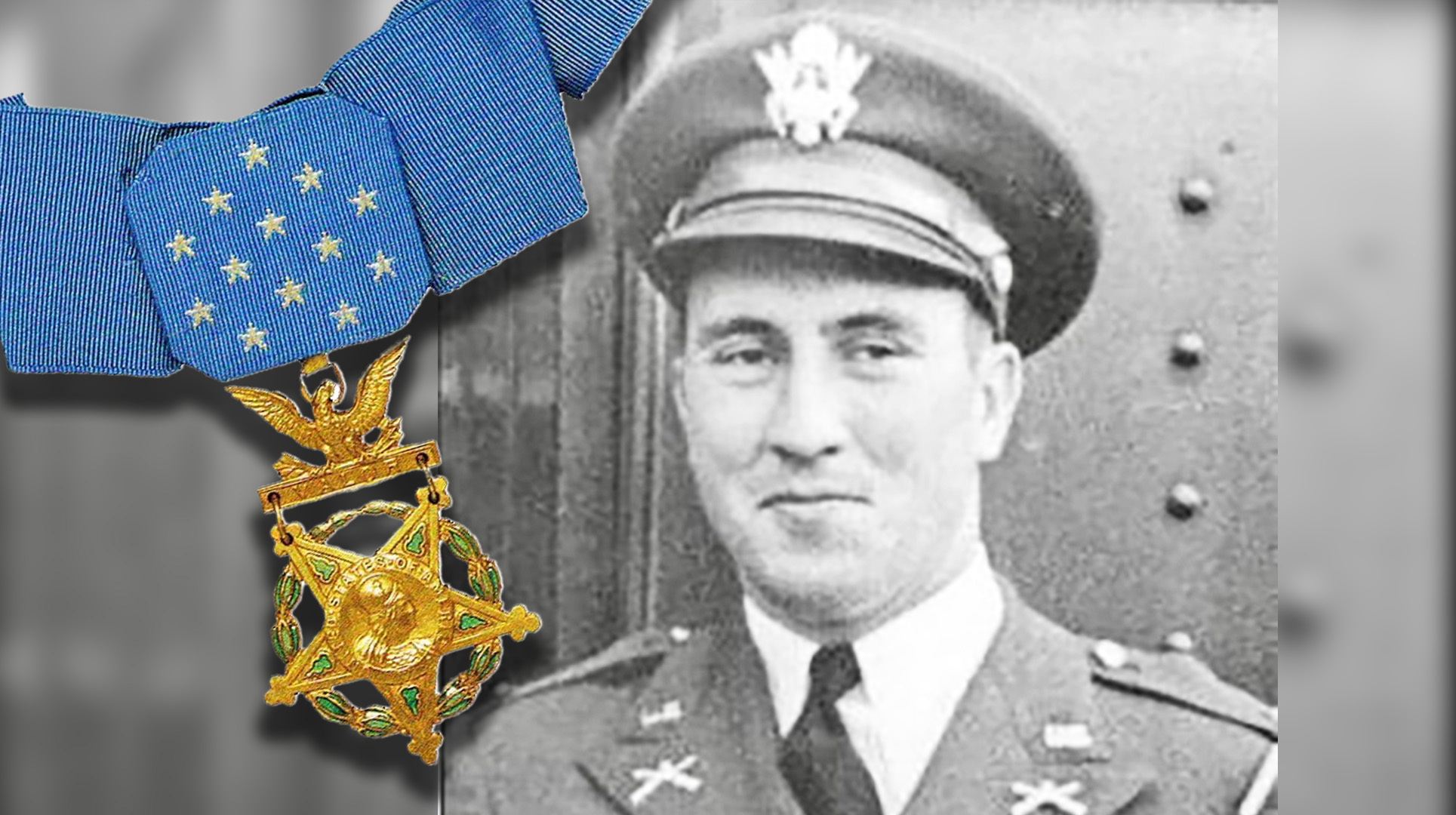
Eight decades after he died, the Department of Defense confirmed it had positively identified the remains of Capt. Willibald Bianchi, a Medal of Honor recipient who went “beyond the call of duty in action with the enemy” while fighting in the Philippines during World War II.
Bianchi was captured during the fall of the Philippines to Japanese forces and survived the Bataan Death March. He would eventually die near the end of the war on Jan. 9, 1945, when U.S. planes hit the Japanese transport ship the Enoura Maru that he was on near Taiwan.
The Defense POW/MIA Accounting Agency, the Pentagon agency tasked with working to identify those lost in combat, successfully identified Bianchi on Aug. 11, but waited to publicly announce the news on Friday, which was National POW/MIA Recognition. According to the DPAA, more information on how he was identified will be released once Bianchi’s family is fully briefed.
Speaking on Friday at Arlington National Cemetery, Secretary of Defense Pete Hegseth said that 431 unknown remains are associated with the sinking of the Enoura Maru. Hegseth said that Bianchi’s remains will be transported to Minnesota for a proper burial.
Born in New Ulm, Minnesota in 1915, Bianchi initially left school to help his family farm. He eventually attended South Dakota State University and earned a commission through ROTC. He requested foreign service and in April 1941 was assigned to the U.S. Army’s 45th Infantry Division, Philippine Scouts. When Japan declared war on the United States, imperial forces moved into the Philippines. Bianchi and the other soldiers were among the first American group troops to fight them. They were in a losing battle, undersupplied and unprepared for an all-out assault.
Months later, in February 1942, the Philippine Scouts were still fighting. On Feb. 3, 1st Lt. Bianchi joined another rifle platoon to take out a pair of Japanese machine gun nests in the Tuol River pocket on West Bataan.
“When wounded early in the action by 2 bullets through the left hand, he did not stop for first aid but discarded his rifle and began firing a pistol. He located a machinegun nest and personally silenced it with grenades,” his Medal of Honor citation reads. “When wounded the second time by 2 machinegun bullets through the chest muscles, 1st Lt. Bianchi climbed to the top of an American tank, manned its antiaircraft machinegun, and fired into strongly held enemy position until knocked completely off the tank by a third severe wound.”
But Bianchi would not die there. He survived his wounds and kept fighting during the battle for Bataan, being promoted to captain. Two months after taking out the machine gun nests, Bianchi was one of the more than 70,000 Filipino and American soldiers captured by Japanese forces. He and others were subjected to what would become known as the Bataan Death March.
Top Stories This Week
According to the Minnesota Medal of Honor Memorial, Bianchi endured the brutal march, moving up and down the line to help other soldiers. He pushed them to keep going, in order to save them from being killed by Japanese forces. From there it was three years in captivity. The Minnesota Medal of Honor Memorial’s biography notes that Brig. Gen. Ted Spaulding saw Bianchi barter for food, doing what he could to feed his starving soldiers.
Eventually he and other prisoners of war were transported out of the Philippines. In December 1944, he was loaded onto the Japanese ship the Orokyo Maru, which was soon hit by American forces and sank. He survived and then was moved to Taiwan on the Enoura Maru.
Those killed in the sinking of the ship were initially buried in a mass grave. Eventually they were brought back to the United States and interred at the National Memorial Cemetery of the Pacific in Honolulu, Hawaii, also known as the Punchbowl. There, they are listed as “unknowns” until the DPAA is able to identify them.