
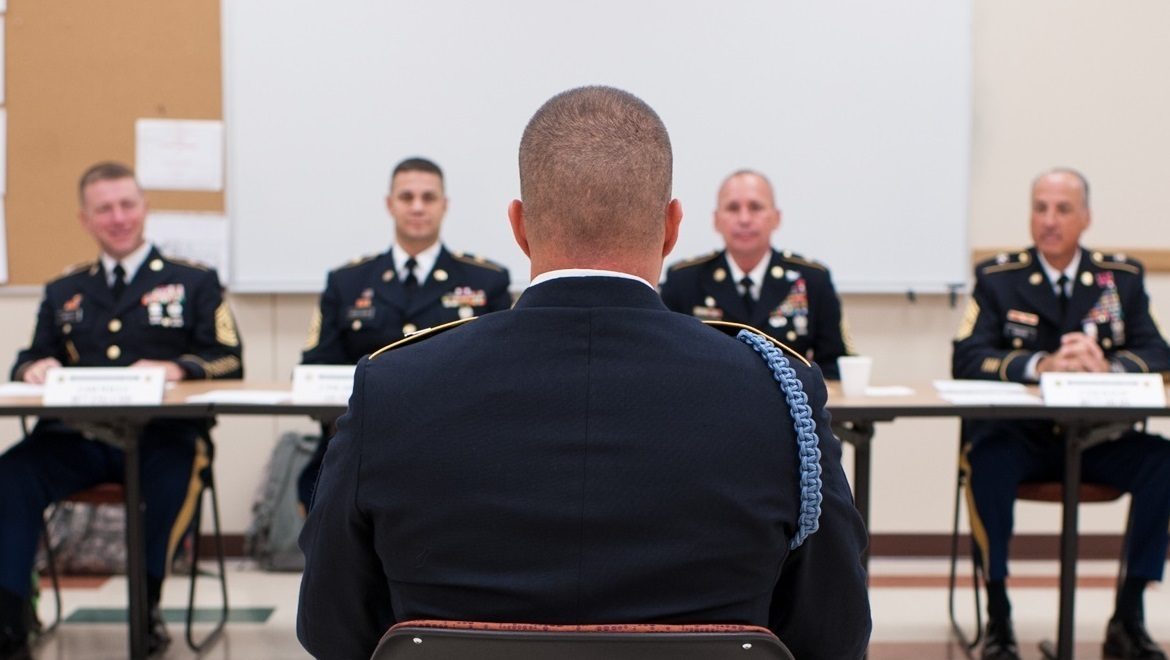
An Army program that used peer and subordinate feedback to select leaders for command is being discontinued.
The Command Assessment Program, CAP, was created as a pilot program in 2019 to evaluate sergeants major, lieutenant colonels, and full-bird colonels for command assignment in battalion and brigade-level units using peer and subordinate feedback. Each year, nearly 2,000 candidates are evaluated under CAP for Army leadership positions.
The Army will now revert to its previous review system for command selection that used reviews by superiors, a system that one former officer told Task & Purpose was so superficial that it was akin to choosing leaders based on “the equivalent of two tweets.”
Former Army Secretary Christine Wormuth formally established CAP in January in the final week of the Biden administration. But her successor in the Trump administration, Army Secretary Dan Driscoll, downgraded CAP from a formal program and placed it under review last month, with officials saying the pause was a way to make changes to the program. Officials also had recently announced a renaming of the program to the Army Warrior Leader Certification.
Army officials told Task & Purpose that CAP was officially ended and that the service would revert back to the boards used in the Centralized Selection List process.
The Centralized Selection Board/List, CSL, process has officers review evaluation reports for command candidates written by both a rater and a senior rater to determine whether soldiers are suitable for leadership positions. Maj. Travis Shaw, an Army spokesperson said the officers who sit on CSL boards evaluate officers’ past assignments, performance and “demonstrated potential” to produce an order of merit list.
“Previous CAP results will not factor into the process,” Shaw said.
Army officials did not elaborate on why CAP was ended as an evaluation program. Shaw said in a statement that the discontinuation of CAP is in “in line with” a June 20 memo from the Under Secretary of Defense for Personnel and Readiness that mandated a review of military officer evaluations, promotion boards, and command selection processes, Shaw said.
A defense official said the Pentagon is “still reviewing and evaluating military officer promotion and selection procedures” and referred Task & Purpose to the Army for questions on CAP.
The program was at the center of controversy last year when Gen. Charles Hamilton was relieved as head of Army Materiel Command after an investigation found he attempted to go around the CAP system to push the promotion of a subordinate officer for battalion command.
CAP looked at feedback from ‘joes’
In a Military Review article from January, two former CAP officials wrote that the previous command selection processes were “inadequate” because they “present a narrow view of an officer’s performance and potential” based on fewer sources of feedback and over a limited amount of time.
In one board, an officer who ranked last against 29 other candidates on the CSL order merit list was ranked first on their battalion-level CAP assessment, according to an article written by former Army Chief of Staff James McConville and Maj. Gen. J.P. McGee, director of the Army Talent Management Task Force for War on the Rocks.
Under CSL, a board of officers is charged with reviewing more than 1,000 packets, some for only minutes at a time, McConville told reporters in 2019 when announcing the battalion pilot program. McConville said CAP would be a “transformational change” in how the service selected its leaders.
CAP included multiple evaluations from subordinates and peers who worked with the officer and looked at performance “developed over the course of an Army career, not in the last six months before assessment,” Army officials said.
A former Army officer who took part in three CAP selections in 2020 and 2021 said the process was an upgrade from the CSL selection process, which only used senior rater and rater feedback, making evaluations pretty limited in scope.
“We counted this up. Their opinion matters most. When you look at what they write on your evaluation it’s an average of 110 characters, 18 words. Multiply that by five evaluations, which is generally what they look at. That’s the equivalent of two tweets,” the former officer said. “I’m not kidding. That’s the information that they used to select officers, and that’s what we’re going back to.”
In addition to peer and subordinate reviews, CAP candidates were also given an overall score based on written communication, verbal communication, physical fitness, and strategic potential skills.
The former officer who said the inclusion of anonymous peer and subordinate evaluations often helped uncover candidates who had problematic behaviors like bullying.
“This isn’t like anonymous Twitter comments or something like that,” the officer said. “You can definitely tell the difference between one person with an axe to grind and multiple people observing very extreme behavior.”
Everett Spain, an Army colonel and head of the behavioral sciences and leadership department at the U.S. Military Academy at West Point wrote in a Harvard Business Review article in 2020 that CAP was designed to overcome legacy challenges where officers were picked based on a ranking compared to their peers instead of personality traits that would make them more suitable for a prescribed role.
Spain gave the example of choosing the “best company commander” for a role to advise the military of a U.S. ally overseas. While company commanders lead soldiers “who are similar to oneself,” advisers influence people from other cultures in foreign environments.
“Better results could be obtained by identifying individuals with superior cognitive flexibility, cross-cultural fluency, and interpersonal skills,” he wrote. “If the army knew which officers enjoyed international travel and meeting people from different cultures, it could choose someone whose talents and preferences were suited to the position, most likely ending up with a high performer who would enjoy and remain in the job.”
