The Pentagon is shifting $200 million in funds previously appropriated to Marine Corps barracks, military-run schools, a jet pilot training site, facilities in Guam and more to pay for 20 miles of a partial border wall at a service testing range on the border, according to official documents.
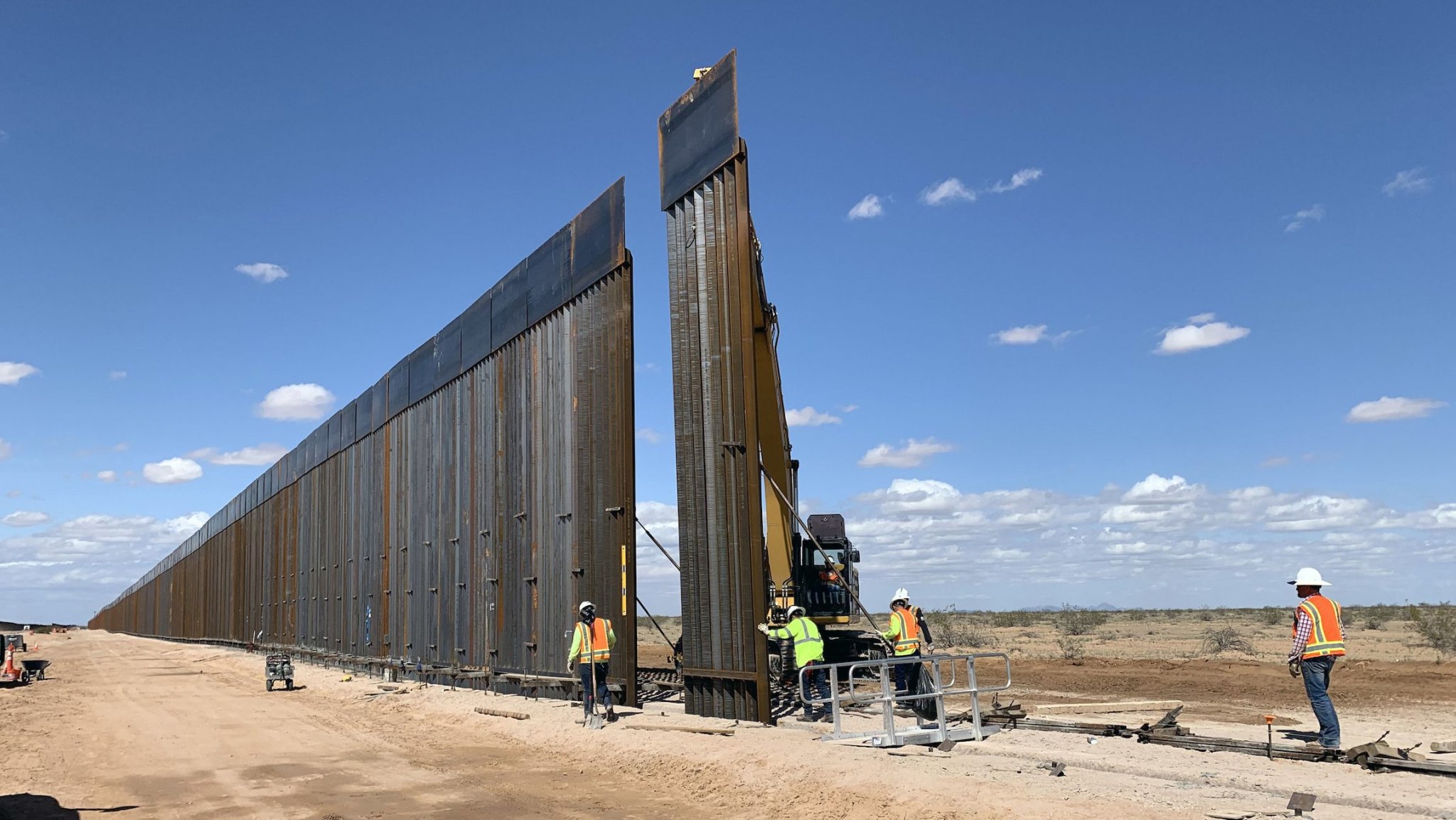
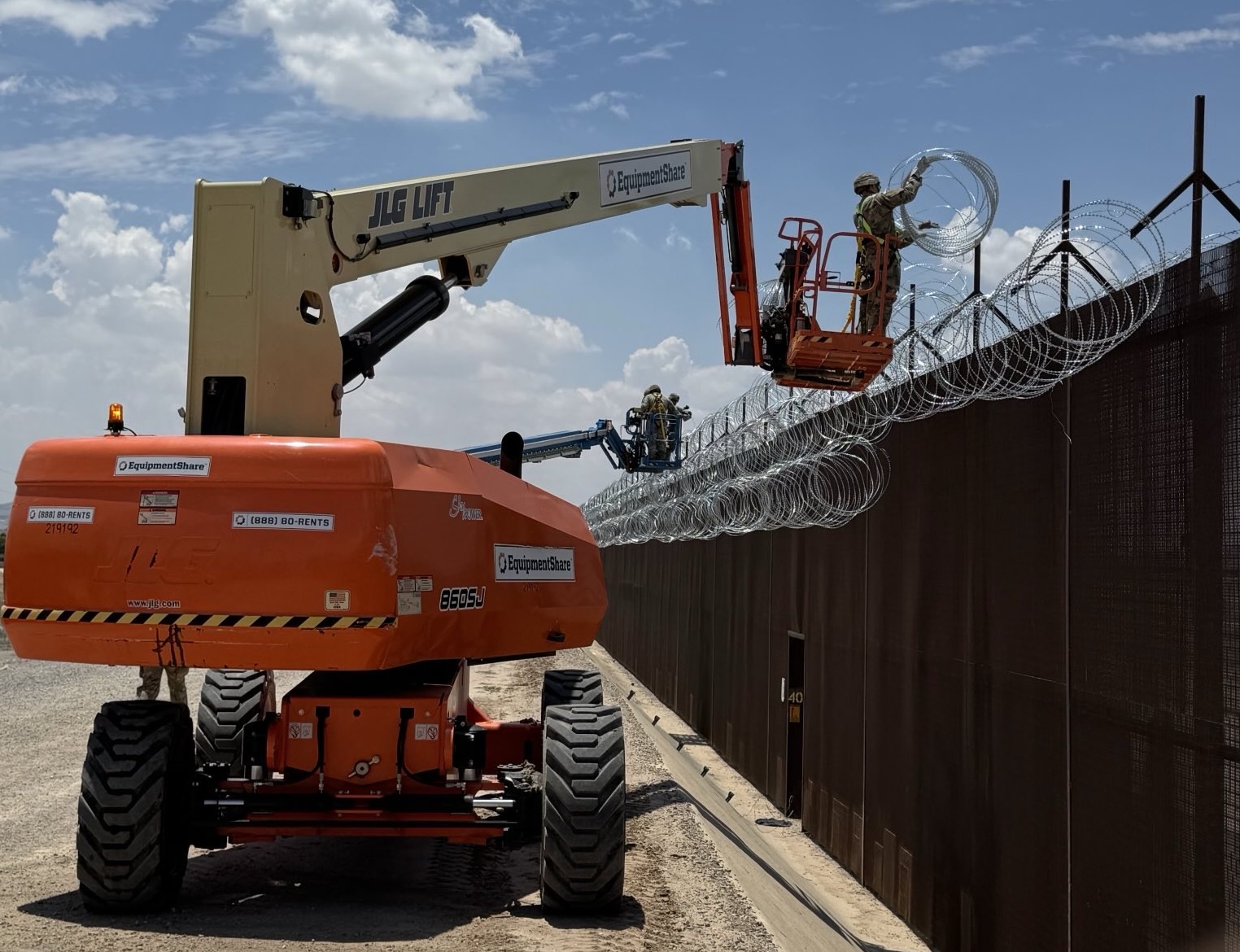
The repurposed funds would pay to replace a 12-foot-tall mesh barrier with a 30-foot-tall permanent protective barrier at the Barry M. Goldwater Range, a training site in the Sonoran Desert in Arizona, according to a Pentagon letter sent to Senate appropriators on May 28.
The eastern part of the range is managed by the Air Force, and the western section, where the barriers would be built, is managed by Marine Corps Air Station Yuma and used for ground, live fire and non-live fire military training. The letter indicates that the roughly 20-mile-long barrier would extend between the International Boundary and Water Commission’s border monuments #192 to #197 which run along the Southwestern Arizona-Mexico border. The commission maintains and demarcates land and water boundaries between the U.S. and Mexico.
The Pentagon notified Congress that $200 million allotted to programs in the Army, Air Force, Navy and Department of Defense as far back as fiscal year 2021, would instead be rerouted to pay for the permanent barrier at the test range.
Secretary of Defense Pete Hegseth determined that the permanent steel bollard barrier, pedestrian gates and a patrol road, are “necessary to obtain full operational control of the border” at the training range, the Pentagon letter states.
The Pentagon justified the construction with President Donald Trump’s Jan. 20 executive order aimed at stemming the flow of migrants at the southern border with temporary and physical barriers.
It also follows the Pentagon’s announcement earlier this month that the Navy would control 140 miles of federal property along the U.S.-Mexico border near the Goldwater range as an extension of Marine Corps Air Station Yuma. It was the fourth national defense area of federal lands now controlled by the Department of Defense for security operations along the border, joining three other established areas in New Mexico, West and South Texas.
In 2020, the Department of Defense built and funded 31 miles of border barrier at the range.
A 2023 report by Luke Air Force Base noted “an increase in illegal foot traffic.” The report stated that because of the range’s proximity to the border, it is “heavily patrolled” by U.S. Customs and Border Protection agents to potentially interdict and apprehend smugglers and migrants. A 2023 Barry M. Goldwater Range Executive Council meeting noted that there were 7,000 known entries and 3,000 apprehensions in a three-month span and a seizure in December of 40 kilos of meth.

The U.S. code cited by the Pentagon in the May 28 letter gives the service secretaries “pretty broad authority” to reprogram funds without Senate or House approval, but there’s a cost cap of $50 million dollars per service secretary, a congressional source said.
The documents reference four notifications from the Army, Navy, Air Force secretaries and the Office of the Under Secretary of Defense for Acquisition and Sustainment, who “determined that this project is vital to national security” and have identified $50 million each for the project, bringing it to a total of $200 million. The funding is also broken down into four separate projects that would go towards five miles worth of barrier, each.
The documents show the amount of money previously appropriated per project, the current working estimate and how much would be repurposed for the permanent barrier wall.
Some of the repurposed fund requests include:
- $21 million Defense Health Agency funds for the Oak Harbor, Washington Ambulatory Care Center and Dental clinic from fiscal year 2022.
- Almost $19 million in Army funds for minor military construction from fiscal year 2022.
- $15 million in Department of Defense Education Activity funds to replace Robinson Barracks Elementary School in Stuttgart, Germany from fiscal year 2021.
- More than $14.5 million in Navy funds for the Joint Region Marianas, Guam distribution warehouse from fiscal year 2021.
- Over $12.4 million in Air Force funds for Columbus Air Force Base, Mississippi’s T-7a Ground Based Training System Facility from fiscal year 2024. Congress was notified of the project’s cancellation in May.
- Over $5.4 million in Navy funds for Marine Corps barracks at Kadena Air Base, Japan.
Pentagon justification
The letter cites U.S. Code for emergency construction which allows service secretaries to carry out military construction projects that are not authorized by Congress if they determine “it is vital to national security or to the protection of health, safety, or the quality of the environment,” and that it’s “of such urgency that it cannot wait for the next military construction authorization Act,” like the annual National Defense Authorization Act.
Greg Williams, director of defense research for the Project on Government Oversight said Democrat and Republican administrations have used these types of authorities to repurpose funds for other projects. Doing this outside of the formal budgeting process means less review and oversight by the Defense Department and then by Congress, he said.
“To reallocate funds in this way, bypasses that,” Williams said. “It also raises the question of how this could possibly be an emergency when it covers a very small portion of how that range abuts the border with Mexico.”
The authority has been used to fund “emergency” military projects before, but the Pentagon’s current intended use for a more political project, such as a border wall, is unusual, a congressional source said.
There have been 21 uses of U.S. Code 2803 since fiscal year 2009, according to a list compiled by the Congressional Research Service and viewed by Task & Purpose. Previous projects have included a rotary wing parking lot in Kandahar, Afghanistan, in 2009, perimeter security upgrades at a compound near the Dam Neck Annex in Virginia in 2012, and a Multi-Purpose Training Range at Fort Bragg, North Carolina, in 2024.
When asked about the use of Defense Department funds for the border wall, Robert Ditchey, a Department of Defense spokesperson, said that “utilizing DoD funds to support the president’s top priorities underscores Secretary Hegseth’s commitment to spending every dollar wisely” and “dedication to working alongside the Department of Homeland Security.”
The use of military funds for border wall projects previously raised concerns and numerous legal battles during Trump’s first term in office, but under a different U.S. code for rerouting unused construction funds. More recently, Military.com reported that $1 billion in Army barracks funding would be redirected to the border mission.
Mark Nevitt, a retired Navy lawyer commander, law professor at the Naval Academy and current law professor at Emory University, noted that the Jan. 20 executive order more directly links the military’s mission to border security, in a piece for the National Security blog, Just Security.
“The Trump administration appears to anticipate legal challenges that the use of military construction funds for border wall construction is not necessary to support the armed forces, but I am not sure the president’s strategy will be successful,” Nevitt wrote.
Elaine McCusker, former Department of Defense comptroller during the first Trump administration, told Task & Purpose in an email that a number of authorities were considered and used to support border wall construction.
“The declaration of emergency and justification was strong last time,” McCusker said, adding the executive order “seems clear and unequivocal.”
Under U.S. law, the Pentagon has the authority to repurpose the funds and can begin construction five days after the Congressional notification. The Pentagon did not respond to inquiries about the construction timeline.
Earlier this month, President Donald Trump signed the Big Beautiful Bill into law which appropriated $165 billion to the Department of Homeland Security, with $46.5 billion for border wall construction.